Most guides to the Georgian language and useful phrases get at least one word wrong — the price question, the wrong form of “thank you,” a toast mangled past recognition. This one fixes that: the words you’ll actually use, in the real alphabet, with pronunciation that survives an actual conversation.
What Language Do Georgians Speak?
Georgians speak Georgian, or Kartuli, the main language of a family called Kartvelian that is unrelated to English, Russian, Turkish, or any major language group. About 3.8 million people speak it natively, and it is the first language of roughly 88 percent of the country, which Georgians call Sakartvelo — not “Georgia.”
The nearest relatives are small regional languages: Megrelian (spoken in Samegrelo), Laz, and the more distant Svan of the high mountains. None of them will help you if you already speak a European or Slavic language. That is the honest reason Georgian feels alien at first — there is nothing to hook it onto. It also means every word you learn is genuinely new, so the payoff for effort shows up fast.
One practical upside hides inside all that difficulty: Georgian is written exactly as it sounds. Learn the alphabet and you can read a menu, a metro sign, or a wine label out loud, even if you have no idea what it means.
The Georgian Phrases Worth Learning First
If I could hand a traveler four words before a flight, they would be gamarjoba (hello), madloba (thank you), ra ghirs (how much), and gaumarjos (cheers). Those four cover the greeting, the courtesy, the transaction, and the table — which is most of a trip in Georgia.
Here is the working set, with the native script and a traveler’s pronunciation. Georgian stress is light and fairly even, so resist the urge to hammer any one syllable.
| English | Georgian | Say it | When to use |
|---|---|---|---|
| Hello | გამარჯობა | gah-mar-jo-ba | Default greeting; use gamarjobat for a group or to be polite |
| Hello (the reply) | გაგიმარჯოს | ga-gi-mar-jos | The traditional response — “victory to you too” |
| How are you? | როგორ ხარ | ro-gor khar | Casual; switch to rogor brdzandebit with elders or strangers |
| Yes | კი / დიახ | kee / dee-akh | ki is everyday, diakh is formal, ho is very casual |
| No | არა | ah-ra | |
| Thank you | გმადლობ | gmad-lob | To one person, informal; gmadlobt is formal or plural |
| Thank you very much | დიდი მადლობა | dee-di mad-lo-ba | |
| You’re welcome | არაფრის | a-rap-ris | Literally “for nothing” |
| Excuse me | უკაცრავად | oo-kats-ra-vad | To get past someone or get attention |
| Sorry | ბოდიში | bo-dee-shi | To apologize for something |
| How much is it? | რა ღირს? | ra ghirs | Asks the price — see the section below on why this matters |
| Delicious | გემრიელია | gem-ree-eh-lee-a | Say it to a host and watch what happens |
| Goodbye | ნახვამდის | nakh-vam-dis | |
| Cheers / to victory | გაუმარჯოს | gau-mar-jos | The toast word at every table |
A word on the pronunciations above: they are approximations, and romanization of Georgian is inconsistent across sources, so treat them as a starting point.
Pro Tip: Before you rely on any transliteration, pull the word up on Forvo and hear a native speaker say it once. The “kh,” “gh,” and ejective sounds in the pronunciation guide are hard to fake from spelling alone, and 30 seconds of audio fixes most of it.
Why “Gamarjoba” Means “Victory”
Gamarjoba does not translate to a neutral “hello.” It comes from the root gamarjveba (გამარჯვება), meaning victory, so the greeting carries the sense of “victory to you.” The traditional reply, gagimarjos, wishes victory back — a small verbal ritual that predates modern small talk.
The same root threads through the language in ways worth noticing. The everyday hello, the toast at dinner (gaumarjos, “to victory”), and the greeting-reply all share it. Once you hear the pattern, you start catching “victory” everywhere at a Georgian table, which tells you something about how the culture frames welcome and celebration.
For anyone older than you, or for a group, add the -t: gamarjobat. It reads as respect, and over-formality almost never offends here.
How Do You Say Thank You in Georgian?
The everyday word is gmadlob (გმადლობ) to one person, or gmadlobt (გმადლობთ) to a group or anyone you want to treat formally. Madloba (მადლობა) is the noun and works on its own. For extra warmth, say didi madloba — thank you very much. That opening “g” is a grammatical prefix and is barely voiced.
This is one of the words guidebooks routinely fumble. You will see gmadloba printed as a single word, which is not correct — the forms are gmadlob (to one person), gmadlobt (formal or to several), and madloba as the standalone noun. If you only remember one, make it gmadlobt. It is polite by default and never lands wrong.
How Much Does It Cost? The Phrase Guidebooks Get Wrong
The correct way to ask a price is ra ghirs? (რა ღირს?) — literally “what does it cost?” A surprising number of popular phrasebooks instead print ramdeni aris es, which actually asks “how many are there,” a quantity question that will confuse a vendor at a produce stand. Native readers have flagged this error in the comments of well-known travel blogs, and it keeps getting copied anyway.
Use ra ghirs at markets, taxis, and counters. If you want to bargain at a bazaar, the number you hear first is rarely the last one, and a friendly repeat of ra ghirs with a doubtful look usually starts the negotiation without a word of shared language.
- Ask the price: ra ghirs? (რა ღირს?)
- Avoid: ramdeni aris es — that asks about quantity, not cost
- Follow-up that needs no grammar: point, say ra ghirs, and wait
Formal vs. Informal Georgian: When to Switch
Georgian splits almost every social phrase into a casual form and a polite one, and most guides skip this entirely. Getting it right is the difference between sounding like a respectful guest and sounding like you learned the language from a meme.
The rule of thumb is simple: use the formal or plural form with anyone older than you, anyone working a counter, and anyone you have just met. Save the casual forms for friends and people clearly your own age or younger.
- Yes: ki (კი) is casual; diakh (დიახ) is formal; ho (ჰო) is very relaxed
- Thank you: gmadlob to one friend; gmadlobt for formal or plural
- Hello: gamarjoba is default; gamarjobat is polite or plural
- How are you: rogor khar for peers; rogor brdzandebit for elders and strangers
Pro Tip: When in doubt, default to gmadlobt, diakh, and gamarjobat across the board. Over-formality reads as good manners; over-familiarity with a stranger can read as rude. You will almost never be corrected for being too polite.
How Do You Pronounce Georgian’s Hardest Sounds?
The two hurdles are ejective consonants — k’, t’, p’, ts’, ch’, q’ — and the throaty pair kh (ხ) and gh (ღ). Ejectives are sharp, popped sounds made by briefly closing your throat before you release them. Kh is the rasp in the Scottish “loch”; gh is its gargled, voiced cousin. Everything else is spelled as it sounds.
To feel an ejective, try this: hold your breath for a beat, build a little pressure behind your tongue or lips, then pop the consonant so it clicks rather than puffs. English “k” comes with a breath after it; the Georgian ejective k’ does not. The difference is small to an English ear and enormous to a Georgian one, because it separates real words.
Then there are the consonant clusters, which are the language’s signature party trick. The word for water, ts’q’ali (წყალი), stacks an ejective ts’ straight into an ejective q’. Some words open with as many as six consonants in a row before you reach a vowel. Nobody expects a visitor to nail these, and attempting them at all earns goodwill.
- kh (ხ): rasp at the back of the throat, like “loch”
- gh (ღ): the same spot but voiced, closer to a French “r”
- Ejectives (k’, t’, p’, ts’, ch’, q’): popped, breath-held consonants
- ts’q’ali (water): the cluster that trips up every beginner
What Alphabet Does Georgian Use?
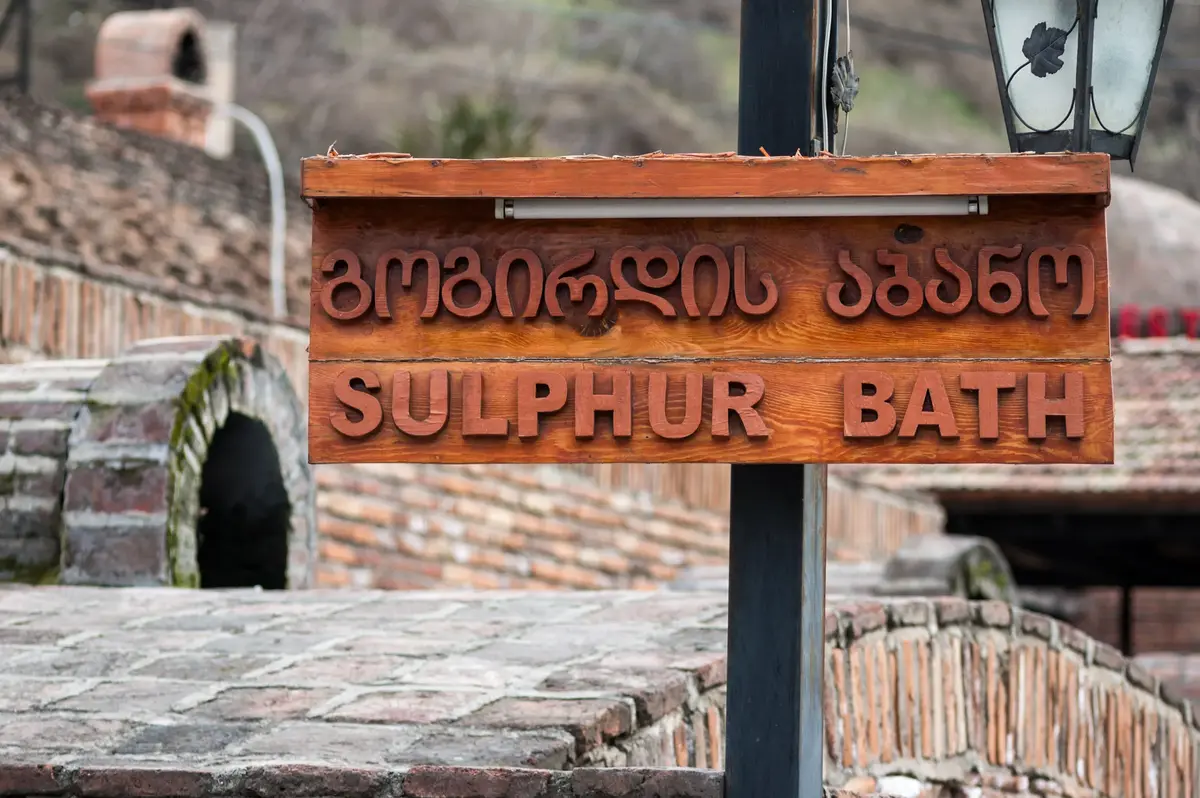
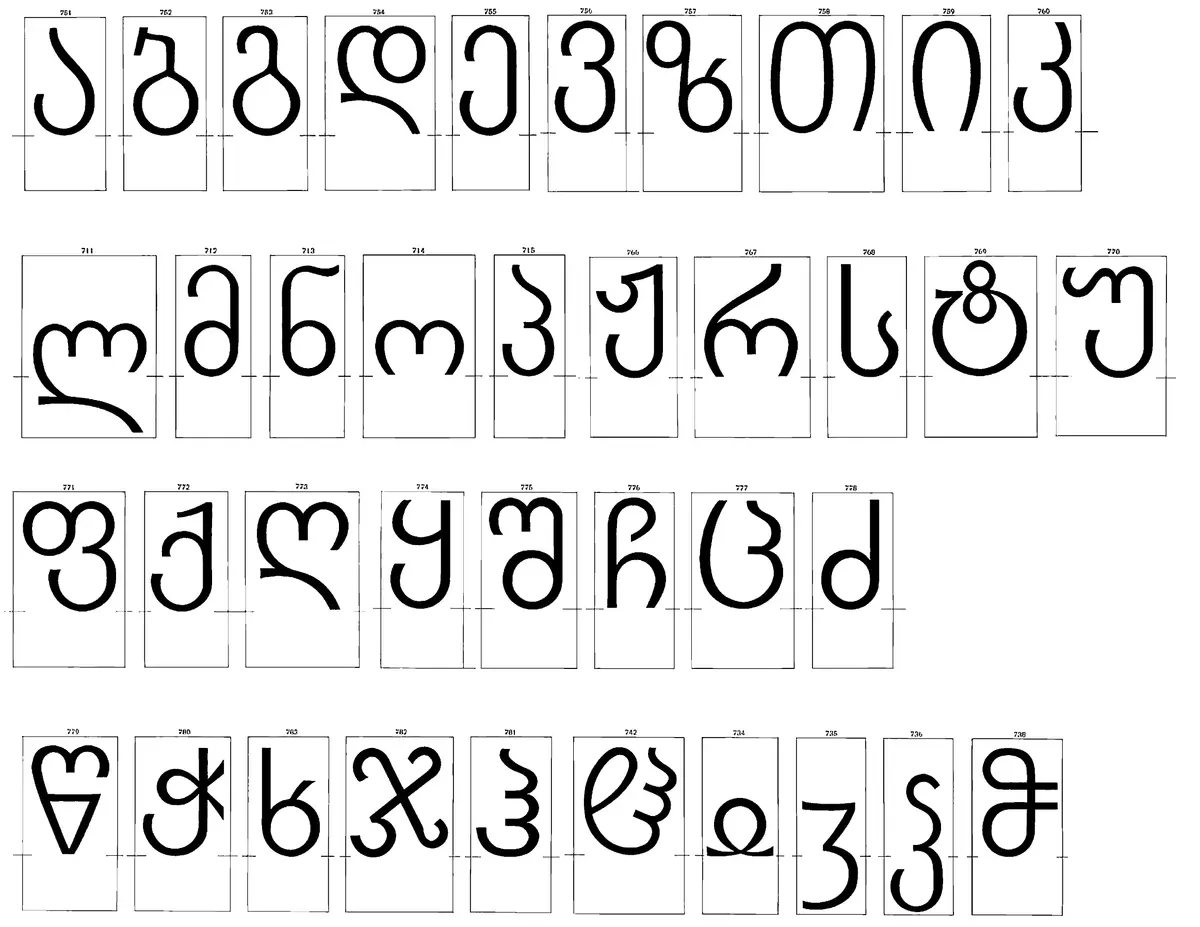
Georgian is written in Mkhedruli, an alphabet of 33 letters — 5 vowels and 28 consonants — with no capital or lowercase forms. Each letter maps to one sound, so once you learn it you can read any word aloud. Two older scripts, Asomtavruli and Nuskhuri, survive mainly in the Georgian Orthodox Church.
Mkhedruli means “of the cavalry,” and it is the youngest of three historical scripts. Asomtavruli came first, followed by Nuskhuri; together those two form the ecclesiastical script, Khutsuri, still used in church books. Mkhedruli emerged centuries later and became the everyday script. The three-writing-system tradition sits on UNESCO’s Representative List of the Intangible Cultural Heritage of Humanity.
The alphabet once had 38 letters. Five fell out of use through reforms in the nineteenth century, led by the writer Ilia Chavchavadze and a literacy society, leaving the 33 you see now. Because there is no uppercase and lowercase, sentences look uniform in height, and the “shouting” title style on signage is a separate display form called Mtavruli.
The Supra: How Toasting Works and Why “Gaumarjos” Matters
Sit down to a proper Georgian meal and you have not walked into a dinner — you have walked into a supra (სუფრა), a structured feast that runs on toasts rather than free conversation. One person, the tamada (თამადა), acts as toastmaster and sets the order: to Georgia, to peace, to guests, to family, to those who have passed. You raise your glass, say gaumarjos, and drink. Then you wait for the next one.
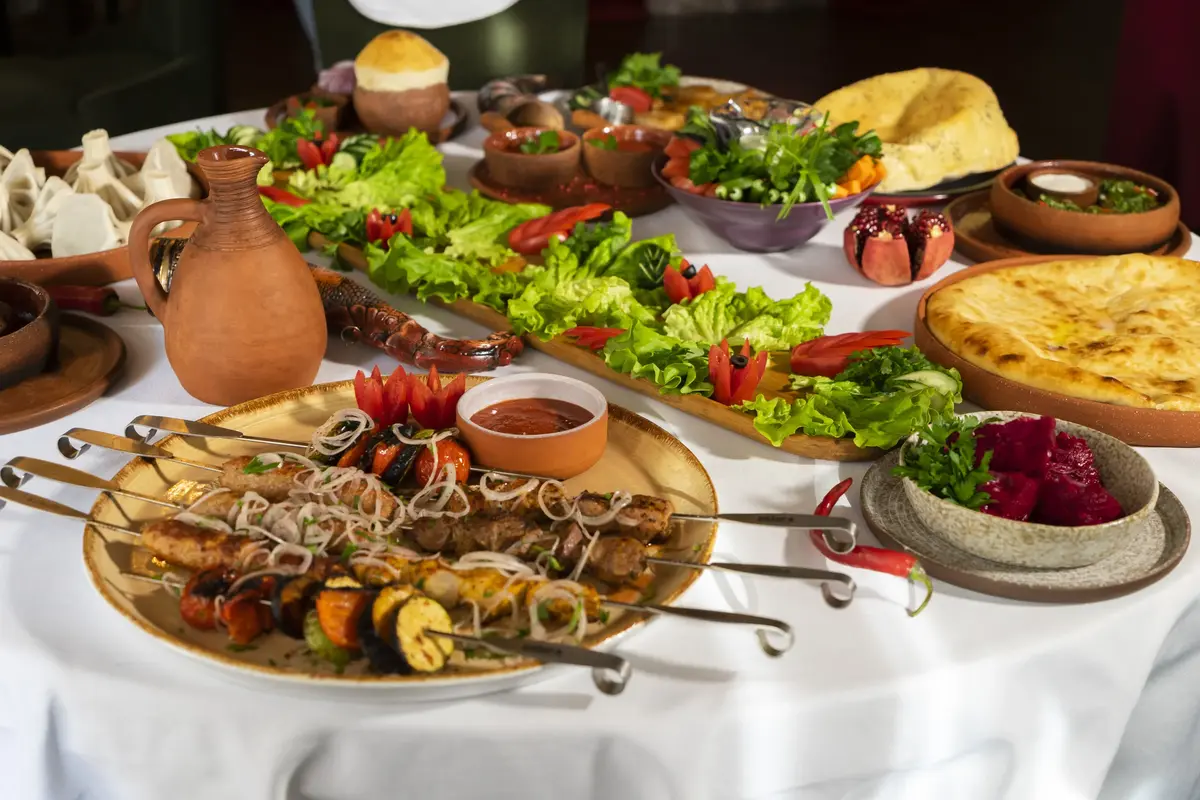
Two words unlock the ritual. Gaumarjos is the toast itself — “to victory,” the same root as the greeting. Alaverdi is the tamada handing the toast to another guest, inviting them to expand on it, so if someone says your name after alaverdi, you are expected to speak. Drinking on your own between toasts is mildly frowned upon; the point is that everyone lifts together.
There is one more phrase worth carrying into a supra, and it does not translate cleanly. Shen genatsvale (შენ გენაცვალე) is a term of endearment that means something like “let me take your burden” or “I would stand in your place.” It gets said to people you love, and hearing it directed at you as a guest is a genuine compliment.
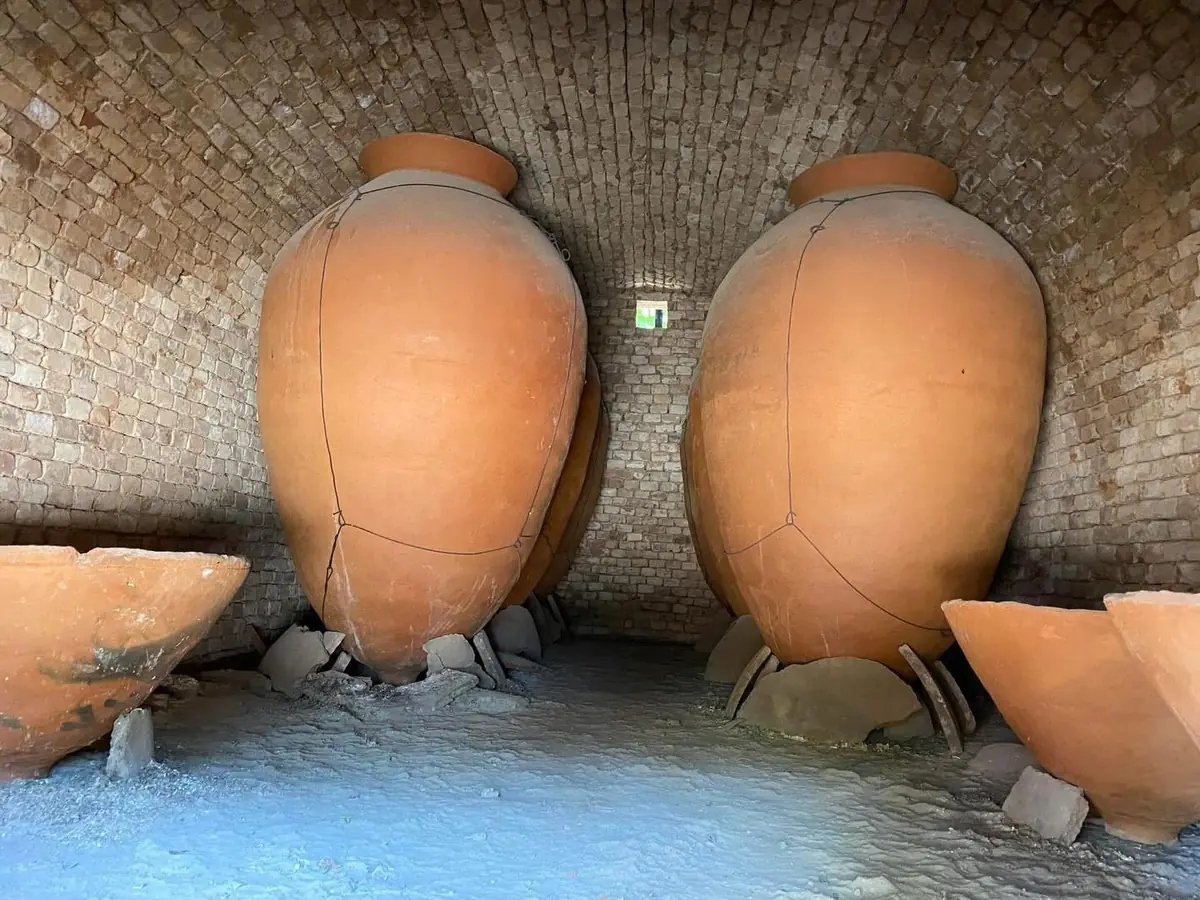
Underneath all of this is wine. Georgia is widely called the birthplace of wine, and archaeologists have found roughly 8,000-year-old grape residue in clay jars unearthed about 20 miles (32 km) south of Tbilisi. The traditional method still buries fermenting wine in egg-shaped clay vessels called qvevri, a technique that also carries UNESCO recognition. The word for wine, ghvino (ღვინო), is often floated as the ancient root of the English word itself.
Food and Wine Words for the Table
You will read these words on every menu, so learning them saves you from pointing. Georgian food names are also easy wins because most are short and follow the read-as-spelled rule.
- khachapuri (ხაჭაპური): cheese bread; the boat-shaped Adjaruli version comes with a raw egg you stir into the melted cheese
- khinkali (ხინკალი): soup dumplings; hold the doughy top knot, sip, then eat — the knot is a handle, not food, and locals leave it on the plate
- mtsvadi (მწვადი): skewered grilled meat, usually pork or veal
- churchkhela (ჩურჩხელა): walnuts strung and dipped in thickened grape juice, shaped like a candle
- puri (პური): bread, the base of nearly every meal
- ghvino (ღვინო): wine; chacha (ჭაჭა) is the strong grape spirit that appears at the end of a supra
Pro Tip: When the khinkali arrives, count them before you start — they are ordered by the piece, and the empty knots left on your plate are how the kitchen tallies the bill in traditional spots.

Is Georgian Hard to Learn?
Yes — for English speakers it is one of the hardest. The U.S. State Department’s Foreign Service Institute places Georgian in its top difficulty tier, at roughly 1,100 class hours, or about 44 weeks, to reach working fluency. There are no familiar cognates, the sounds are unusual, and the grammar packs a lot into each verb. Reading, though, becomes logical once the alphabet clicks.
The specific things that make it hard are worth naming, because they tell you where to spend effort:
- No cognates: nothing carries over from English, Romance, or Slavic languages
- Ejectives and clusters: sounds and consonant stacks with no English equivalent
- Agglutinative verbs: a single verb can hold up to eight pieces, marking subject and object at once
- Seven noun cases and a base-20 number system (twenty is otsi, forty is ormotsi — “two twenties”)
The counting works up cleanly at the start: erti, ori, sami, otkhi, khuti, ekvsi, shvidi, rva, tskhra, ati (one through ten). It is past twenty, where the vigesimal system kicks in, that arithmetic sneaks into your sentences.
The reassuring part: no grammatical gender, no articles, and a one-letter-one-sound alphabet. So while speaking well takes years, reading signs and menus is a weekend skill.
Do People in Georgia Speak English?
In tourist areas and among younger Georgians, you’ll find enough English to get by, especially in Tbilisi and Batumi. Older people are far more likely to share Russian than English. Outside the cities, expect little of either. A few correct Georgian words open doors that English alone will not.
This is where the effort pays off. In a country where most visitors default to English or a scrap of Russian, a traveler who leads with gamarjoba and gmadlobt stands out immediately — not because the accent is good, but because so few people try at all. Regional languages add texture too: you may hear Mingrelian in Samegrelo or Svan up in Svaneti, though standard Georgian is understood everywhere.
Which Apps Actually Teach Georgian?
Start with the blunt fact that trips people up: there is no Duolingo course for Georgian, and no Babbel one either. The two apps most travelers reach for first do not cover the language at all, which is why so many people arrive with zero words.
What does exist:
- Ling: the most complete app option, with a large set of Georgian lessons, native audio, and speech recognition
- Pimsleur: audio-first, good for pronunciation drilling on the go
- Memrise and Glossika: spaced repetition and listening practice
- italki: live tutors, the fastest route to fixing your ejectives
- Forvo: a pronunciation library — search any word and hear a native speaker say it
- Google Translate: handles Georgian text well, though its audio has historically been limited
For a short trip, the efficient stack is Ling or Pimsleur for the core phrases, Forvo to check any word before you say it, and Google Translate for reading signs and menus in the moment. You do not need fluency; you need about 15 words said correctly.
Before You Land
TL;DR: Learn gamarjoba, gmadlobt, ra ghirs, and gaumarjos, and you can greet, thank, buy, and toast your way through most of a trip. Expect the alphabet and the ejective sounds to be the real work — and know that the price question is ra ghirs, not the quantity phrase most guides print. A handful of correct words earns warmth that English on its own never will.
Georgian rewards a small, accurate effort out of all proportion to what you put in. Which of these will you practice first — the greeting, the toast, or the one that fixes the bill?