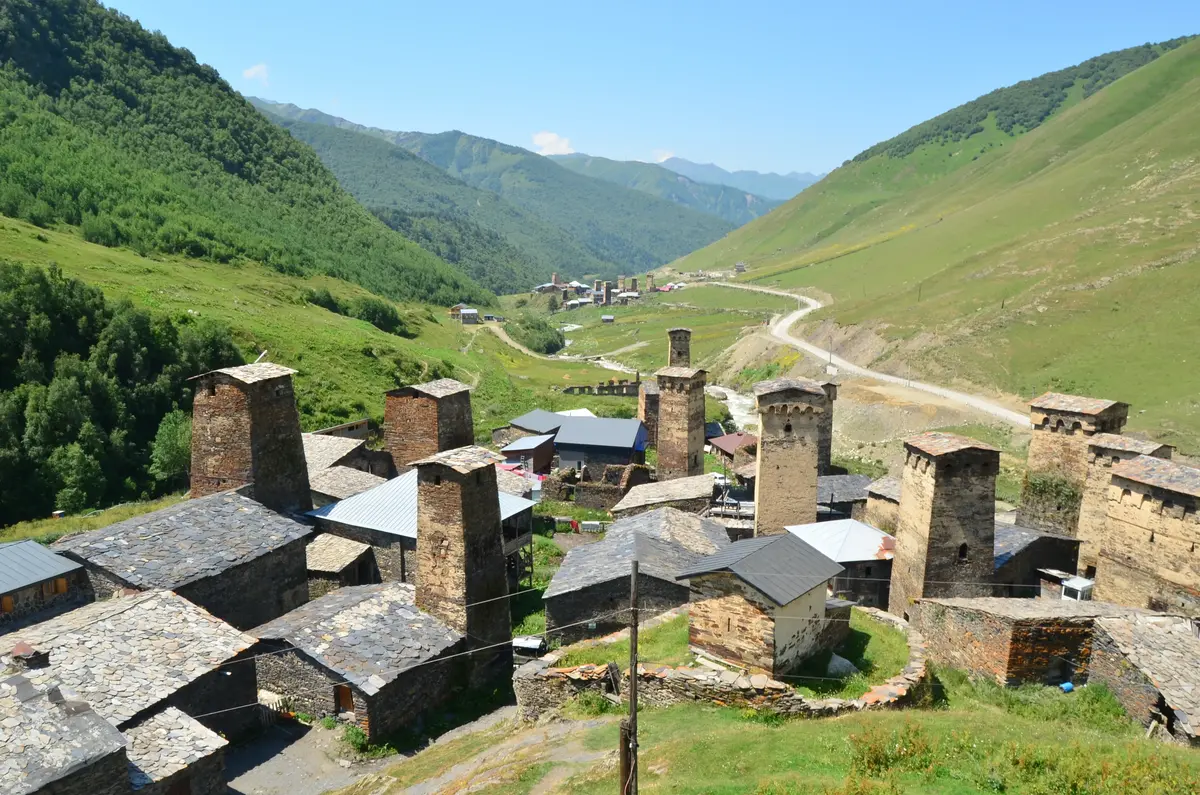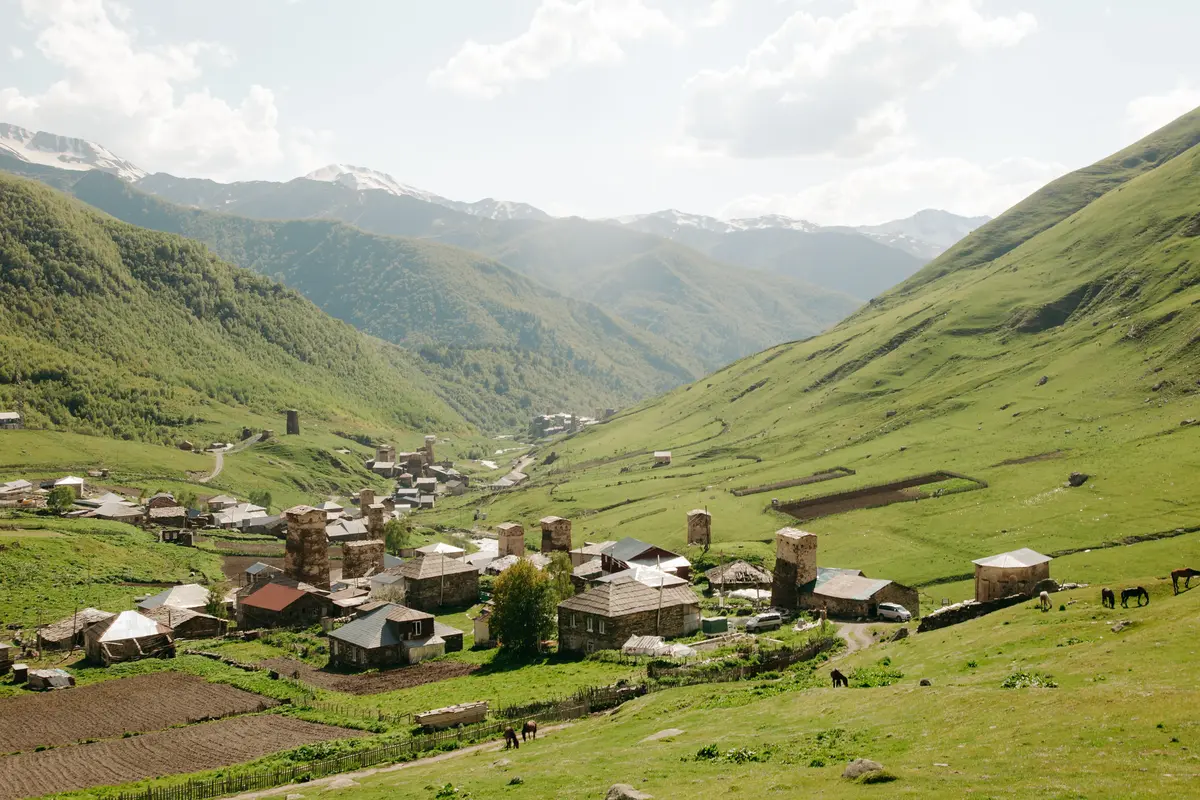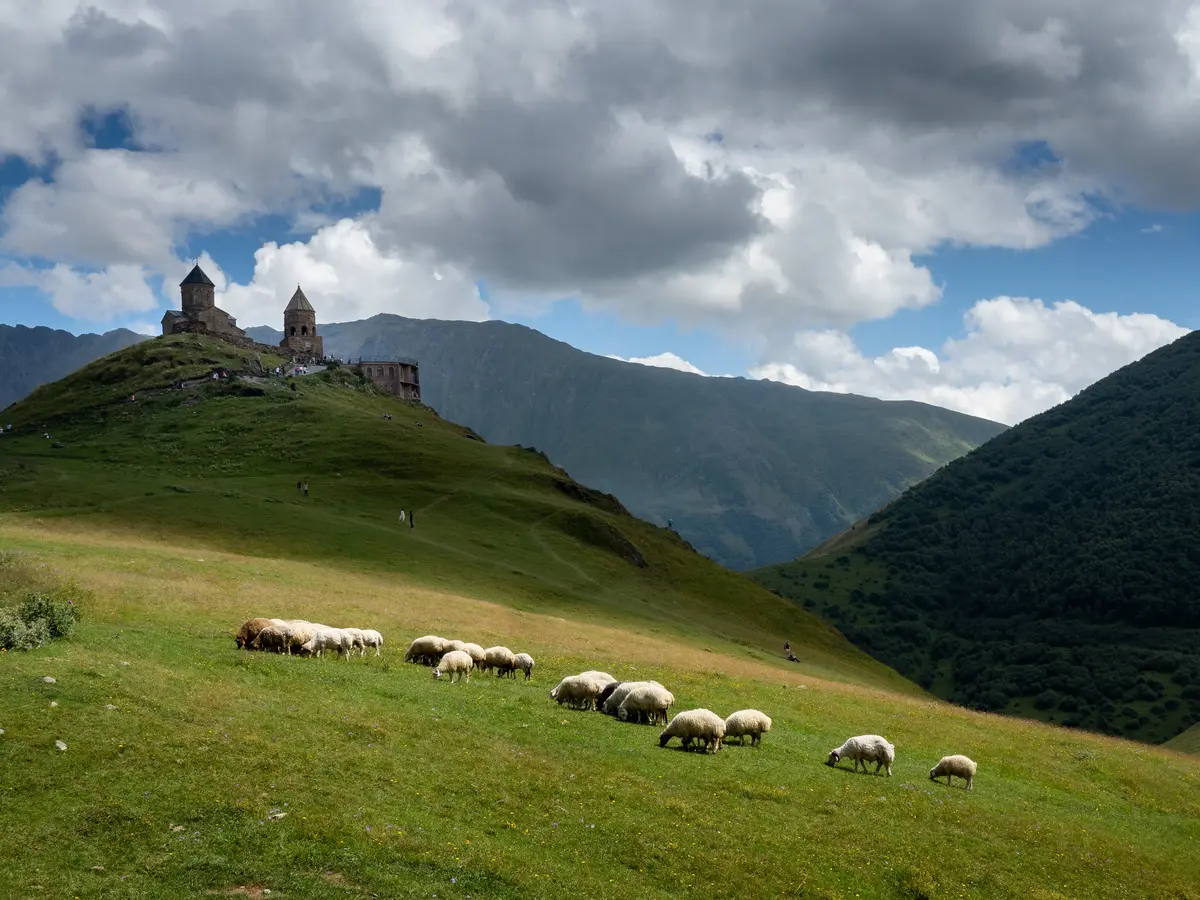
Tbilisi to Kazbegi is the best road trip in Georgia — about 93 miles (150 km) up the Georgian Military Highway to Mount Kazbek and the Gergeti Trinity Church. There are four realistic ways to make the trip, and the cheapest one skips every view worth stopping for. Here’s what each costs and who it suits.
The Quick Answer: Which Way to Kazbegi Is Right for You
The drive runs about 2.5 to 3.5 hours over roughly 93 miles (150 km). Cheapest is the Didube marshrutka, around ₾15–25 ($6–9) one way. Most flexible is a private GoTrip transfer from about ₾185 ($68) per car. Easiest for one day is a booked tour, $30–90, which includes the 4×4 up to Gergeti. Most people should stay a night.
For most first-timers, the smart play is to split a GoTrip car with your travel companions and sleep one night in Stepantsminda. It costs a little more per head than the van, but it buys you the stops and the sunrise — which is the entire reason to come.
Here’s who each option actually fits:
- Budget backpacker: the marshrutka from Didube. Cheapest by far; you’ll skip the scenery.
- Comfort or mid-range traveler: a private GoTrip transfer or a shared taxi, so you can stop where you want.
- Time-poor day-tripper: a booked group or private tour that handles the 4×4 up to Gergeti.
- Overnight hiker: any transport in, then a base in Stepantsminda for Gergeti, Juta, or Truso.
- Photographer chasing the peak: stay over. Mount Kazbek is clearest at sunrise.
Distance, Time, and the Four Ways to Travel
Sources put the distance between about 93 and 98 miles (150–157 km), and a few route planners measure more depending on exactly where they drop each endpoint — so treat the number as a range, not a fixed figure. Whichever way you go, budget 2.5 to 3.5 hours, more in winter or with stops. Here’s the whole decision in one table:
| Option | Cost (one way) | Time | Comfort | Flexibility | Scenic stops |
|---|---|---|---|---|---|
| Marshrutka (minibus) | ₾15–25 ($6–9), +₾5 luggage | 3–3.5 hrs | Low, cramped | None | None (one rest stop) |
| Shared taxi | ₾30–60 ($11–22)/seat | ~3 hrs | Medium | Leaves when full | Driver’s choice |
| Private transfer (GoTrip) | from ₾185 ($68)/car | 2h45m–3 hrs | High | Full | Any you want |
| Organized day tour | $30–90/person | 10–14 hrs round trip | Medium | Fixed schedule | Ananuri, Gudauri, Gergeti 4×4 |
| Self-drive rental | $35–50+/day + fuel | ~2h45m | High | Full | Any you want |
One line in that table decides the whole trip: the direct marshrutka makes no scenic stops. Ananuri, Gudauri, and the Friendship Monument all slide past the window, and travelers who took the cheap van repeatedly name that as the biggest regret of the day. If the road is the reason you’re going, the marshrutka is a false economy — for two or more people, splitting a GoTrip car often lands close to the same price per head and saves the point of the drive.
Taking the Marshrutka From Didube, Step by Step
The budget path is genuinely easy once you know the moves, and messy if you don’t. The marshrutka leaves from Didube Bus Terminal, a chaotic market-and-parking sprawl on the north side of Tbilisi.
Getting there and getting on:
- Reach Didube: take the metro red line to Didube station (₾1, about $0.35) or a Bolt from the center (~₾12–15, $4–6).
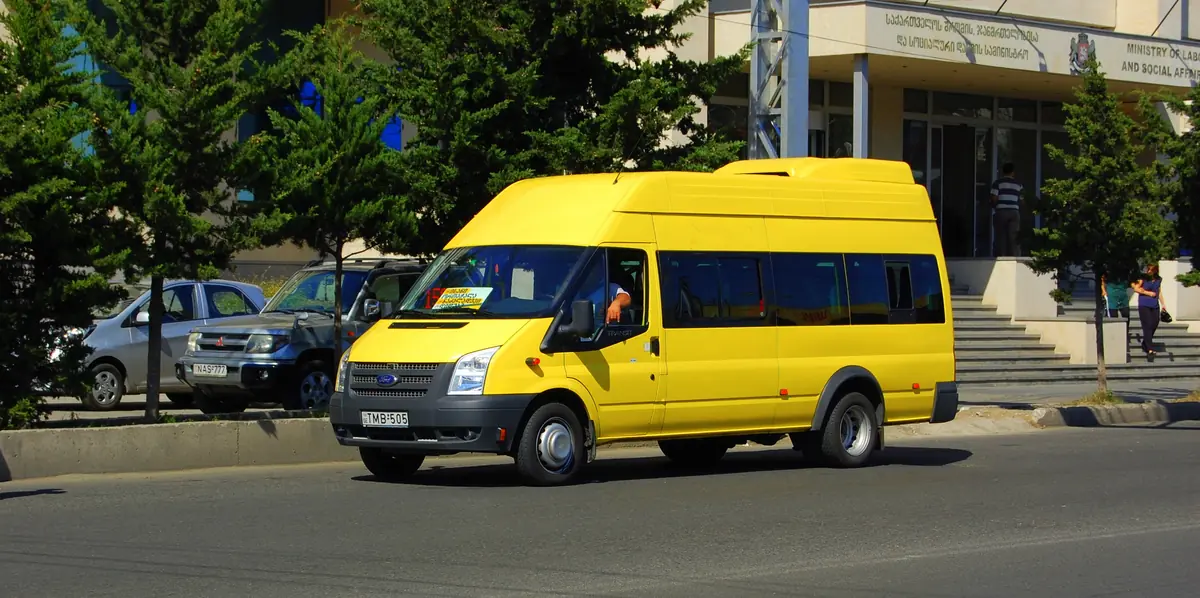
- Find the vans: from the metro, head down the stairs and right through the underpass and market to the second parking lot; look for the minibus with a “Stepantsminda / Kazbegi” sign in the window.
- Pay: cash to the driver, ₾15–25 ($6–9), plus about ₾5 for oversized luggage. There’s a Bank of Georgia ATM at Didube if you need lari.
- Departures: vans run daily, roughly 8 a.m. to 6 or 7 p.m., leaving when full or on the hour — about 11 a day in each direction.
- On the way: one rest stop of roughly 10 minutes near Sakiaani; otherwise it’s a straight run.
- Arrival: you’re dropped on Stepantsminda’s main street, near the tourist info point, a SPAR, and a Liberty Bank ATM within about 100 yards (100 m).
In high season, show up 30 to 45 minutes early if you want a decent seat. And ignore the sales pitch: drivers at Didube will sometimes tell you the marshrutka already left or isn’t running today. It’s a tactic to push you into a pricier shared taxi. The vans run daily.
Pro Tip: If you get carsick, claim one of the front two rows and take Dramamine before you leave. The switchbacks past Gudauri undo a lot of stomachs — travelers frequently report nausea on the curves, and one recounted an American passenger shouting for the driver to pull over so she could be sick at the roadside.
What Will It Really Cost? A Budget Breakdown by Traveler Type
Transport is only half the bill. Add the 4×4 up to Gergeti Trinity Church (about ₾40–70 per car return, roughly $15–26), meals at ₾15–50 ($6–18) a head, and a bed for the night, and a “cheap” trip climbs fast. Nobody quotes the all-in number, so here it is by who you’re traveling as.
| Traveler | Getting there (round trip) | Gergeti church | Rough all-in (overnight, per person) |
|---|---|---|---|
| Solo backpacker | Marshrutka ₾30–50 ($11–18) | Hike free, or 4×4 seat ₾15–20 ($6–7) | ~$50–90 |
| Couple | Split GoTrip or shared taxi | 4×4 ₾40–70/car, split two ways | ~$100–180 |
| Family of 4 | Private transfer or tour | 4×4 ₾40–70/car (fits the family) | ~$70–140 |
| Comfort traveler | GoTrip + a mountain-view room | 4×4, or drive up | ~$180–300+ |
These are ballpark, and lodging swings them the most: a guesthouse bed runs roughly ₾40–200 ($15–75) a night, while the town’s one upscale hotel starts well above that. A couple more numbers worth knowing:
- A standard taxi ride within Stepantsminda is about ₾10 ($4).
- The Gergeti 4×4 is priced per car return, so filling the vehicle drops the per-person cost sharply.
- Georgia runs largely on cash. There are ATMs in Stepantsminda, but bring lari.
One warning from repeat visitors: Gergeti taxi drivers open high. One guide flatly calls ₾40 for the roughly 4-mile (6 km) run up to the church “almost a scam” — so haggle, or wait to fill a van and split it five or six ways.
The Drive Itself: Every Stop Worth Making on the Georgian Military Highway
Ride the direct van and you’ll see none of this. Take a car, a tour, or a shared taxi with a patient driver, and the road becomes the highlight. The stops, in order out of Tbilisi:
Mtskheta, about 16 miles (25 km) out, is Georgia’s ancient capital and a UNESCO site — Jvari Monastery watches the river confluence from the hilltop, and Svetitskhoveli Cathedral anchors the old town below.
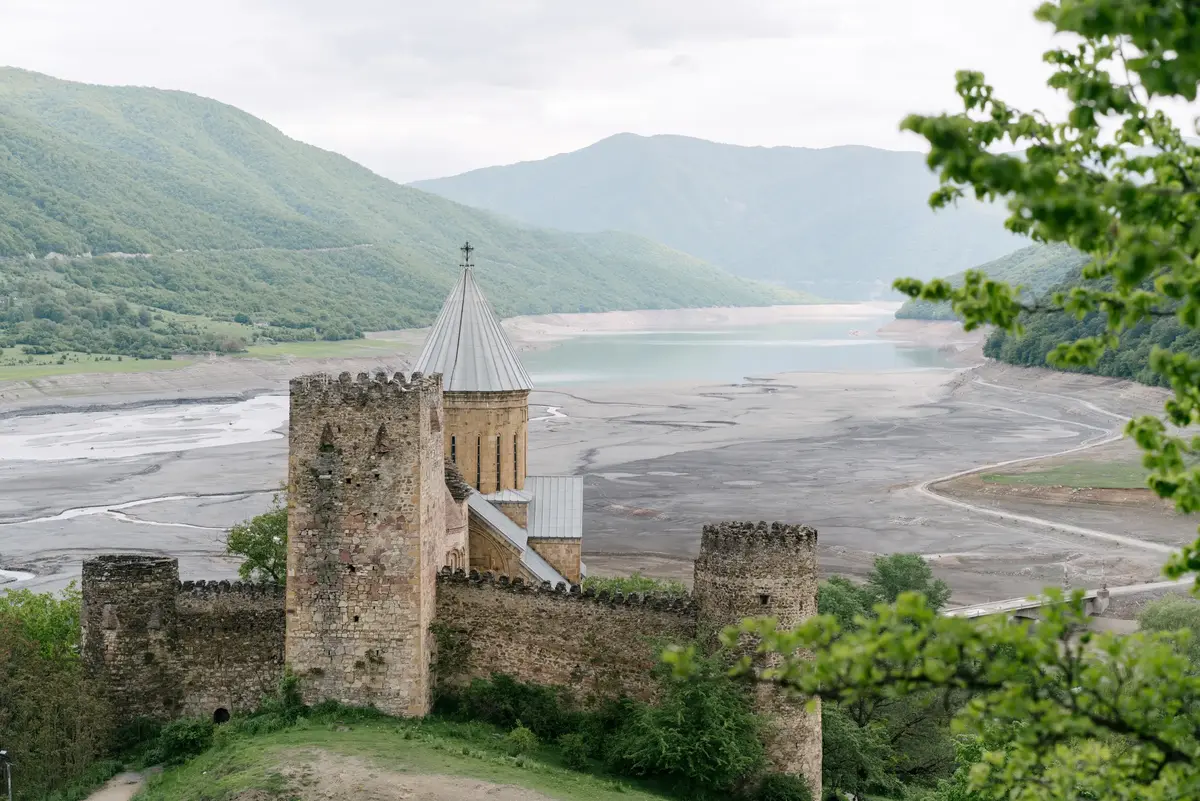
Zhinvali Reservoir appears around 44 miles (70 km) in, a long stretch of turquoise water that stops most people in their tracks. Right above it, at roughly 45 miles (72 km), sits Ananuri Fortress, a 12th-to-18th-century church-and-tower complex on the water’s edge. It’s free to enter.
Pasanauri, near 56 miles (90 km), claims to be the birthplace of khinkali. If you’re hungry, Korbuda is the local pick for the dumplings.
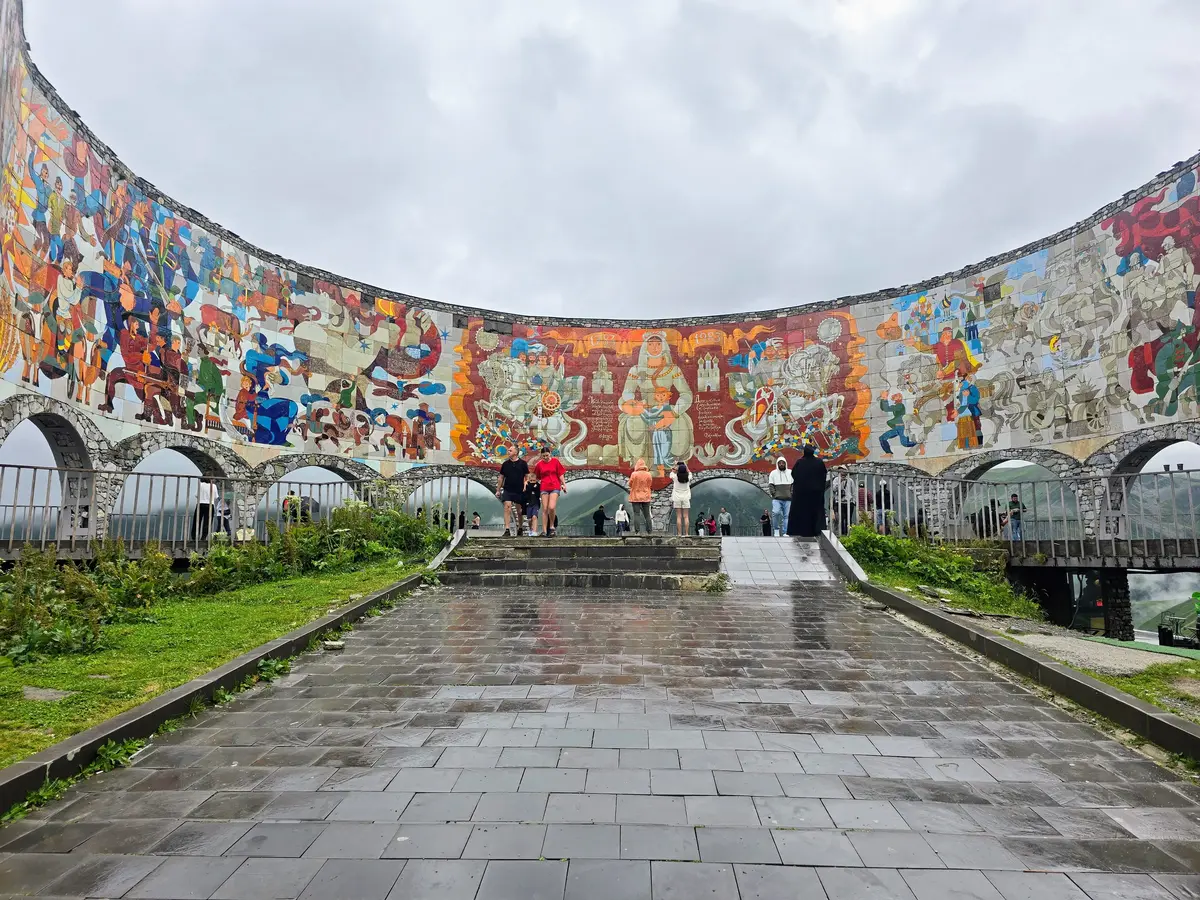
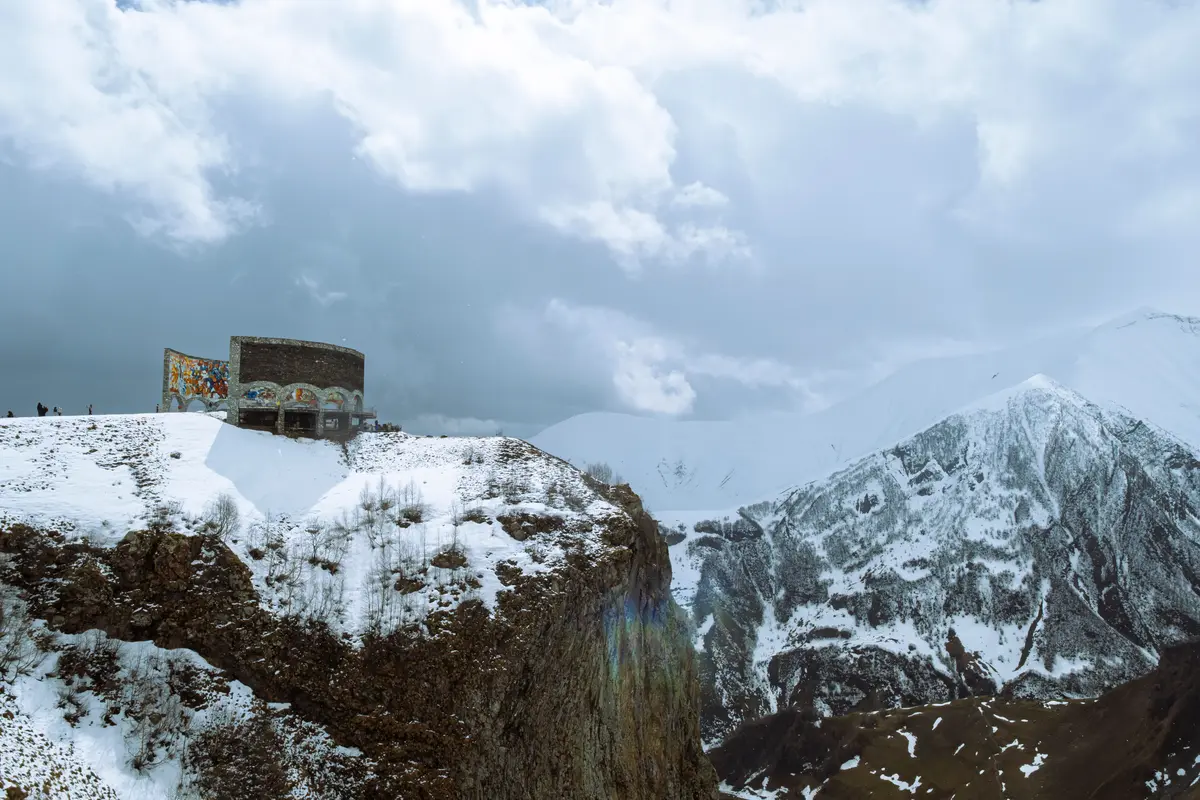
Climbing on, Gudauri is a ski resort strung along the highway at about 7,200 feet (2,200 m). Just past it, the Russia–Georgia Friendship Monument — a circular stone terrace lined with a Zurab Tsereteli mosaic — hangs over the drop into the Devil’s Valley. It’s the best panoramic pull-off on the route.
The road tops out at the Jvari (Cross) Pass, 7,800 to 7,860 feet (2,379–2,395 m), where mineral springs stain the rock orange. From here it’s downhill through Sno Valley to Stepantsminda at 5,710 feet (1,740 m).
A sobering note on the driving: one traveler photographed a freight truck that had gone over the edge into the ravine below a viewpoint past Kazbegi. Truck traffic and blind overtaking are constant on this highway. If you’re behind the wheel, it earns your full attention.
Is Tbilisi to Kazbegi Worth It as a Day Trip, or Should You Stay Overnight?
You can do it in a day — leave Tbilisi by 7–8 a.m. and you’ll be back by 8–9 p.m. — but you probably shouldn’t. A day trip means 6 to 7 hours in transit, a rushed church visit, and a real chance of a cloud-covered Mount Kazbek. One night lets you catch the peak at sunrise, when it’s most likely to be clear.
The math is unforgiving. A tour runs 10 to 14 hours door to door, and the last marshrutka back leaves Kazbegi in the late afternoon, roughly by 6 to 7:30 p.m. One Tbilisi local on a travel forum warned that counting on a return by 7 p.m. is “risky” unless you’ve booked a private car.
Then there’s the mountain itself. Kazbek is obscured more than half the days even in summer, and it tends to be clearest in the early morning. This is not a small risk. One blogger returned to Kazbegi three separate times and never once got a clear view of the glacier; another watched the peak stay hidden until the final evening of the stay. Sleep in a mountain-view guesthouse and you can simply open the curtains at dawn and check — which is the whole game.
Skip the Group Tour if You Get Carsick or Want the Church to Yourself
Group day tours are efficient and the guides earn steady praise, but they run on the standard program and someone else’s clock. Reviewers who enjoyed their trips still wished for less time at the filler stops — one flagged 20 minutes at a grocery store as wasted — and the whole thing puts you on the switchbacks whether your stomach likes it or not.
There’s a better play if you’re prone to motion sickness or want Gergeti to yourself. A private GoTrip car, or an overnight stay with an early start, lets you reach the church before the jeep queues build — and in July and August, those queues get long. Guides advise leaving for the top by 7 or 8 a.m. to beat them. This isn’t a knock on tours; for a time-poor single day they’re the right call. It’s just the wrong call if flexibility is what you’re after.
Getting Up to Gergeti Trinity Church: Hike or 4×4?
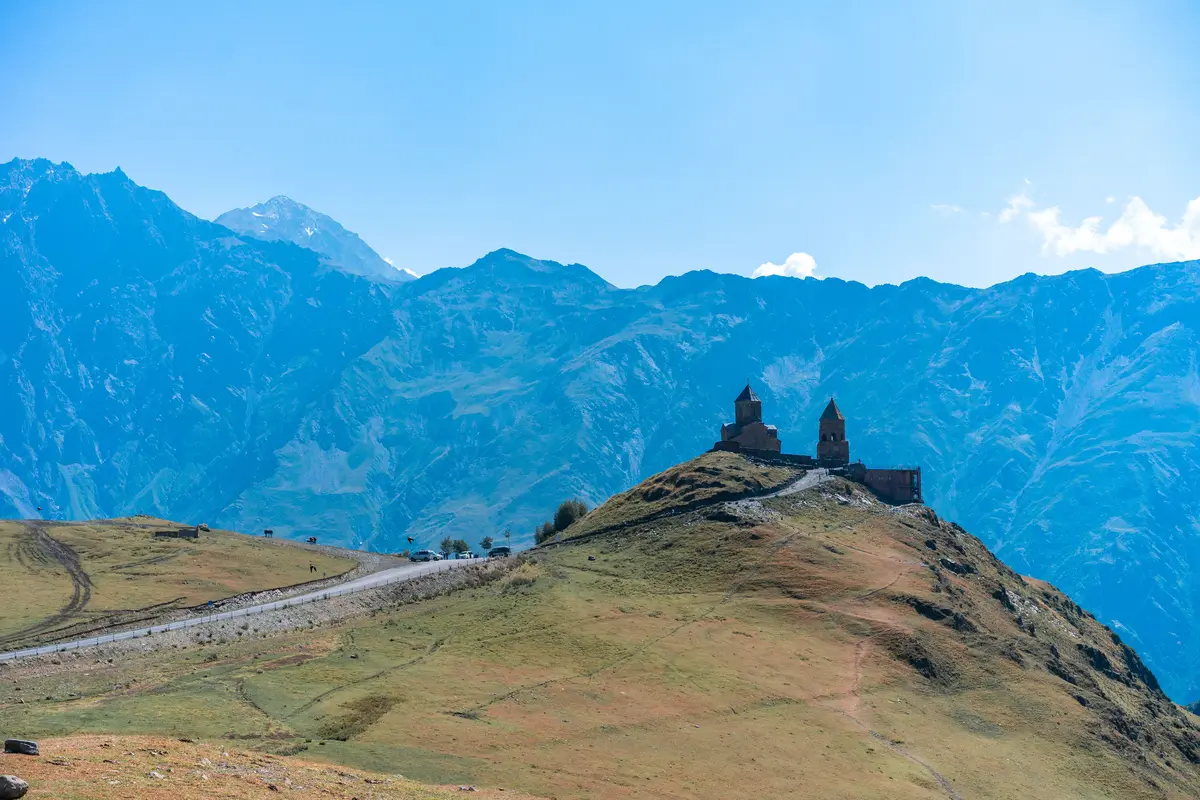
From Stepantsminda it’s a 1.5-to-2-hour uphill hike — about 3.5 miles (5.6 km) round trip, roughly 1,400 feet (430 m) of gain — to the 14th-century Gergeti Trinity Church at 7,120 feet (2,170 m). A 4×4 taxi does it in 20 to 30 minutes for about ₾40–70 ($15–26) per car return. Dress modestly; it’s an active church.
A few things worth sorting out before you start up:
- Pick the right trail. From Gergeti village, take the valley route on the left, past the stone tower — not the steep forest path, which is a harder, sweatier climb for the same church.
- Dress code is enforced. Cover your head, shoulders, and knees; there are sarongs at the entrance. No photos inside.
- The road is passable but rough. It was repaired a few years back, so a regular car can manage outside winter — but reviewers still describe the track honestly.
That “honestly” is doing some work. Travelers call the 4×4 leg “bone-breaking and nerve-racking,” with potholes deep enough to tilt the car toward 45 degrees and single-lane stretches where vehicles have to wait each other out. And almost everyone who complained about the ride still rated the church itself among the highlights of Georgia. In winter, skip the debate: only a 4×4 gets up.
When to Go, and Is the Kazbegi Road Safe in Winter?
The best months are May–June and September–October: the highway is open, the meadows are green, and crowds thin out. Summer is warmest and gives the clearest odds on Mount Kazbek. In winter the Jvari Pass can close for hours or days after heavy snow or avalanche risk — check before you go, and never ride a marshrutka after dark.
Here’s the seasonal reality side by side:
| Summer (May–Oct) | Winter (Nov–Apr) | |
|---|---|---|
| Road surface | Paved, good | Snow and ice on the pass |
| Vehicle | Standard car fine | Chains or 4WD; chain law enforced |
| Closure risk | Low | Pass can close hours to days |
| Temp at Stepantsminda | 59–77°F (15–25°C) | Below freezing |
| What to pack | Layers (the pass runs 10–15°F cooler) | Serious winter gear |
Two practical points on temperature and rules. Even in summer, pack layers — it can be 95°F (35°C) in Tbilisi and 59°F (15°C) in Kazbegi on the same day, and the Jvari Pass can sit around 39°F (4°C) as late as May. And in winter, Georgia’s chain law bites: fines reported as high as around $1,000 apply for driving the pass without chains during a declared emergency.
The closure risk is not theoretical. One writer got stranded in Gudauri on Christmas Eve when the pass shut, and Kazbegi is cut off for several days most winters after heavy snow or avalanche. Before you travel, the reliable move is to check the road department and the U.S. State Department advisory the morning you leave, not the week before.
Where to Stay and Eat in Kazbegi
Where you sleep in Kazbegi should follow what you came to do. There are three broad zones:
- In-town, east bank: near the bus drop and the restaurants. Most convenient for transport and food.
- The hill above town: trades a short climb for the mountain views.
- Gergeti village, west bank: closest to the trailhead, and it shaves about 30 minutes off the walk up to the church.
For most people, a family guesthouse — Guest House Tamta, Ketino’s Home, or Red Stone are common picks — is the honest sweet spot: mountain views, home cooking, and cash-friendly rates. The one name everyone recognizes gets a more mixed verdict.
Rooms Hotel Kazbegi is the town’s design landmark, 143 rooms with a spa, a pool, and a terrace that looks straight at Gergeti Trinity Church with Kazbek behind it. That terrace is real, and it’s the reason to book. It’s also, by many accounts, the only reason. Guests keep reporting thin walls and late-night hallway noise, small and dated rooms, breakfast crowding, and prices that outrun the value; management has publicly pointed to renovations. If you do book, ask for an odd-numbered room — those are the ones that face the mountain.
- Location: Above Stepantsminda, facing Gergeti
- Cost: from roughly $100+/night, higher in peak season
- Best for: Couples who want the view without the hike
- Time needed: One to two nights
On food, order local: mokhevuri (mountain-style) khinkali, mountain trout, and kharcho. Cafe 5047m and Café Gergeti are the reliable in-town tables, and Korbuda in Pasanauri is worth a stop on the drive up.

Before You Go: Visa, Insurance, Money, and Safety
A short, current checklist for US travelers:
- Visa: US citizens can enter visa-free for up to 365 days, per the U.S. State Department. No paperwork, no fee.
- Insurance is now required. Georgia requires every tourist entering the country to hold valid health and accident insurance, with coverage of at least ₾30,000 (about $11,000), under Government Regulation No. 602 and the Law on Tourism. It’s enforced at the border: without it you can be refused entry or fined (reported at ₾300, about $110), and airlines may check documents before boarding. See the U.S. Embassy in Georgia for the details, and carry proof in English or Georgian.
- Safety level: the State Department rates Georgia Level 1, “exercise normal precautions.” Only the Russian-occupied regions of South Ossetia and Abkhazia sit at Level 4 — and both are nowhere near the Tbilisi–Kazbegi route.
- Money: largely cash (lari). ATMs exist in Stepantsminda, but arrive with cash. Use Bolt for city taxis in Tbilisi.
- Maps: download offline maps before you go. Signal is patchy in the mountain valleys.
- Solo female travelers: the State Department notes reports of harassment. Use reputable taxi services and sit in the back seat.
Don’t Rush the Highway
However you travel, don’t treat the road as dead time. The Georgian Military Highway is the trip; Mount Kazbek is the reward for giving it time. Leave early, build in one night if you possibly can, and let the peak show itself on its own schedule.
Pick your lane:
- Backpacker on a budget: the Didube marshrutka, front seat, Dramamine in your bag.
- Couple or comfort traveler: split a GoTrip car and sleep one night facing the mountain.
- Short on time: a booked tour with the Gergeti 4×4, and accept you’re rolling the dice on the clouds.
Tbilisi to Kazbegi rewards patience. Give it two days and one clear sunrise, and it pays you back with the view half of all visitors drive home without.