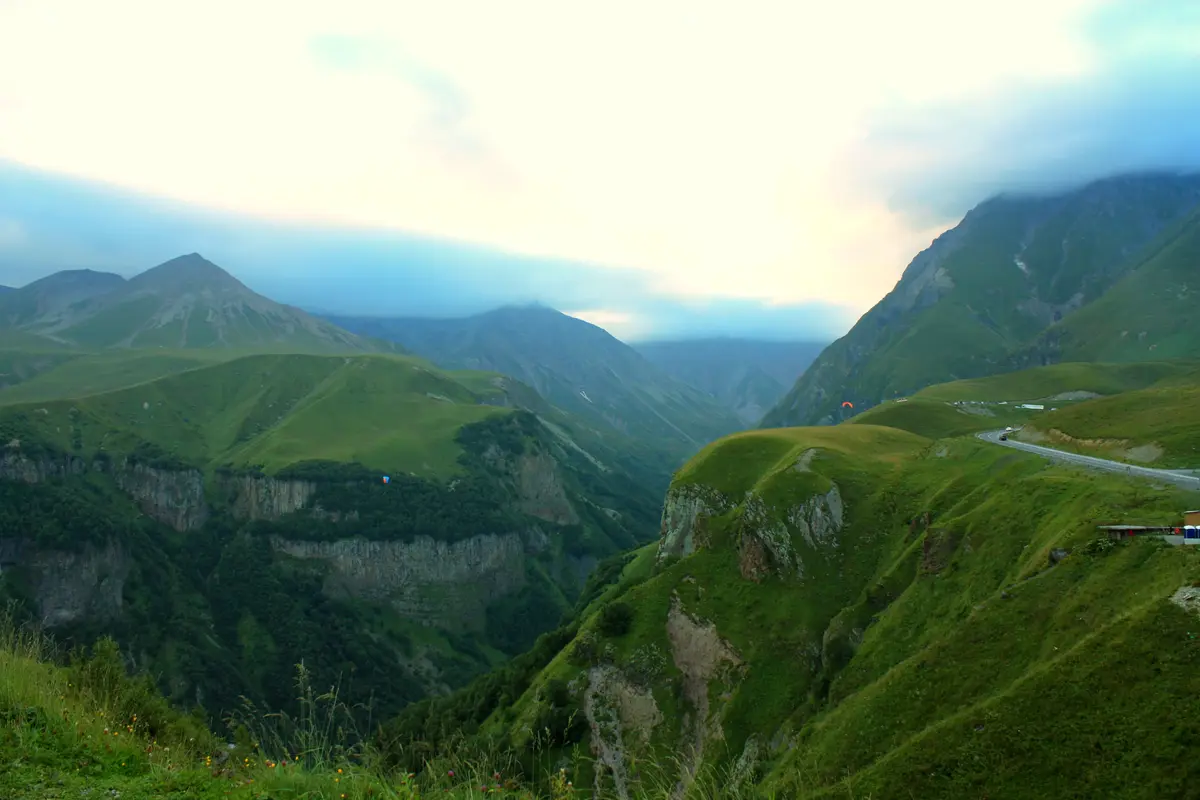
This is a road trip itinerary for the country of Georgia in the Caucasus, not the US state. No Savannah, no Blue Ridge Parkway, no Georgia 400. This is Sakartvelo: a nation the size of West Virginia wedged between the Greater Caucasus range and the Black Sea, where you can eat breakfast in a medieval hill town, drink 8,000-year-old-style wine out of a clay vessel buried in the ground, and be standing under a glacier by dinner.
Here is the short version. Ten days is the sweet spot. The route runs Tbilisi to the Kakheti wine country, north over the Georgian Military Highway to Kazbegi, west through Gori and Borjomi to the cave city of Vardzia, then on to Kutaisi and back to Tbilisi. That is roughly 800 miles of driving, about 25 to 30 hours behind the wheel spread across ten days, and it costs a mid-range American traveler somewhere between $50 and $125 a day once the car is paid for.
Below you will find that ten-day plan broken down day by day, plus 5-day, 7-day, 14-day, and winter versions. Every drive time listed has been corrected upward from the Google Maps estimate, because Maps is optimistic about Georgian mountain roads in a way that will wreck your schedule if you trust it. Costs are in US dollars. Distances are in miles with kilometers alongside, since every road sign in the country is metric.
Why drive the country of Georgia instead of taking tours
A rental car is the single biggest upgrade you can make to a trip to Georgia, because the best parts of the country are villages, monasteries, and mountain valleys that public transportation reaches badly or not at all.
Georgia’s intercity network runs on marshrutkas, shared minibuses that are cheap, frequent on main corridors, and completely inflexible everywhere else. They leave when full, they drop you at the edge of town, and they do not stop for the ruined watchtower on the ridge or the roadside stand selling churchkhela. The country’s real charm lives in exactly those unscheduled stops.
With a car you can do things that are otherwise a logistical project: sleep in a family guesthouse in Racha, hit three Kakheti wineries in an afternoon, pull over at the Zhinvali reservoir when the light turns green-blue, or reroute entirely because someone at breakfast told you about a better road. Distances are short by American standards. Almost nothing in this itinerary is more than a four-hour drive from the next thing, which means you are rarely committed to a full day of highway.
The honest counterargument: Georgian driving culture is aggressive, mountain roads demand attention, and the country has an effectively zero-tolerance drunk driving law in a place where lunch routinely comes with wine. If you are a nervous driver, if your trip is heavily wine-focused, or if you are traveling in deep winter, hiring a driver for specific legs is not a defeat. It is often the smarter play, and there is a whole section on how to decide below.
Georgia road trip at a glance
| Detail | The 10-day trip |
|---|---|
| Country | Georgia (Sakartvelo), South Caucasus, not the US state |
| Start and end | Tbilisi (TBS airport) |
| Total driving | About 800 miles / 1,290 km |
| Time behind the wheel | 25 to 30 hours across 10 days |
| Regions covered | Tbilisi, Kakheti, Mtskheta-Mtianeti, Shida Kartli, Samtskhe-Javakheti, Imereti |
| Best months | Late May through June, and September through October |
| Vehicle needed | Standard 2WD sedan or crossover; no 4WD required |
| Difficulty | Moderate. Paved throughout, but mountain grades and unpredictable local driving |
| Daily budget | $50 to $125 per person, mid-range, excluding flights |
| Rental cost | $17 to $50 per day from local agencies |
| Tolls | None. Georgia has no toll roads |
| Visa for US citizens | Visa-free for up to 365 days |
| Currency | Georgian lari (GEL), roughly 2.7 GEL to $1 |
Before you go: essentials for US travelers
Four things separate a smooth Georgia trip from a stressful one: getting there, the new insurance requirement, cash, and timing. None of them are hard, but all four surprise Americans regularly.
Flights from the US to Tbilisi
There are no nonstop flights between the United States and Georgia. Every routing involves at least one connection, most commonly through Istanbul on Turkish Airlines, Doha on Qatar Airways, Frankfurt or Munich on Lufthansa, Warsaw on LOT, or Paris on Air France. Istanbul is usually the cheapest and has the most frequency, including flights that land in Tbilisi in the small hours of the morning.
Plan on 14 to 17 hours of total travel from East Coast hubs like New York, Boston, or Washington, and 20 to 24 hours from the West Coast. Tbilisi International Airport (TBS) is the main gateway and sits about 11 miles southeast of the city, roughly 25 minutes by taxi. Kutaisi International Airport (KUT) is the budget alternative served by European low-cost carriers, and it is a legitimate option if you want to run this itinerary in reverse.
Georgia is eight to nine hours ahead of the East Coast depending on daylight saving time. The country does not observe DST. Most transatlantic connections put you on the ground in Tbilisi between midnight and 5 a.m., which is why Day 1 of this itinerary is deliberately soft.
Visa and the mandatory insurance rule
US citizens can enter Georgia visa-free and stay up to 365 days. It is one of the most generous entry policies in the world and requires no application, no fee, and no advance paperwork. Your passport should be valid for the duration of your stay.
The rule that catches people out is newer: Georgia now requires every tourist entering the country to hold valid health and accident insurance covering the entire stay, arrival and departure dates included. The requirement comes from Government Regulation No. 602, implementing Article 12 of the Law of Georgia “On Tourism,” and it applies regardless of nationality or visa-free status. The specifics that matter:
- Minimum coverage of 30,000 GEL, roughly $11,000. Some sources break this down as 5,000 GEL for emergency outpatient care plus 30,000 GEL for inpatient care.
- The policy can be issued by a Georgian or a foreign insurance company.
- It must be presented in physical or electronic form, written in Georgian or English.
- Border officers at airports and land crossings may ask to see it, and travelers without it can in principle be refused entry.
Most standard US travel medical policies clear the 30,000 GEL bar easily, but the document has to state the coverage limit plainly and be in English. Do not assume your credit card’s travel benefit counts. Print the policy summary, save a PDF to your phone, and keep it with your passport. Enforcement has been described as inconsistent in practice, but this is not a rule worth gambling on at 4 a.m. after 17 hours of flying. Because it is recent, confirm the current requirement on the US Embassy in Georgia website before you fly.
Money, cards, and ATMs
Georgia uses the lari (GEL), and the exchange rate has been sitting near 2.7 GEL to the dollar. A useful mental shortcut: divide lari by three and add a little. A 40 GEL dinner is about $15.
Cards work fine in Tbilisi, Batumi, Kutaisi, and most hotels and mid-range restaurants. They stop working reliably the moment you leave a city. Village guesthouses, mountain gas stations, small wineries, roadside produce stands, and parking attendants all want cash. Carry 200 to 400 GEL in small bills whenever you head into the mountains.
ATMs are everywhere in cities and present in most towns of any size, including Telavi, Stepantsminda, and Mestia. Bank of Georgia and TBC Bank machines are the most reliable. Decline the machine’s currency conversion offer every time. A Charles Schwab checking account, Wise, or Revolut will save you meaningful money over a typical US bank’s foreign ATM fees across a ten-day trip.
Tipping runs about 10 percent in restaurants. Check the bill first, because many Tbilisi restaurants add a service charge automatically. Gas station attendants, guesthouse hosts, and 4WD drivers do not expect tips, though rounding up is always welcome.
Phone service and navigation
Buy a local eSIM or SIM card. Magti and Silknet both sell tourist data packages that cost a few dollars for more data than you will use in ten days, and coverage on the main highways and in towns is genuinely good, often better than rural America. You can buy at the airport on arrival or activate an eSIM before you leave home.
Coverage does drop in specific places worth knowing about: the upper Ushguli valley in Svaneti, sections of the Truso and Juta valleys, and essentially all of Tusheti. Download offline maps for the whole country before you leave Tbilisi. This is not optional advice, for reasons covered in the driving section.
Language and script
Georgian is not related to Russian, and it is not written in Cyrillic. It has its own alphabet, a set of rounded characters that look like nothing else on earth and that you will not learn to read in ten days. Do not try.
The practical situation is easier than that sounds. Highway signs on major routes are bilingual, Georgian and Latin transliteration. Younger Georgians in cities and anyone working in tourism usually speaks decent English. Older Georgians often speak Russian. Guesthouse hosts in the mountains may speak neither, and this is where a translation app with the Georgian offline pack downloaded earns its keep. Learning gamarjoba (hello) and madloba (thank you) will get you disproportionately far.
When to go
Late May through June and September through October are the best windows. You get open mountain passes, mild temperatures, and fewer crowds than midsummer. September and early October add the Rtveli grape harvest in Kakheti, which is the single most atmospheric time to be in Georgian wine country.
| Season | Conditions | Best for | Watch out for |
|---|---|---|---|
| May to June | 70s to low 80s F in the lowlands, alpine flowers, high rivers | The full itinerary; Kazbegi at its greenest | Abano and Zagari passes may still be closed in May |
| July to August | Tbilisi hits the mid-90s F; mountains stay pleasant | Svaneti, Tusheti, high-altitude hiking | Lowland heat, peak crowds, higher rental prices |
| September to October | Warm days, cool nights, harvest season | Kakheti wine, photography, easy driving | Passes start closing in mid-October |
| November to April | Snow in the mountains, gray and damp in the lowlands | Gudauri skiing, Tbilisi city breaks | Most mountain routes closed; Military Highway can shut for hours |
Driving in Georgia: what US drivers need to know
Driving in Georgia is entirely manageable for a confident American driver, with three genuine caveats: local driving habits are aggressive, Google Maps underestimates mountain drive times and occasionally routes through occupied territory, and rental contracts contain restrictions that matter more here than at home.
Georgians drive on the right, same as home. Cars are mostly left-hand drive, though the country imports a lot of used Japanese vehicles, so you will see right-hand-drive cars in the flow of traffic. Speed limits are 60 km/h (37 mph) in towns, 90 km/h (56 mph) on rural roads, and 110 km/h (68 mph) on the E60 expressway. Speed cameras are common on the E60 corridor and fines reach the rental company eventually. Seat belts are mandatory. The blood alcohol limit is effectively zero.
Do you need an International Driving Permit?
Legally, a valid US driver’s license is good in Georgia for up to one year from the date you enter the country, and a US license is already printed in the Latin alphabet. So the strict legal answer is that you can probably drive without an International Driving Permit.
The practical answer is get one anyway. Rental agencies set their own rules, and a meaningful share of them, including several of the international brands operating in Tbilisi, require an IDP to hand over the keys regardless of what Georgian law says. It also removes any ambiguity at a police checkpoint and matters if you plan to cross into Armenia or Turkey.
Getting one is trivial and cheap. The US State Department authorizes exactly two organizations to issue IDPs: AAA and the American Automobile Touring Alliance (AATA). Both charge $20. At a AAA branch you walk in with your license, two passport photos, and a completed form, and walk out with the booklet the same day. AAA also offers an online and mail option, and AATA is fully mail and online based, typically adding a photo processing fee of around $9 to $10 plus shipping. The permit is valid for one year and cannot be issued more than six months before its effective date.
Anything advertised as an “international driver’s license,” an instant digital IDP, or a ten-year permit for $40 to $300 is a scam. The real document is a gray paper booklet, it costs $20, and it only works alongside your actual license.
Renting a car in Georgia
Local Georgian agencies are usually the better value. Expect $17 to $50 a day for a compact or small crossover from a local operator, versus $60 to $90 a day for an SUV from an international brand. Local agencies also tend to be more flexible on deposits and more honest about which roads their cars are allowed on.
Things to sort out before you sign:
- Deposit. Most agencies hold $200 to $500 on a credit card. Some local operators accept a cash deposit. Confirm the amount and the release timeline.
- Insurance exclusions. Basic collision damage waiver is normally included with a high deductible, but tires, windshields, undercarriage, and gravel-road damage are commonly excluded. In Georgia those are the exact things that get damaged. Ask directly and consider paying for the upgrade.
- Credit card coverage. Many US credit cards that offer rental car coverage exclude specific countries or exclude gravel roads. Call the number on the back of your card and get the answer in writing before you rely on it.
- Road restrictions. Some contracts explicitly prohibit driving the Mestia to Ushguli road, the Lentekhi road, and the Abano Pass, even though the first two are now paved. Violating this voids your coverage entirely.
- One-way fees. Picking up in Tbilisi and dropping in Kutaisi or Batumi typically costs $30 to $60 extra, which is often worth it.
- Transmission. Automatics exist but are less common and cost more. Book early if you cannot drive a manual.
Pick the car up on your way out of Tbilisi rather than on arrival. Tbilisi’s Old Town has narrow streets, aggressive traffic, and difficult parking, and you will not want a car for your first day.
Google Maps will lie to you about drive times
This is the most practically useful thing in this entire guide. Google Maps routinely underestimates Georgian mountain legs by 20 to 40 percent, because it does not properly account for switchbacks, livestock, truck convoys grinding up grades, road works, and the fact that you will stop constantly. Add a buffer to every estimate.
More seriously, Google Maps has been known to route drivers through South Ossetia, a Russian-occupied region that Georgia does not control and that foreigners must not enter. There is no legal border crossing from Georgia proper, and attempting to pass through can result in detention. Always look at the actual line your navigation draws before you start driving, especially on any route heading north from Gori or Kutaisi.
Here are corrected drive times for the main legs in this itinerary, based on real driving with normal photo stops.
| Leg | Distance | Maps estimate | Realistic time |
|---|---|---|---|
| Tbilisi to Sighnaghi | 68 mi / 110 km | 1 hr 45 min | 2 hr 15 min |
| Sighnaghi to Telavi | 37 mi / 60 km | 1 hr | 1 hr 30 min |
| Telavi to Stepantsminda via Mtskheta | 150 mi / 240 km | 4 hr | 5 hr to 5 hr 30 min |
| Tbilisi to Stepantsminda direct | 93 mi / 150 km | 2 hr 30 min | 3 hr to 3 hr 30 min |
| Stepantsminda to Borjomi via Gori | 155 mi / 250 km | 3 hr 45 min | 4 hr 30 min |
| Borjomi to Vardzia | 60 mi / 96 km | 1 hr 30 min | 2 hr |
| Vardzia to Kutaisi | 150 mi / 240 km | 3 hr 30 min | 4 hr 15 min |
| Kutaisi to Tbilisi on the E60 | 143 mi / 230 km | 3 hr 15 min | 3 hr 45 min |
| Zugdidi to Mestia | 83 mi / 134 km | 3 hr | 4 hr |
| Mestia to Ushguli | 28 mi / 45 km | 1 hr 15 min | 1 hr 30 min |
Georgian driving culture, honestly
Main highways are fine. The E60 between Tbilisi and Kutaisi is a modern divided expressway. The Georgian Military Highway is fully sealed and well maintained. Road quality is not the problem.
The problem is other drivers. Overtaking on blind curves is normal. Tailgating is normal. Lane markings are treated as suggestions. Pedestrians step into roads without looking. In rural areas, cows, pigs, and sheep own the pavement and have no interest in negotiating. Drive defensively, leave big gaps, and never assume an oncoming car will stay in its lane on a mountain bend.
Driving is consistently ranked as the number one safety risk for tourists in Georgia, which is worth internalizing: the risk here is not crime, it is traffic. Avoid driving mountain roads after dark, when unlit vehicles, livestock, and potholes combine badly.
Two numbers to save in your phone: 112 for all emergencies (police, ambulance, fire), and the Roads Department of Georgia information line at +995 322 31 30 76 for road and pass conditions.
Fuel, and where to find it
Gas is sold by the liter at stations branded Wissol, SOCAR, Gulf, Rompetrol, and Lukoil. Ninety-five octane is standard for rentals. Prices have been volatile and recently ran around 3.77 GEL per liter, which works out to roughly $5.25 per gallon. Budget $5 to $5.75 a gallon and expect fluctuation.
Attendants pump for you. You typically tell them an amount in lari, they fill, and you pay after, often inside. Rural stations may not take cards. Always carry cash for fuel.
Fill up before you commit to any mountain leg. There is no reliable fuel between Ushguli and Lentekhi, none at all in Tusheti, and stations between Gudauri and Stepantsminda are limited. The rule of thumb: leave the last real town with more than half a tank.
Which routes actually need a 4WD
Most of Georgia does not require four-wheel drive. Here is where it does.
| Route | Vehicle needed | Notes |
|---|---|---|
| Tbilisi to Stepantsminda (Military Highway) | 2WD sedan | Fully sealed the whole way |
| Stepantsminda to Gergeti Trinity Church | 4WD or local taxi | Final 4 mi / 6 km is steep and rough |
| Kakheti wine route | 2WD sedan | All paved |
| Zugdidi to Mestia | 2WD sedan | Paved, open year-round |
| Mestia to Ushguli to Lentekhi | 2WD crossover | Recently paved end to end; check your rental contract |
| Juta and Truso valleys | 4WD | Rough gravel; Truso requires a border permit check |
| Abano Pass to Tusheti | 4WD plus local driver | Never attempt in a rental |
| Vardzia and Borjomi circuit | 2WD sedan | All paved |
Mountain pass seasons
| Pass or road | Elevation | Typical open season | Vehicle |
|---|---|---|---|
| Jvari Pass, Georgian Military Highway | 7,858 ft / 2,395 m | Year-round, with short closures for snow clearing and avalanche control | 2WD, winter tires in cold months |
| Zagari Pass, Ushguli to Lentekhi | 8,606 ft / 2,623 m | Roughly June through October | High clearance recommended |
| Abano Pass, Kakheti to Tusheti | About 9,300 ft / 2,835 m | Mid-June to early October | 4WD with an experienced local driver only |
| Goderdzi Pass, Batumi to Akhaltsikhe | Around 6,600 ft | Summer only; sections unpaved and under long-term works | High clearance |
| Zugdidi to Mestia | Lower elevation | Year-round | 2WD |
Always call the Roads Department line or check with your guesthouse before committing to a pass. Conditions change fast, and the Gudauri to Stepantsminda section is prone to avalanche closures in winter and rockslides in spring.
The 10-day Georgia road trip itinerary
This is the flagship route: a counterclockwise loop from Tbilisi through Kakheti, north to Kazbegi on the Georgian Military Highway, then west across the country to Vardzia and Kutaisi before returning to the capital. It covers about 800 miles, never demands a 4WD, and keeps the longest single driving day under five and a half hours.
Day 1: Land in Tbilisi and don’t rent a car yet
Do not pick up a rental today. Tbilisi’s Old Town is a maze of one-way lanes with genuinely difficult parking, and after 17 hours of flying you should not be negotiating Georgian traffic.
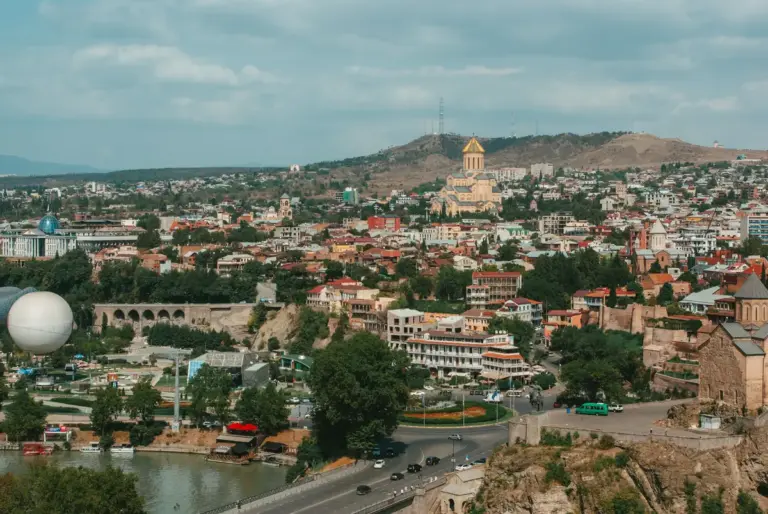
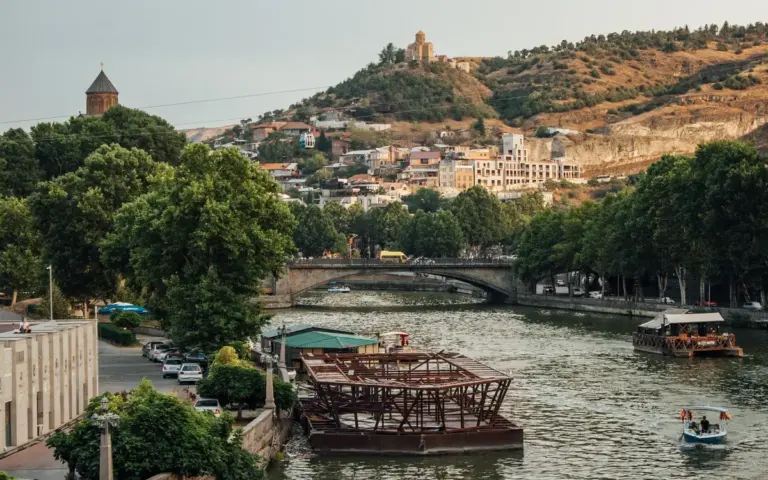
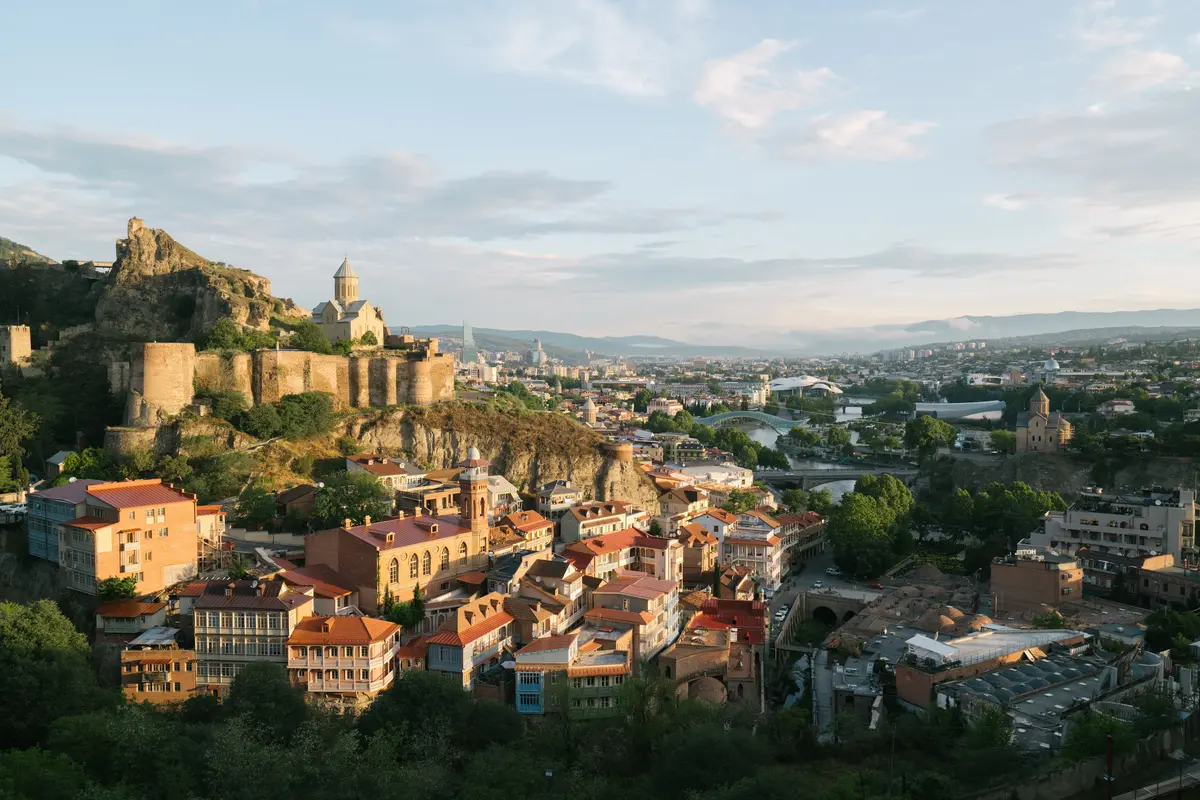
Take a taxi from the airport, roughly 25 minutes and about 40 to 50 GEL if booked through Bolt, and sleep. Then spend the afternoon on foot. Start in Abanotubani, the sulfur bath district, where domed brick roofs sit half-buried in the hillside and a private bath room runs 60 to 150 GEL an hour. Ride the cable car from Rike Park up to Narikala Fortress for the view over the whole crooked city. Walk down through Sololaki past carved wooden balconies and crumbling art nouveau stairwells.
For dinner, order khinkali, the fist-sized soup dumplings you eat by hand, holding the topknot and biting a small opening first. Add khachapuri, the cheese bread that comes in regional variations, including the Adjarian boat shape topped with a raw egg and butter. Both are best washed down with a bottle of saperavi.

Day 2: Tbilisi to Sighnaghi through the Kakheti wine country
Pick the car up mid-morning, once rush hour has thinned, and head east. The drive to Sighnaghi is 68 miles and takes about two hours fifteen with a stop, following the road across the Gombori foothills into Kakheti, the region that produces most of Georgia’s wine.
Stop at Bodbe Monastery, just before Sighnaghi. It holds the tomb of St. Nino, the woman credited with converting Georgia to Christianity in the fourth century, and its cypress-lined terrace looks straight out over the Alazani Valley to the Caucasus wall beyond.
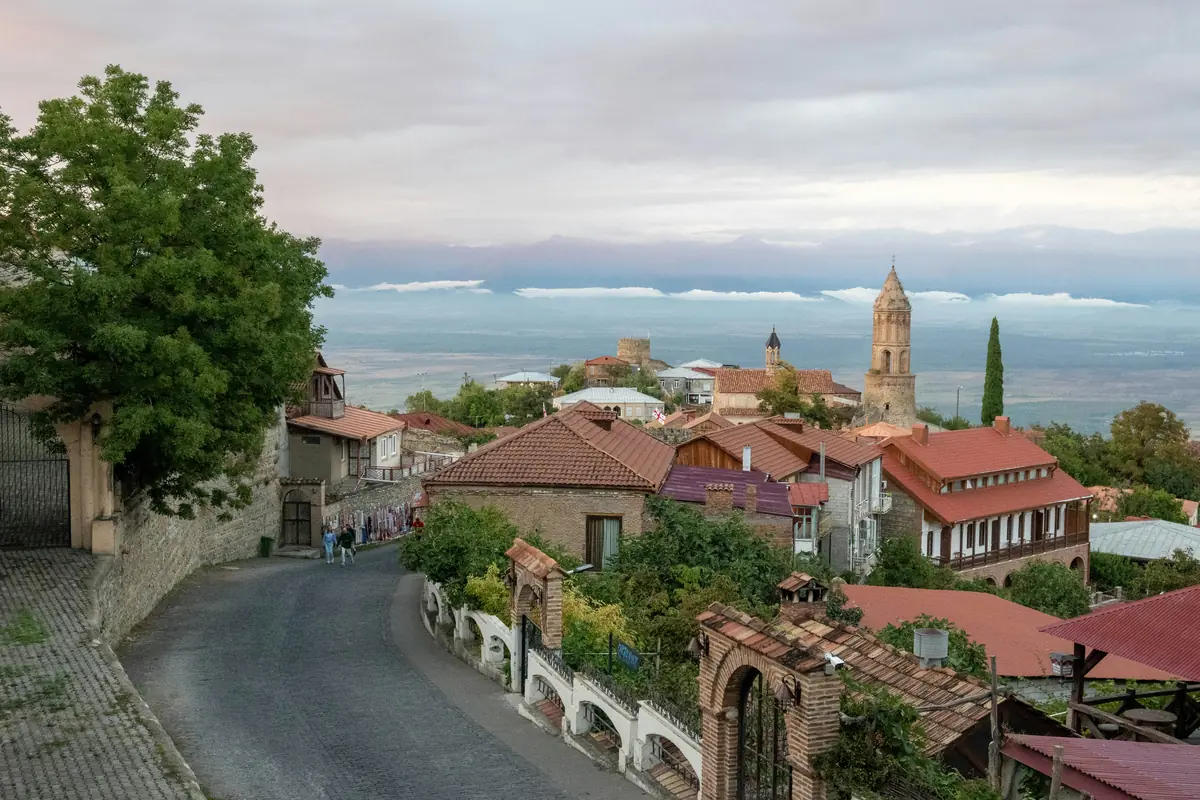
Sighnaghi itself is a small walled hill town of pastel houses and wrought-iron balconies, restored to a degree that borders on theme-park but redeemed entirely by its setting. Walk a section of the 18th-century town walls at sunset when the mountains go pink.
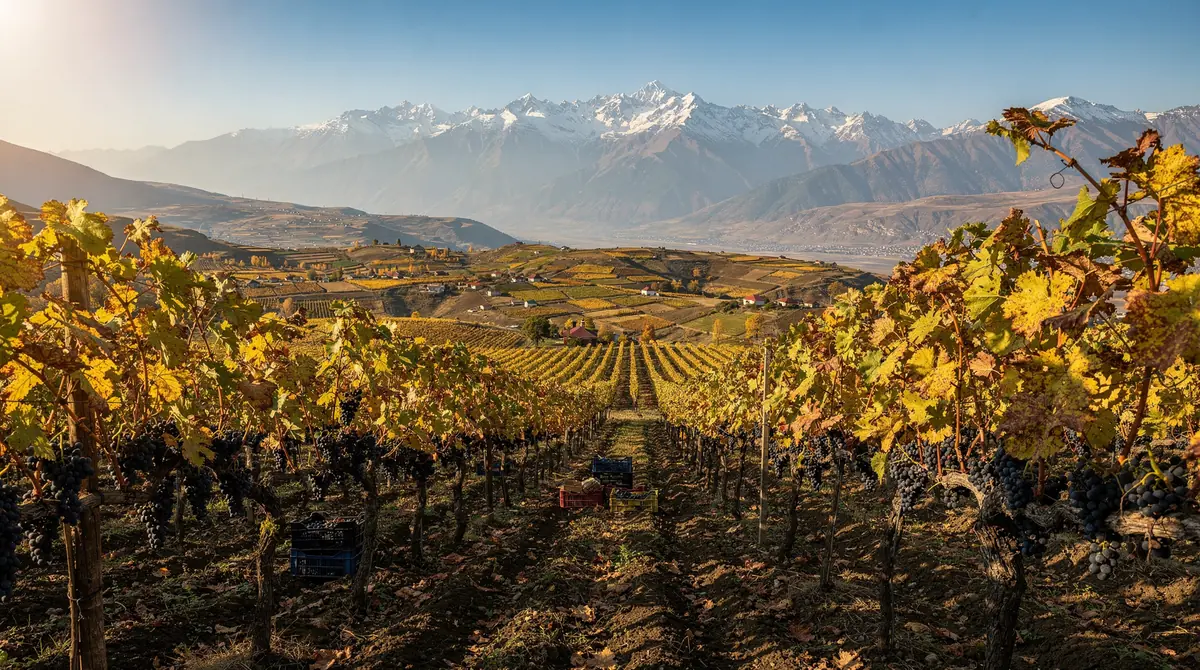
For wine, Pheasant’s Tears is the anchor. Founded by John Wurdeman, an American painter who moved to Georgia and became one of the country’s most influential natural winemakers, it pours qvevri wines made the way Georgians have made them for eight millennia, fermented in beeswax-lined clay vessels buried underground. The technique is UNESCO-recognized and produces amber wines that taste like nothing in a California tasting room.
Where to stay: Hotel Kabadoni in town for comfort, or Villa Kursa in the village of Anaga just outside for a quieter, more rural stay with valley views.
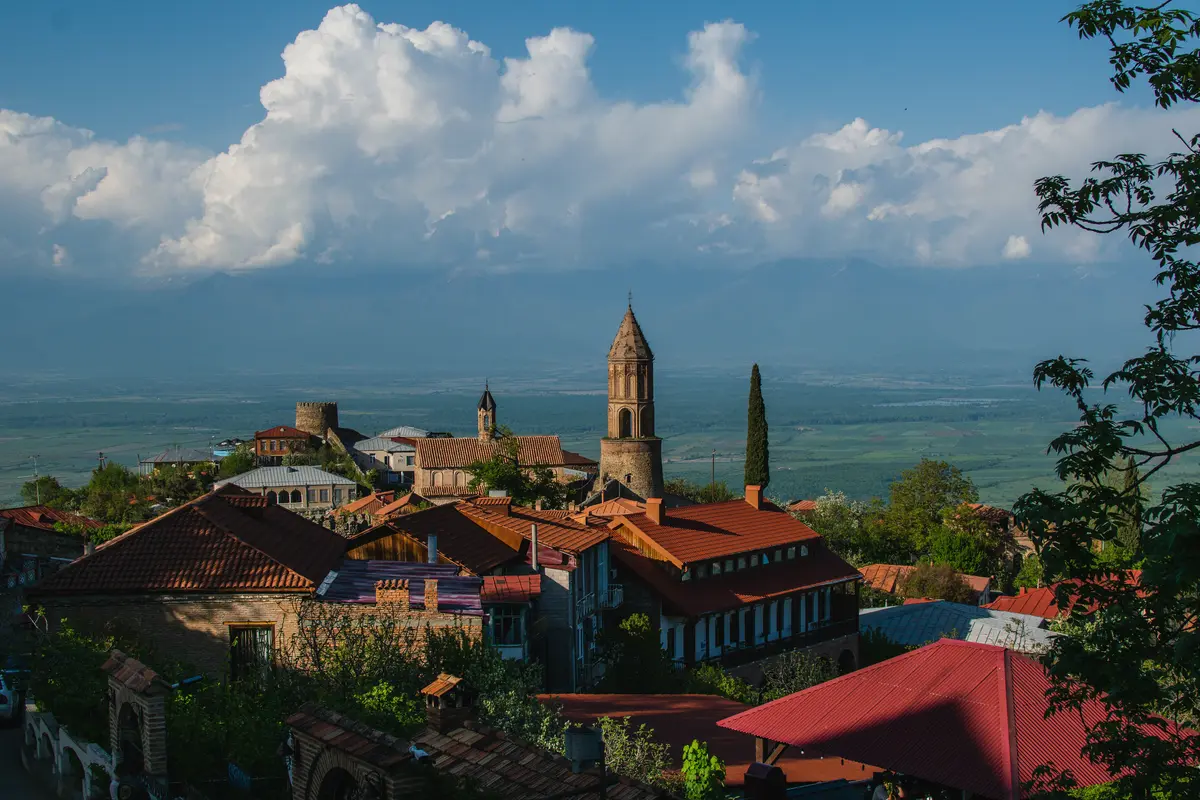
Day 3: Sighnaghi to Telavi, monasteries and qvevri cellars
Today is short driving and long tasting: 37 miles to Telavi, about an hour and a half with the stops below. This is also the day to think seriously about who is driving, because the zero-tolerance alcohol law is not compatible with a full winery day. Either designate a driver, spit at tastings, or hire a local driver for the day for around 150 to 250 GEL.
Head north through the vineyards toward Napareuli and Twins Wine Cellar, which has an attached museum explaining qvevri production and lets you see the buried vessels in situ. Continue to Alaverdi Monastery, an 11th-century cathedral rising out of flat farmland with the Caucasus directly behind it, one of the tallest historic churches in the country and one of the most photographed views in Georgia.
Finish at Tsinandali Estate near Telavi, the 19th-century home of the aristocratic poet Alexander Chavchavadze, with a European-style garden, a historic cellar of bottles going back to the 1800s, and a genuinely good tasting program.
Where to stay: the Radisson Collection at Tsinandali Estate for the upscale option, or one of Telavi’s smaller family-run hotels and guesthouses for a fraction of the price.
Day 4: Telavi to Stepantsminda on the Georgian Military Highway
This is the biggest driving day of the trip and one of the best drives on earth: 150 miles and a realistic five to five and a half hours, crossing the Gombori Pass out of Kakheti, skirting Tbilisi, then climbing the Georgian Military Highway into the high Caucasus.
Break it at Mtskheta, Georgia’s ancient capital and a UNESCO World Heritage site. Svetitskhoveli Cathedral sits in the middle of town, an enormous 11th-century structure that remains the spiritual center of Georgian Orthodoxy. Above it, on a bare hill at the confluence of the Mtkvari and Aragvi rivers, Jvari Monastery is smaller, older, and considerably more atmospheric.
From there the Military Highway proper begins. At mile 45 (72 km from Tbilisi) the Ananuri fortress complex sits directly on the turquoise Zhinvali reservoir, and it is worth a full 45 minutes: two churches, a defensive wall, and a water tower you can climb.
The road climbs steadily to Gudauri, the country’s main ski resort at mile 75 (120 km), then reaches Jvari Pass at 7,858 feet. Just before the pass, pull off at the Russia-Georgia Friendship Monument, a curved concrete arc set with a bright Soviet-era mosaic, cantilevered over a canyon that drops away in every direction. It is a strange, spectacular, complicated piece of history.
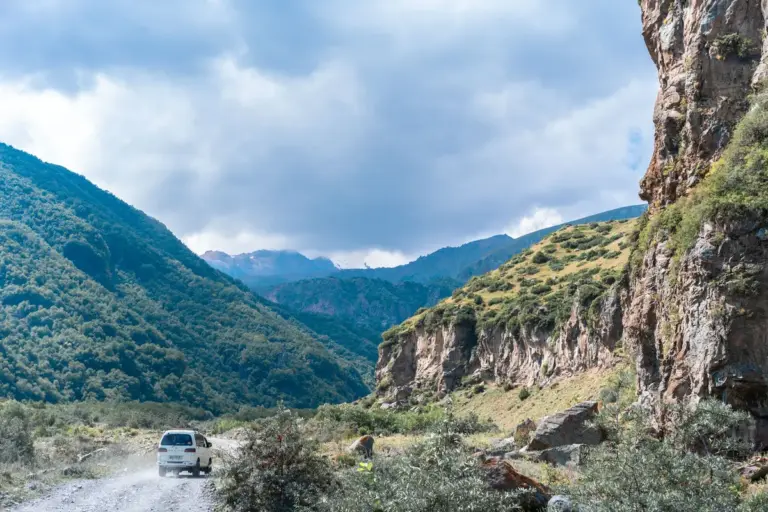
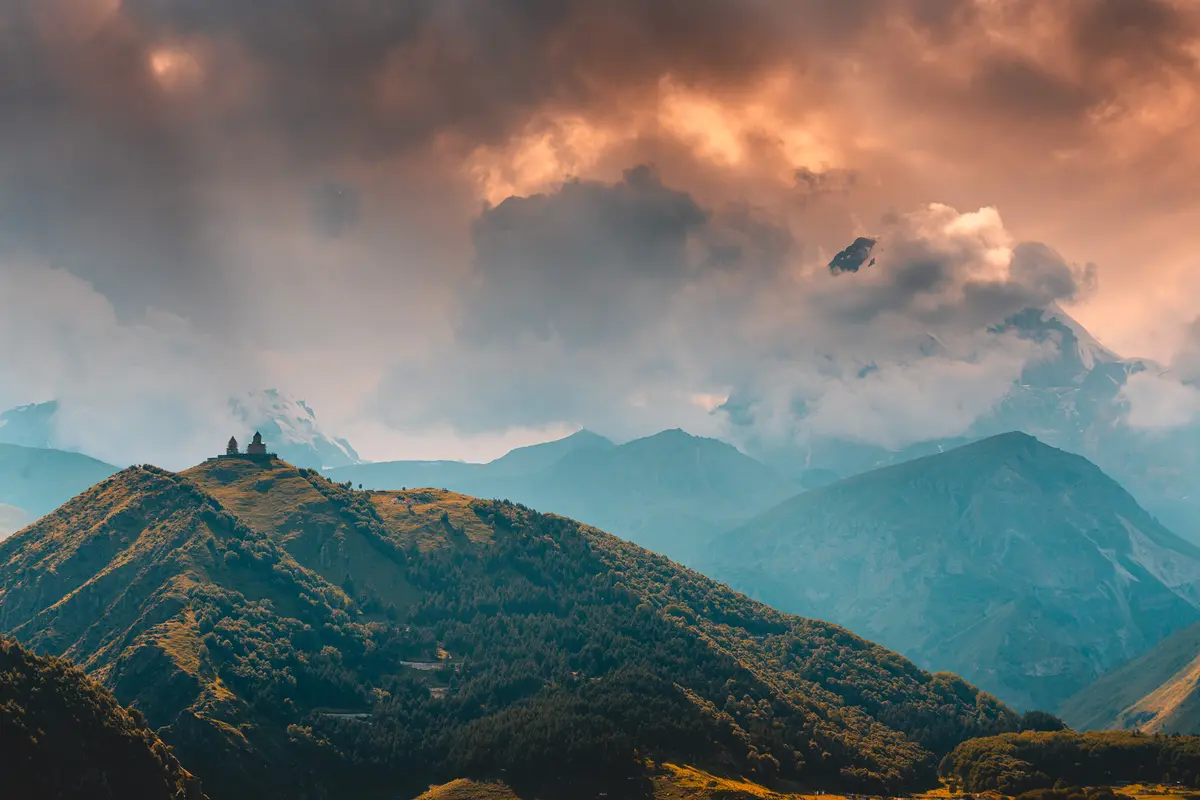
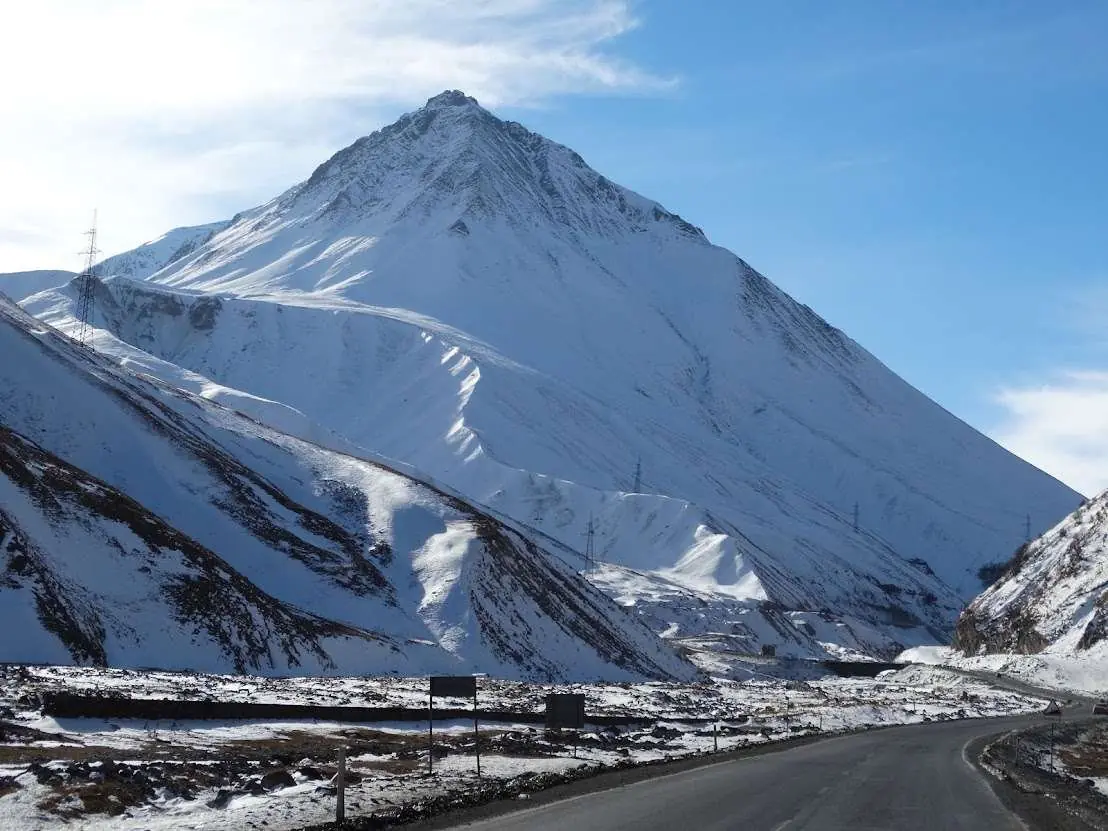
Descend into Stepantsminda, still commonly called Kazbegi, at the foot of Mount Kazbek. The full drive is sealed the entire way and requires no 4WD, though high clearance is welcome on the rough shoulders.
Where to stay: Rooms Hotel Kazbegi has the famous wall of glass facing Gergeti Trinity Church and the mountain behind it. Guest House Tamta is the warm, well-run, dramatically cheaper alternative with the same view from the terrace.
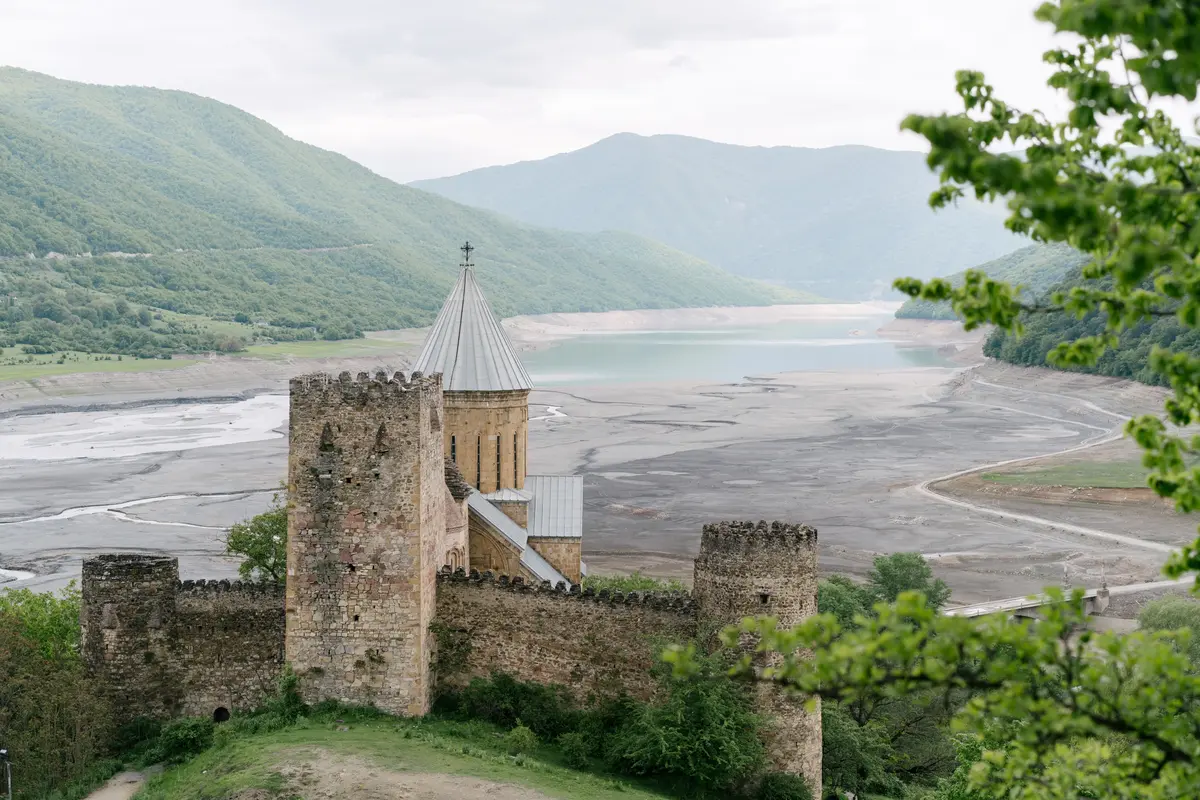
Day 5: Kazbegi, Gergeti Trinity Church, and the Juta valley
No long driving today. Gergeti Trinity Church is the reason most people come to Georgia, and getting up to it is the day’s main event.
The church sits at about 7,100 feet on a grassy shoulder below the Kazbek glacier. The final 4 miles from Stepantsminda are steep, rough, and off-limits under most rental agreements, so take one of the 4WD taxis waiting in the village square, around 60 to 80 GEL round trip for the vehicle, or hike it in about an hour and a half to two hours each way on a well-marked trail through the forest. The hike is genuinely worth it if the weather is clear.
In the afternoon, pick one of three add-ons. Juta is a tiny village at the head of a valley of jagged spires, reached on a rough road best suited to 4WD, with Fifth Season and Zeta Camping offering food and beds with a view of the Chaukhi massif. The Truso Valley runs west toward mineral springs and travertine terraces and requires checking current access rules given its proximity to the administrative boundary. Or simply drive north toward the Dariali Gorge and Gveleti Waterfall, a short and easy hike.
One caution on that northern road: it leads to the Verkhni Lars border crossing with Russia, where lines of freight trucks can stretch for miles and queues sometimes back up into the road. Do not attempt to approach the border itself.
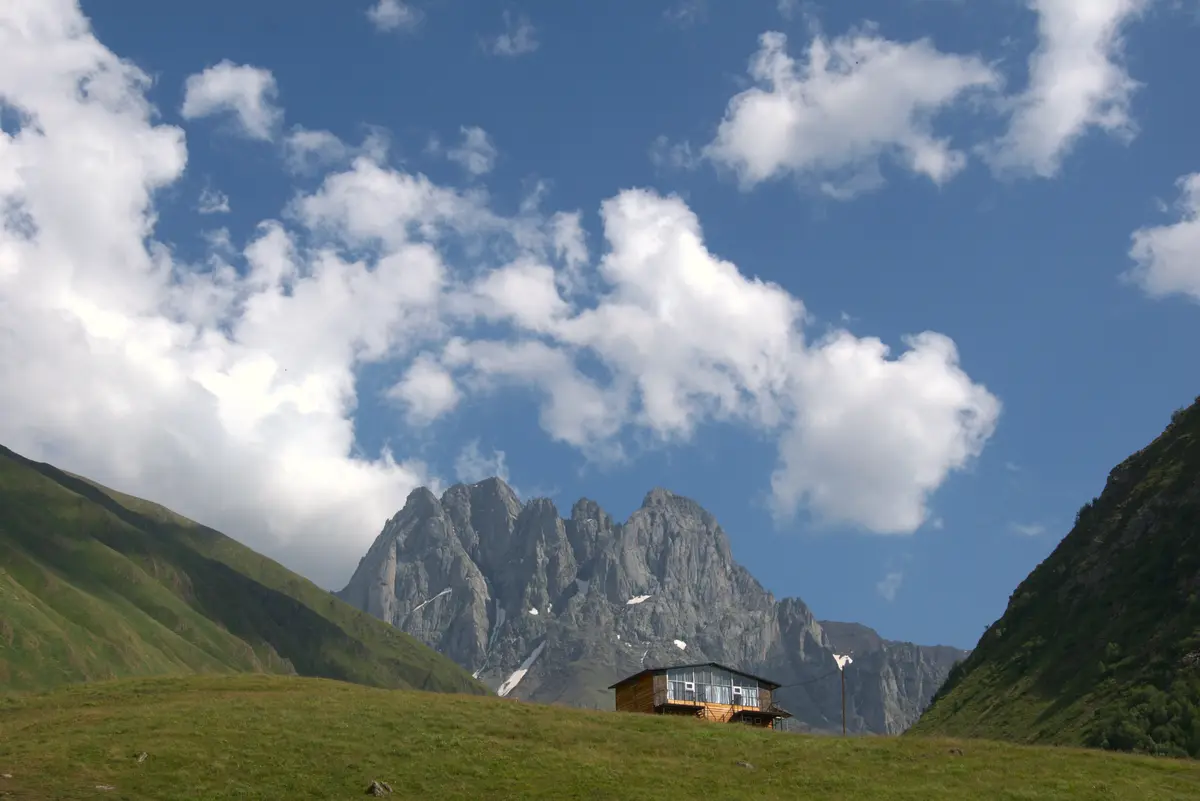
Day 6: Kazbegi to Borjomi via Gori and Uplistsikhe
Back down the Military Highway and west across the country: 155 miles, about four and a half hours of driving, with two substantial stops.
Uplistsikhe is a cave city carved directly into a sandstone bluff above the Mtkvari River, inhabited from roughly the first millennium BC and once a major stop on the Silk Road. You walk through rock-cut halls, a pagan temple later converted to a church, and streets worn into grooves by carts. It takes about an hour and a half and it is entirely different in character from Vardzia, which you will see tomorrow.
Nearby Gori is the birthplace of Joseph Stalin, and the Stalin Museum there is a genuinely strange experience: a largely unreconstructed Soviet-era shrine, complete with his armored railway carriage, that has only recently begun to acknowledge the scale of what he did. Skip it or don’t, but know what you are walking into.
Continue to Borjomi, a faded spa town in a wooded gorge famous nationwide for its mineral water. Walk through Borjomi Central Park, drink the warm sulfurous water straight from the spring pavilion, and ride the old cable car up the hillside.
Where to stay: Borjomi has a good range of small hotels and guesthouses, and you can also push another 30 minutes to Akhaltsikhe to shorten tomorrow.
Day 7: Borjomi to Vardzia, castles and a cave monastery
Sixty miles, about two hours of actual driving, three stops, one of them extraordinary.
Rabati Castle in Akhaltsikhe comes first: a heavily restored hilltop fortress complex that contains a mosque, a church, a synagogue site, and a madrasa within its walls, a physical record of how many cultures have governed this corner of the country. The restoration is aggressive, but the layered history is real.
Khertvisi Fortress sits at the junction of two rivers a bit further on, a lean stone tower on a rocky spur that takes fifteen minutes and rewards you with the classic Javakheti landscape photo.
Then Vardzia. Carved into a cliff face in the 12th century under Queen Tamar, it once held hundreds of rooms across thirteen levels, a monastic city built as a fortress against Mongol invasion, partially exposed by an earthquake in 1283. What remains is a honeycomb of tunnels, chapels, bell towers, and living quarters with the frescoed Church of the Dormition at its heart. Entry runs around 15 GEL and you should allow at least two hours. Vardzia is about 140 miles from Tbilisi, which is exactly why doing it as a day trip from the capital is a mistake and why it belongs on a road trip.
Where to stay: guesthouses in Aspindza or the small hotels directly opposite the Vardzia cliffs, several of which have terraces facing the caves.
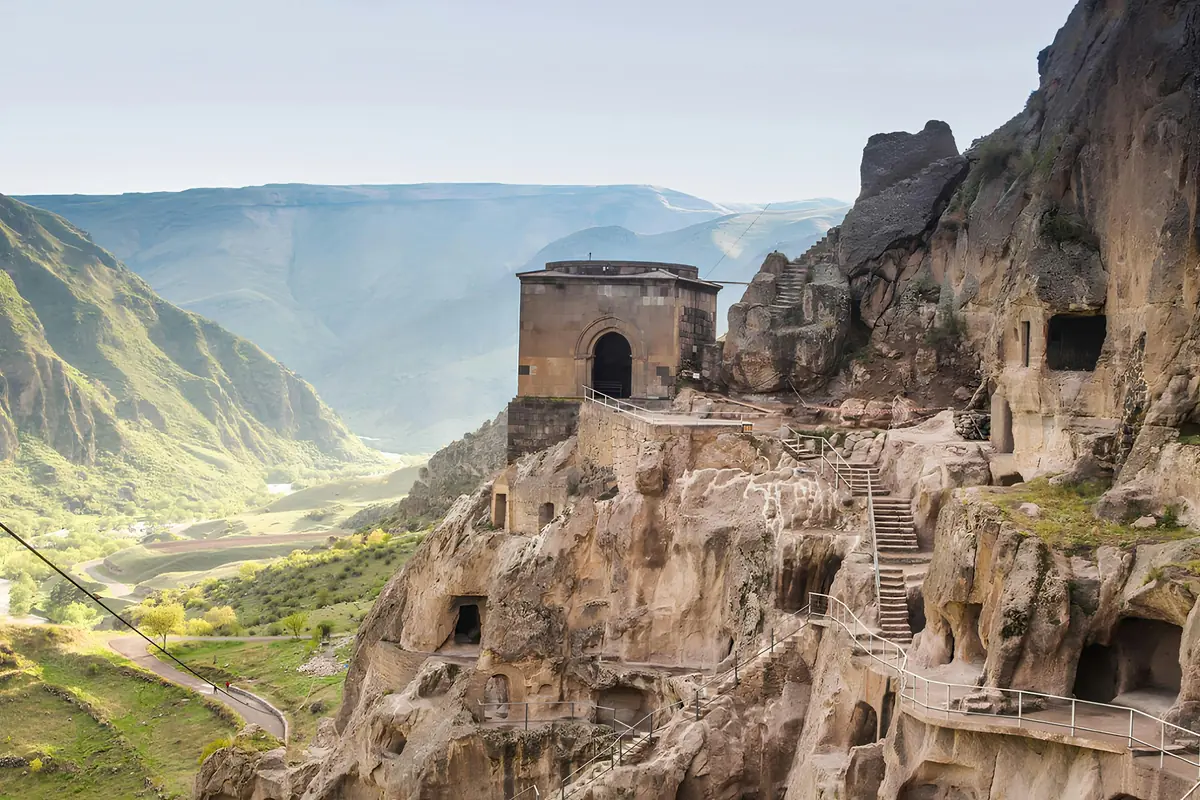
Day 8: Vardzia to Kutaisi and the monasteries of Imereti
A transit day with a strong finish: 150 miles, about four and a quarter hours, backtracking through Akhaltsikhe and Borjomi to Khashuri, then west on the E60 expressway into Imereti.
Arrive in Kutaisi by mid-afternoon and go straight to Gelati Monastery in the hills above town. Founded in 1106 by King David the Builder, it was a medieval academy as much as a monastery, and its main church holds some of the finest mosaics and frescoes in the Caucasus. It is UNESCO-listed and it is the single best reason to stop in Kutaisi. Nearby Motsameta perches on a cliff above a river bend and takes twenty minutes.
Kutaisi itself is a working city rather than a tourist town, with a green central square, a covered market worth an hour, and dramatically cheaper food and lodging than Tbilisi.
Day 9: Canyons and caves from a Kutaisi base
Keep the same hotel and spend the day on short drives. This is western Georgia’s karst country, and there are three excellent options within an hour.
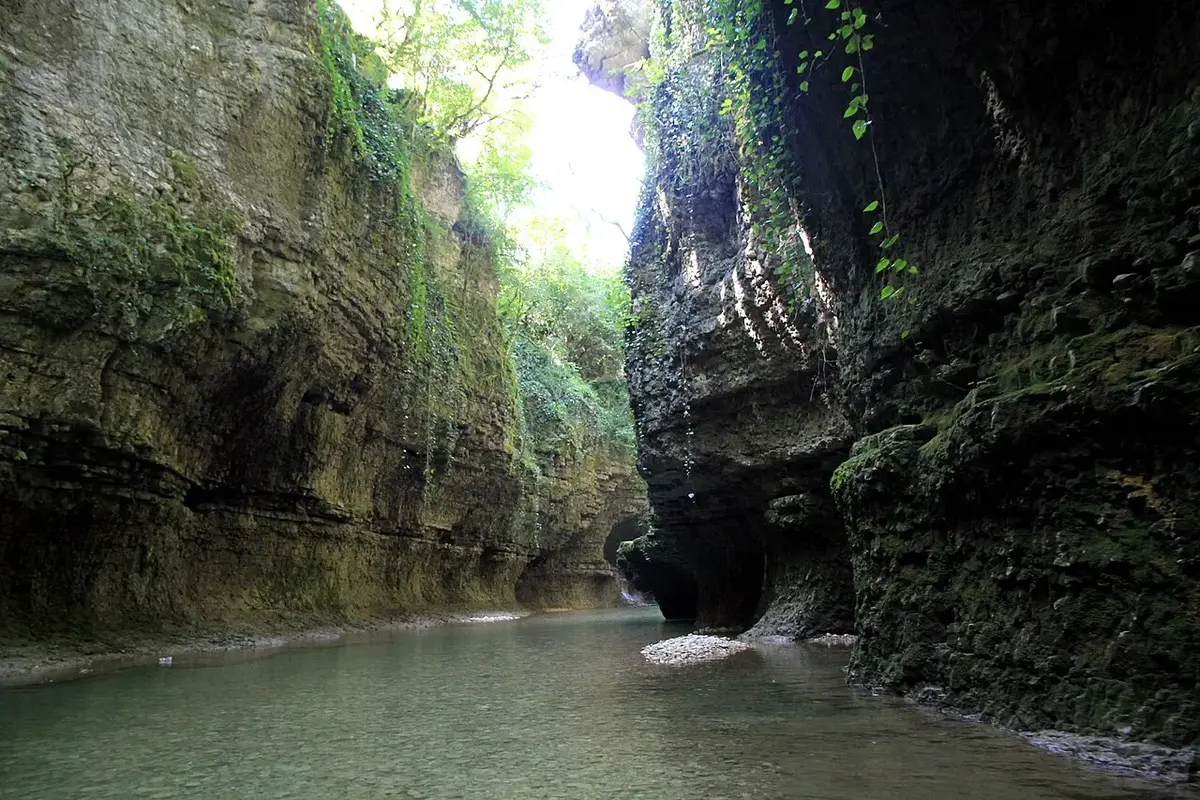
Martvili Canyon is a narrow limestone gorge of vivid blue-green water, walkable on a boardwalk with an optional short boat ride, about 45 minutes northwest. Okatse Canyon takes a different approach: a suspended metal walkway bolted to the cliff face, 45 minutes north. Prometheus Cave near Tskaltubo is a large, well-lit show cave with stalactite chambers and an underground boat section.
If you prefer the strange to the scenic, Tskaltubo itself is a Soviet spa town whose enormous bathhouses and sanatoriums have been left to decay, and it is one of the most photographed abandoned complexes in the region. Check current access rules, as parts are being redeveloped.
Day 10: Kutaisi to Tbilisi with a stop at Katskhi Pillar
The E60 runs 143 miles back to Tbilisi in about three and three-quarter hours, but leave early and take the detour to Katskhi Pillar.
It is a 130-foot natural limestone monolith rising out of a green valley with a tiny church on top, which was occupied for two decades by a monk who lived alone on the summit and climbed down by ladder. Visitors cannot ascend, but the view from the base is worth the stop, and the nearby mining town of Chiatura is a genuinely eerie detour, threaded with Soviet-era cable cars strung across the gorge.
Return the car at the airport or at the agency’s Tbilisi office, and spend your last evening in the city you skipped through on Day 1: Fabrika in Chugureti for the courtyard bar scene, Rustaveli Avenue for the grand boulevard, and one last supra dinner with too many toasts.
Shorter and longer versions of this route
The ten-day loop is modular. Every version below uses the same roads and the same base logic, so you can cut or extend without redesigning the trip.
| Version | Route | Driving | Best for |
|---|---|---|---|
| 5 days | Tbilisi, Kakheti, Kazbegi, Tbilisi | About 350 mi / 560 km | First-timers, add-on to a longer Europe trip |
| 7 days | Adds Mtskheta, Gori, Uplistsikhe, Borjomi, Vardzia | About 550 mi / 885 km | The best value-per-day version |
| 10 days | The flagship loop above | About 800 mi / 1,290 km | The complete picture of the country |
| 14 days | Adds Svaneti and the Black Sea coast | About 1,200 mi / 1,930 km | Mountains, towers, and beach time |
| Winter | Tbilisi, Kakheti, Gudauri, Kazbegi | About 300 mi / 480 km | Skiing and snow-covered monasteries |
The 5-day Georgia road trip
Day 1 Tbilisi on foot. Day 2 drive to Sighnaghi and the Kakheti wineries. Day 3 Kakheti to Stepantsminda via Mtskheta and Ananuri. Day 4 Gergeti Trinity Church and the Kazbegi valleys. Day 5 back down the Military Highway to Tbilisi.
This is the highest-impact short trip in the country. You get the wine region, the ancient capital, and the single most dramatic mountain road, with only one long driving day. If you only have five days, do not try to add Svaneti or the coast.
The 7-day Georgia road trip
Take the five-day plan and, instead of returning straight to Tbilisi from Kazbegi, drive west on Day 5 to Gori and Uplistsikhe, overnight in Borjomi, and use Day 6 for Rabati Castle and Vardzia before returning to Tbilisi on Day 7.
Seven days is arguably the sweet spot for value. You add a completely different landscape, southern Georgia’s dry canyon country, and two of the country’s three great cave sites, for one extra tank of gas.
The 14-day Georgia road trip
Run the full ten-day loop, then instead of returning to Tbilisi on Day 10, continue west from Kutaisi to Zugdidi and up into Svaneti for three nights, come back down to the Black Sea for two nights in Batumi, and return to Tbilisi on the E60.
This is the version that includes everything: the medieval defensive towers of Ushguli, the Enguri Dam, the Zagari Pass loop, and the palm-lined, faintly absurd casino skyline of Batumi. Budget the extra time honestly, because Svaneti deserves three full days and the drive up is longer than it looks.
Winter version
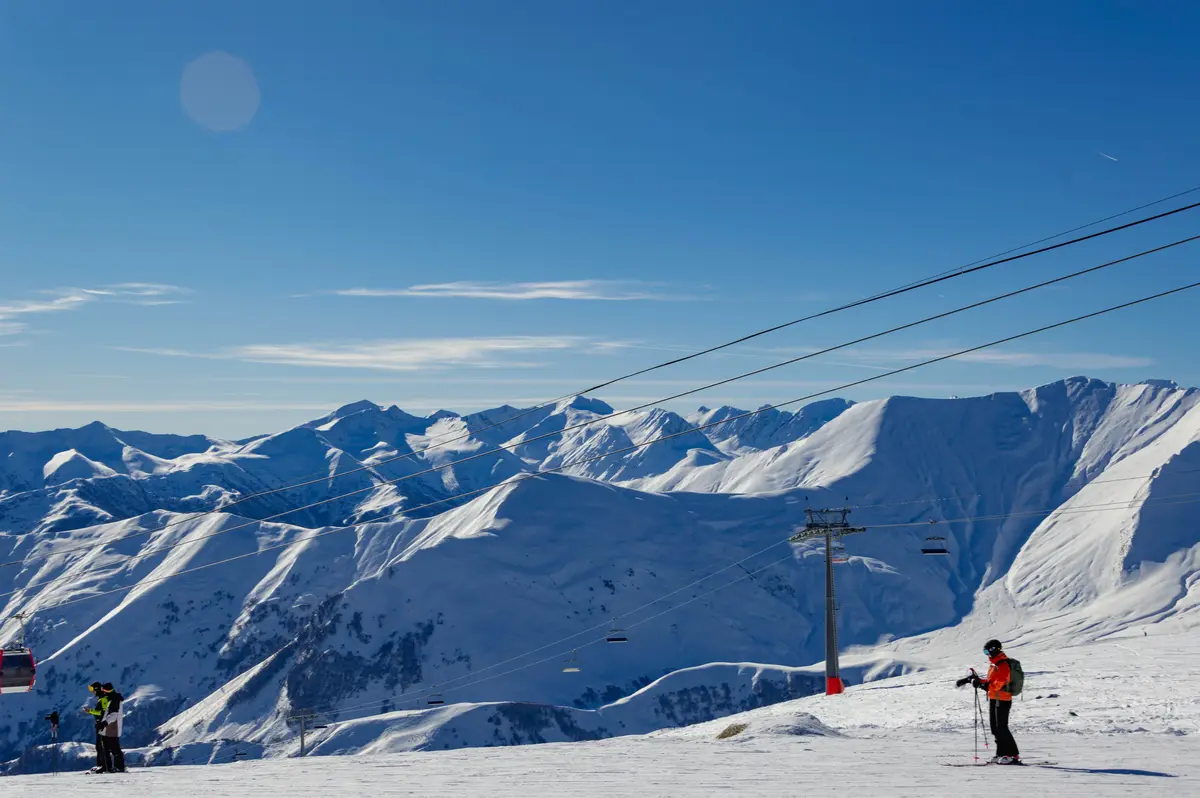
In winter, the itinerary contracts to the eastern half of the country. Tbilisi and Kakheti stay entirely accessible. Gudauri becomes the destination rather than a photo stop, with the country’s best skiing at Caucasus prices and a season that typically runs December into April. Stepantsminda is reachable most days but the Gudauri-to-Stepantsminda section closes for avalanche control with little notice, sometimes for hours and occasionally for days, so build in slack and check conditions daily.
Skip Svaneti self-drive, Tusheti entirely, and the Zagari Pass. Rent a car with winter tires and confirm it in writing. Vardzia and Borjomi remain open and are beautiful under snow.
The classic Tbilisi to Kakheti to Kazbegi loop
If you cut everything else, keep this. The eastern loop combines the country’s wine heartland with its most spectacular mountain road, and it can be driven comfortably in four to five days.
The Kakheti half is about food and wine. Sighnaghi for the setting, Telavi as a practical base, Bodbe and Alaverdi for the monasteries, and a spread of cellars from tiny family operations pouring out of the qvevri in their yard to polished estates like Tsinandali. Georgian wine is not a novelty. This is where wine was invented, roughly eight thousand years ago, and the qvevri method is on the UNESCO list of intangible cultural heritage. Come during Rtveli, the harvest in late September and early October, and you will likely be handed a bucket and pulled into someone’s family picking.
The Kazbegi half is about elevation. The Georgian Military Highway covers 93 miles from Tbilisi to Stepantsminda, takes three to three and a half hours without stops, and takes a full day if you do it properly. The sequence of stops is fixed by geography: Mtskheta, Zhinvali reservoir, Ananuri, Gudauri, the Russia-Georgia Friendship Monument, Jvari Pass, then the drop into Stepantsminda with Gergeti Trinity Church visible on its shoulder above the town.
The road is fully sealed and needs no special vehicle. What it needs is time and daylight. Trucks heading for the Russian border crawl on the grades, weather changes fast above Gudauri, and the section between Gudauri and Stepantsminda is the part that closes in avalanche season and is prone to rockfall in spring.
The western route: Svaneti and the Black Sea coast
Svaneti is the most rewarding region in Georgia and the one that has changed most in the last few years, because the road situation improved dramatically.
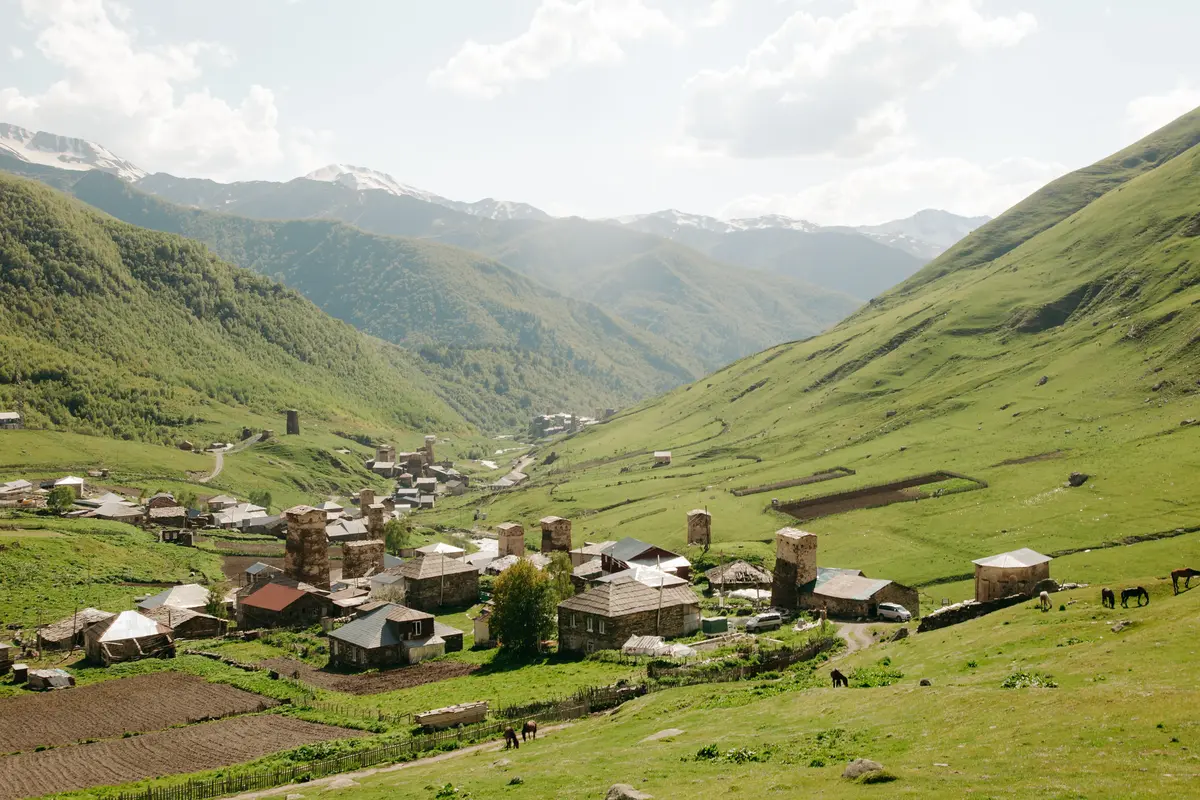
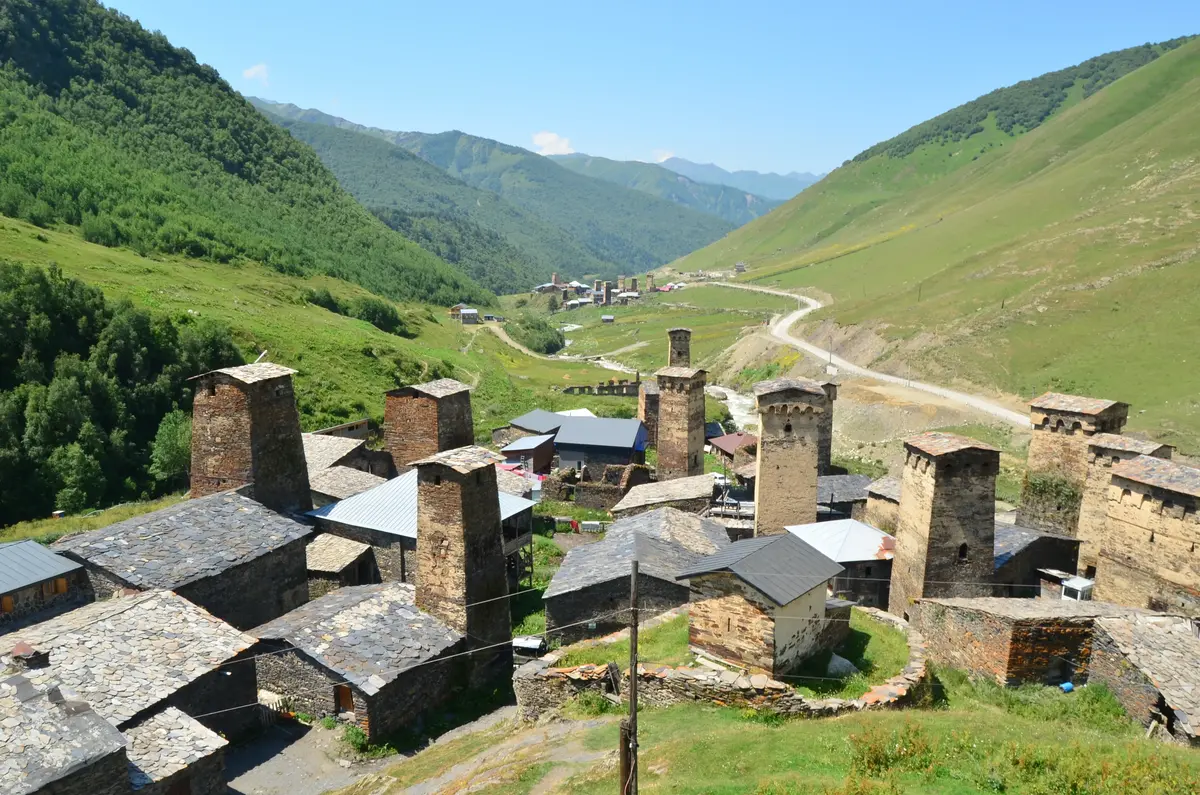
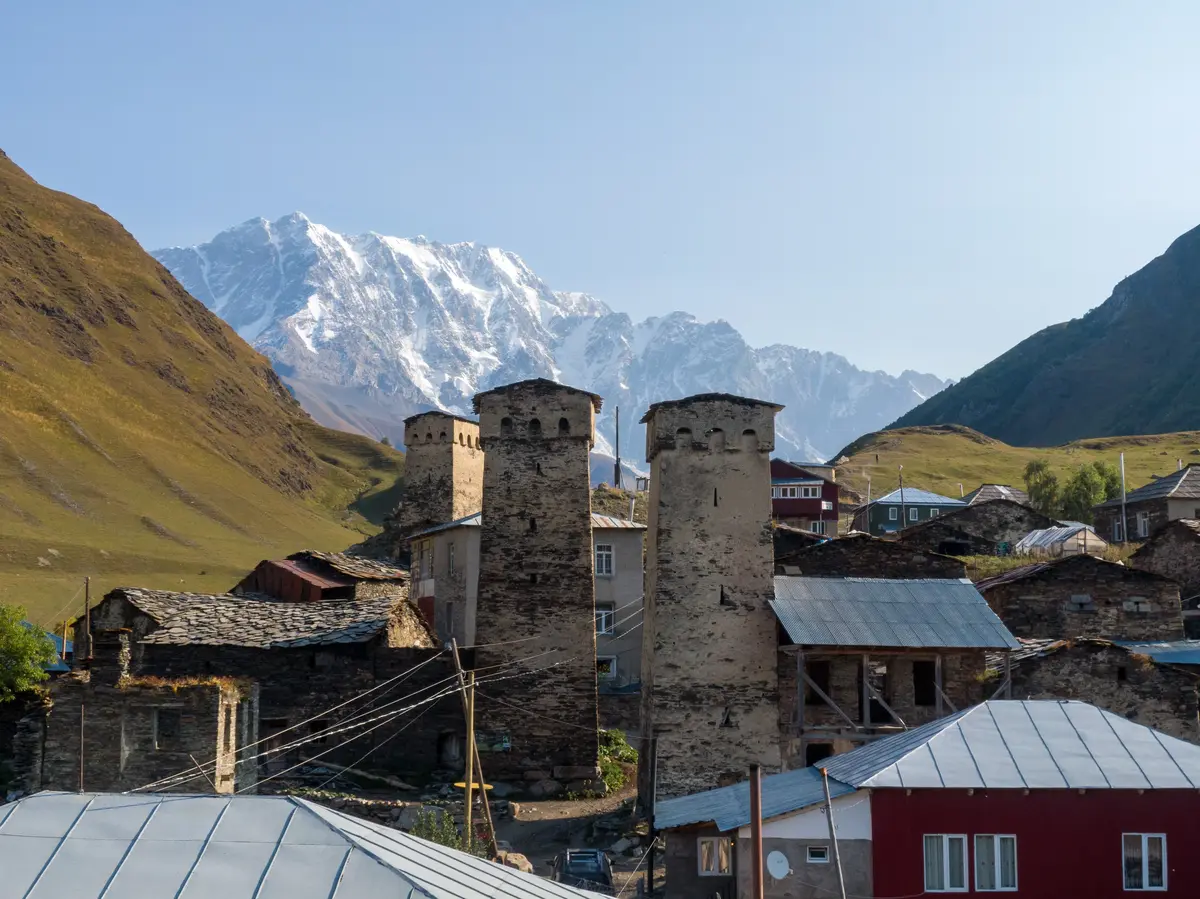
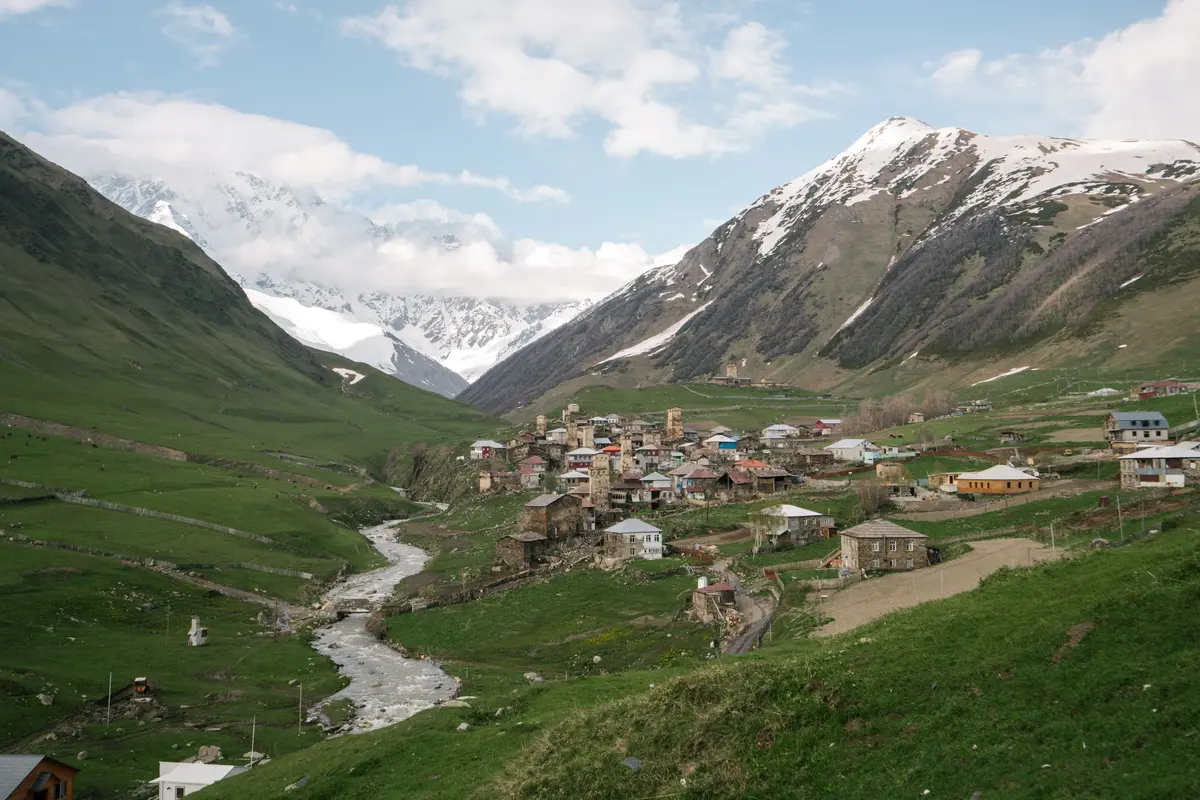
Upper Svaneti is a high valley system in the northwest ringed by 16,000-foot peaks, historically so isolated that its villages developed their own language, their own architecture, and a distinctive defensive tower on nearly every family home. Ushguli, a cluster of four hamlets at the head of the valley, claims to be among the highest continuously inhabited settlements in Europe, and its towers against the face of Mount Shkhara are the image most people carry away from Georgia.
Getting there used to be the hard part. The Zugdidi to Mestia road, 83 miles and about four hours, has been paved and open year-round for some time. The bigger change is that the Mestia to Ushguli road and the onward route to Lentekhi were concreted end to end, turning a three-to-four-hour 4WD ordeal into a 60-to-90-minute drive that a standard crossover handles fine. The new Zagari Pass at 8,606 feet now makes a full clockwise loop possible in summer.
Two warnings. First, some rental contracts still ban the Mestia-Ushguli and Lentekhi roads even though the pavement is new. Read the agreement and get written permission if you need it, because driving a prohibited road voids your insurance. Second, fuel up in Zugdidi and again in Mestia. There is no reliable gas between Ushguli and Lentekhi, and cell signal drops in the upper valley.
On the way, stop at the Enguri Dam, one of the tallest arch dams in the world, and note that the road past it runs toward Abkhazia, a Russian-occupied region that must not be entered.
From Svaneti, drop back to Zugdidi and run south along the coast to Batumi, Georgia’s Black Sea resort city: a strange, entertaining skyline of casinos and experimental towers, a long pebble beach, a genuinely excellent botanical garden north of town, and the best Adjarian khachapuri in the country, which is where the dish comes from. From Batumi, the coastal highway and E60 return you to Tbilisi in about five and a half hours, or you can take the train and skip the drive.
For the adventurous: Tusheti and the Abano Pass
Tusheti is the most remote inhabited region in Georgia, and reaching it means driving a road that regularly appears on lists of the most dangerous in the world. Do not attempt it in a rental car. Hire a local driver.
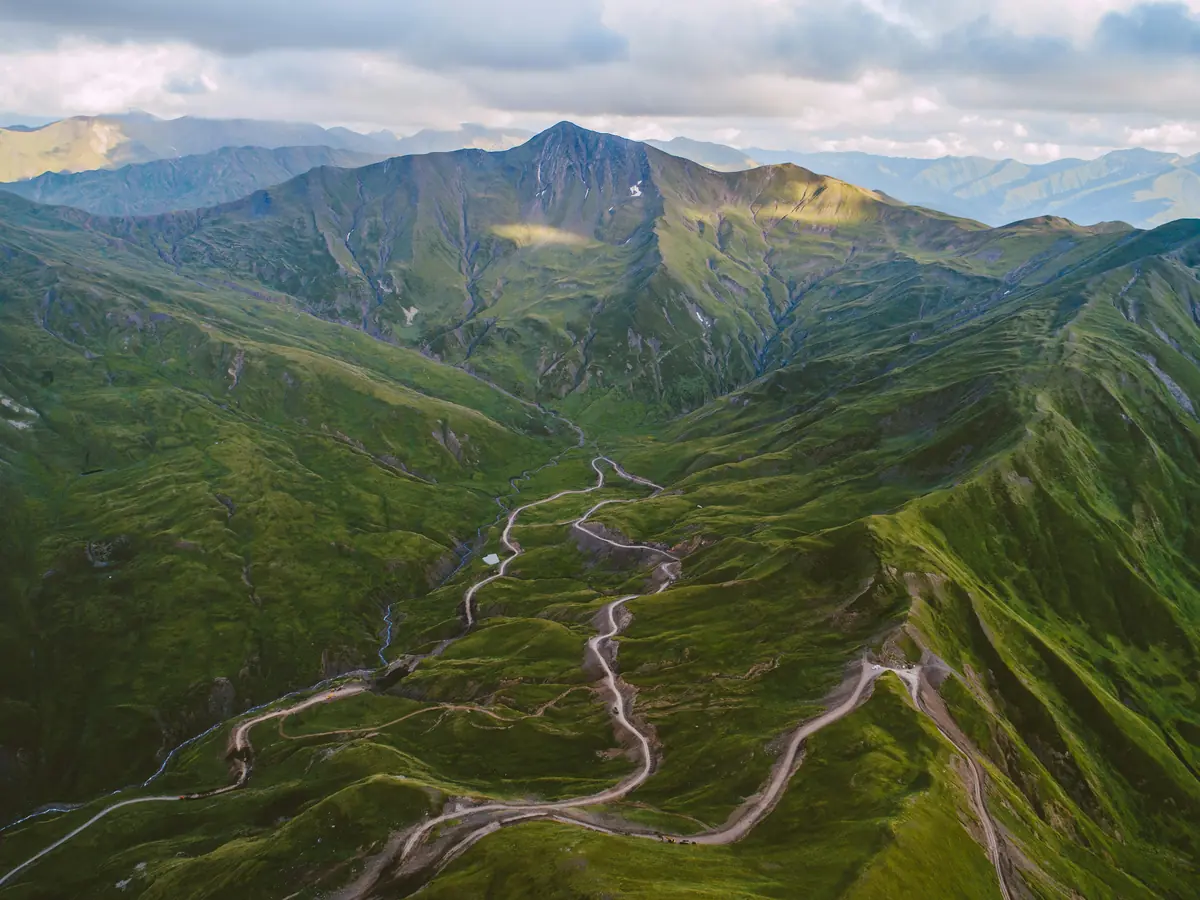
The only land route in runs roughly 43 miles from Pshaveli or Alvani in Kakheti to Omalo, climbing unpaved switchbacks to the Abano Pass at about 9,300 feet. There are no guardrails, the track narrows to a single vehicle width with a vertical drop on one side, and passing requires one vehicle to reverse. Sections wash out. Weather at the summit turns without warning.
The season is short: roughly mid-June to early October, and both ends shift year to year with snowfall. Outside that window the pass is closed and the villages up top are largely empty.
A local driver with an appropriate 4WD costs around 400 to 600 GEL one way per vehicle, which splits reasonably among four people. They drive it weekly, they know where the washouts are, and they know when to turn around. Every rental agreement in the country prohibits this road, and your insurance is void the moment you start up it.
What you get for the effort: slate-roofed stone villages, shepherd culture that has continued largely uninterrupted for centuries, some of the best multi-day trekking in the Caucasus, and a genuine sense of remoteness that is increasingly hard to find. There is no fuel in Tusheti and limited electricity in the villages. Bring cash.
How much a Georgia road trip costs
Georgia is excellent value but no longer dirt cheap. A mid-range American traveler should budget $50 to $125 per person per day on the ground, excluding international flights. Two people sharing a rental car and guesthouse rooms will land near the low end of that.
| Item | Typical cost |
|---|---|
| Rental car, local agency, compact or crossover | $17 to $50 per day |
| Rental car, international brand SUV | $60 to $90 per day |
| One-way drop fee (Tbilisi to Kutaisi or Batumi) | $30 to $60 |
| Gasoline, 95 octane | About $5.25 per gallon |
| Full tank, compact car | $50 to $60 |
| Guesthouse double room | $15 to $25 per night |
| Mid-range hotel double | $45 to $90 per night |
| Home-cooked guesthouse dinner | 15 to 25 GEL ($6 to $9) per person |
| Restaurant dinner for two with wine | $20 to $35 |
| Winery tasting | 20 to 50 GEL ($7 to $19) |
| Bottle of good Georgian wine at a cellar | $8 to $20 |
| Vardzia entry | 15 GEL (about $6) |
| 4WD taxi to Gergeti Trinity Church | 60 to 80 GEL round trip per vehicle |
| Private driver, Tbilisi to Kazbegi (GoTrip style) | $68 to $80 for the car |
| Marshrutka, Tbilisi to Kazbegi | 10 to 15 GEL (about $4 to $6) |
| Local 4WD driver to Tusheti, one way | 400 to 600 GEL ($150 to $225) per vehicle |
| Tolls | None anywhere in Georgia |
Real-world math: a couple driving the ten-day loop in a local-agency compact might spend $250 to $400 on the car, $120 to $150 on fuel, $200 to $250 on lodging, and $250 to $350 on food, wine, and entries. That is roughly $850 to $1,150 total for two people for ten days on the ground.
Prices move. Fuel in particular has been volatile and rose sharply recently, and the lari-dollar rate drifts. Treat every number above as a range to plan around rather than a quote.
Self-drive, private driver, or marshrutka?
You do not have to pick one for the whole trip. The smartest travelers mix all three.
| Leg or situation | Best option | Why |
|---|---|---|
| Tbilisi city | No car at all | Traffic and parking are miserable; use Bolt |
| Tbilisi to Kakheti wineries | Private driver | Tastings plus a zero-tolerance alcohol law |
| Georgian Military Highway to Kazbegi | Self-drive | Sealed road, and stopping when you want is the whole point |
| Kazbegi day trips | Local 4WD taxi | Rental contracts prohibit the rough spurs |
| Kutaisi and Imereti | Self-drive | Short hops, easy roads, scattered sites |
| Mestia and Ushguli | Self-drive if permitted | Now paved; verify your contract first |
| Tusheti | Local driver only | Non-negotiable |
| Tbilisi to Batumi one-way | Train or self-drive | The train is fast, cheap, and skips a five-hour drive |
A private driver booked through a fixed-fare service costs roughly $68 to $80 for a Tbilisi-to-Kazbegi run with stops, versus about $4 to $6 for the same distance by marshrutka and something in between once you factor a rental day plus fuel. For a group of three or four, the driver option is close to the price of driving yourself and removes every stressful part of the day.
Safety, borders, and the things worth taking seriously
Georgia is a safe country for travelers by almost any measure. Violent crime against tourists is rare, cities feel comfortable at night, and Georgian hospitality toward visitors is not a marketing line. The real risks are specific and mostly involve roads and geography.
Traffic is the number one danger. Take it more seriously than you would at home. Avoid night driving on mountain roads entirely.
Occupied territories are the second issue and the one that requires actual planning. South Ossetia and Abkhazia are Russian-occupied regions that the Georgian government does not control. Entering either from Georgia proper is illegal under Georgian law and can result in detention. There is no tourist reason to go near them. The practical trap is navigation: mapping apps have been known to plot routes through South Ossetia, particularly on north-facing routes from Gori. Look at your route line before you drive it, and if it heads north into the mountains between Gori and Kutaisi, reroute.
The Russian border crossing at Verkhni Lars, north of Stepantsminda, generates enormous freight truck queues that occasionally back up onto the Military Highway. Do not drive toward it out of curiosity.
Altitude is worth a mention. Jvari Pass sits at 7,858 feet and the Abano Pass at around 9,300, and travelers coming from sea level occasionally feel it. Drink water, do not plan a hard hike the same day you cross a high pass, and give yourself a night at elevation before pushing higher.
Check the US State Department’s Georgia travel advisory before you book, both for the country generally and specifically for its designations covering the occupied regions. Save 112 for emergencies and the Roads Department line at +995 322 31 30 76 for pass conditions.
Final thoughts before you book
The country of Georgia rewards drivers more than almost anywhere else in this part of the world, because the distances are short, the roads are better than the reputation suggests, and the density of things worth stopping for is extraordinary. Ten days gets you wine country, an ancient capital, a genuinely world-class mountain road, two cave cities, and a Black Sea coast if you stretch it.
Get the boring parts right and the rest takes care of itself. Buy the insurance policy that satisfies the 30,000 GEL requirement and save it to your phone. Spend $20 on an IDP from AAA or AATA. Read the rental contract’s road restrictions before you sign. Carry cash for fuel and guesthouses. Add 30 percent to every drive time your navigation app gives you, and look at the route line before you follow it.
Then go slowly. The best day of most Georgia road trips is the one that got derailed by a guesthouse host who insisted on opening a bottle at eleven in the morning, or a village monastery that was not on any list. Leave room for that.
Prices, exchange rates, road and pass conditions, flight routings, and entry requirements all change. Verify the volatile items, especially the insurance rule, fuel costs, and mountain pass status, close to your departure date.