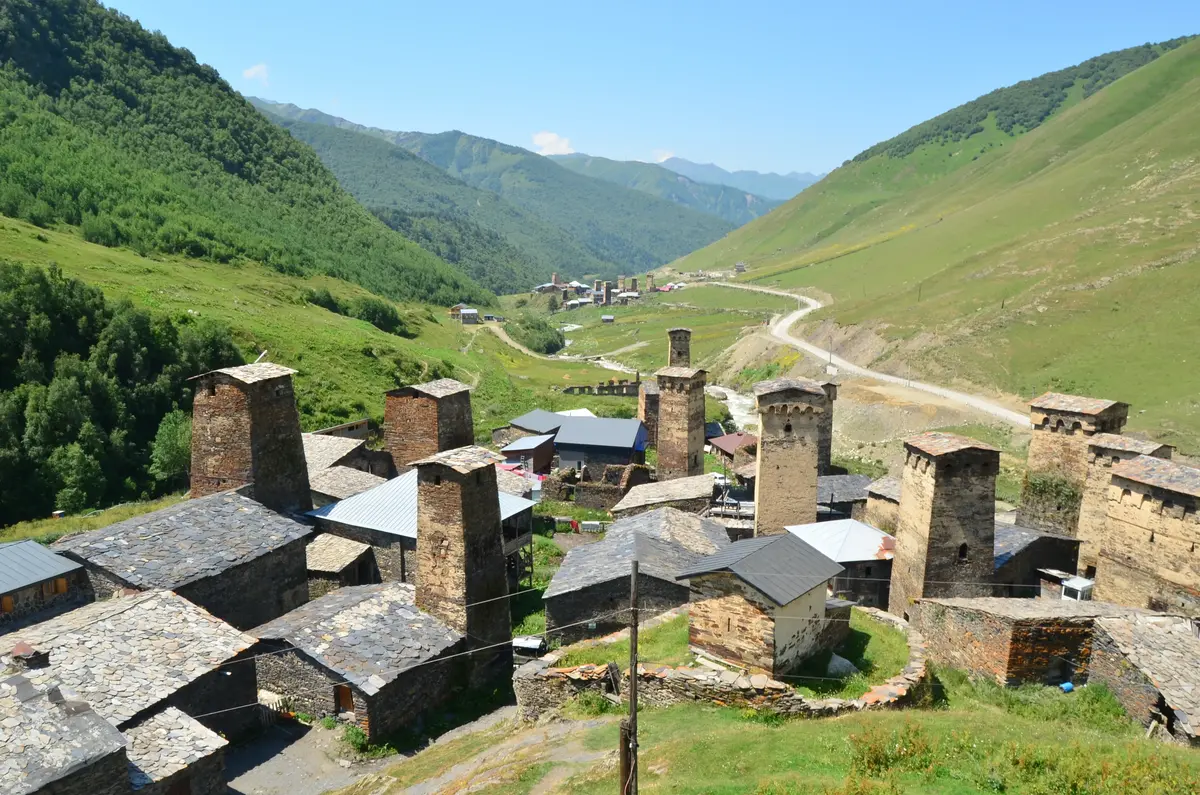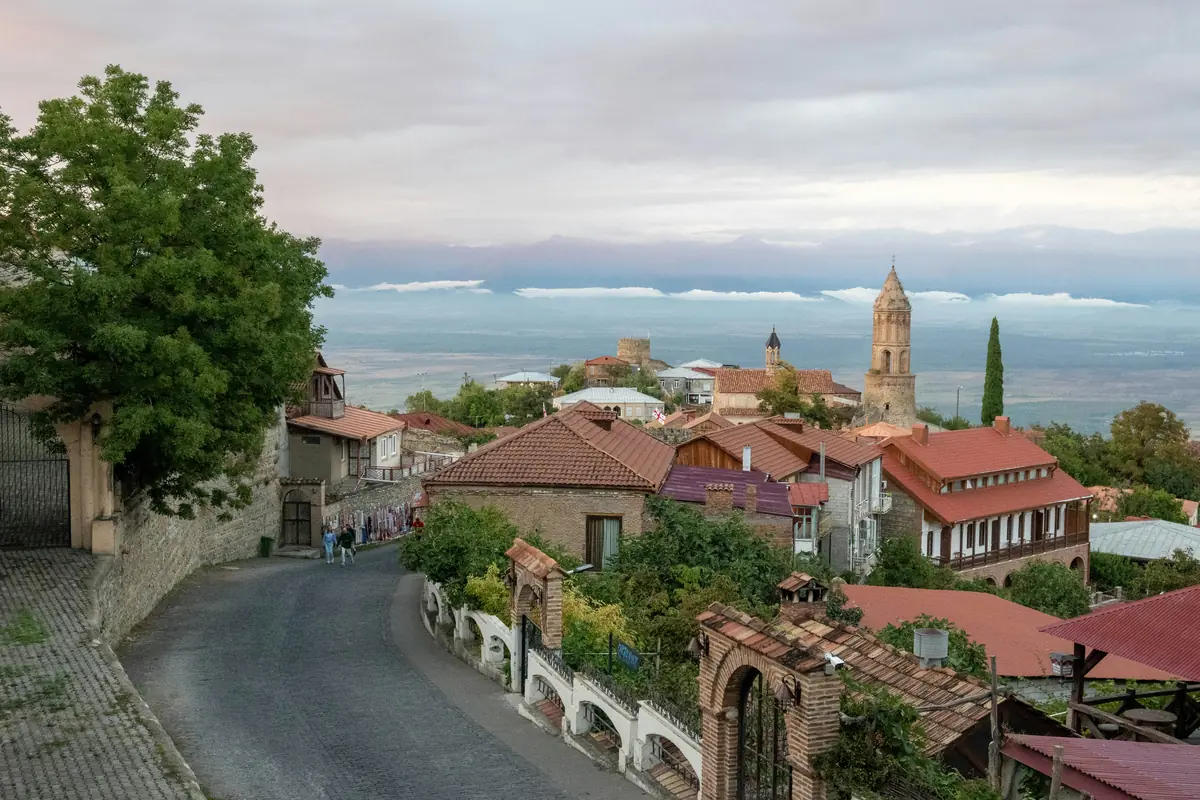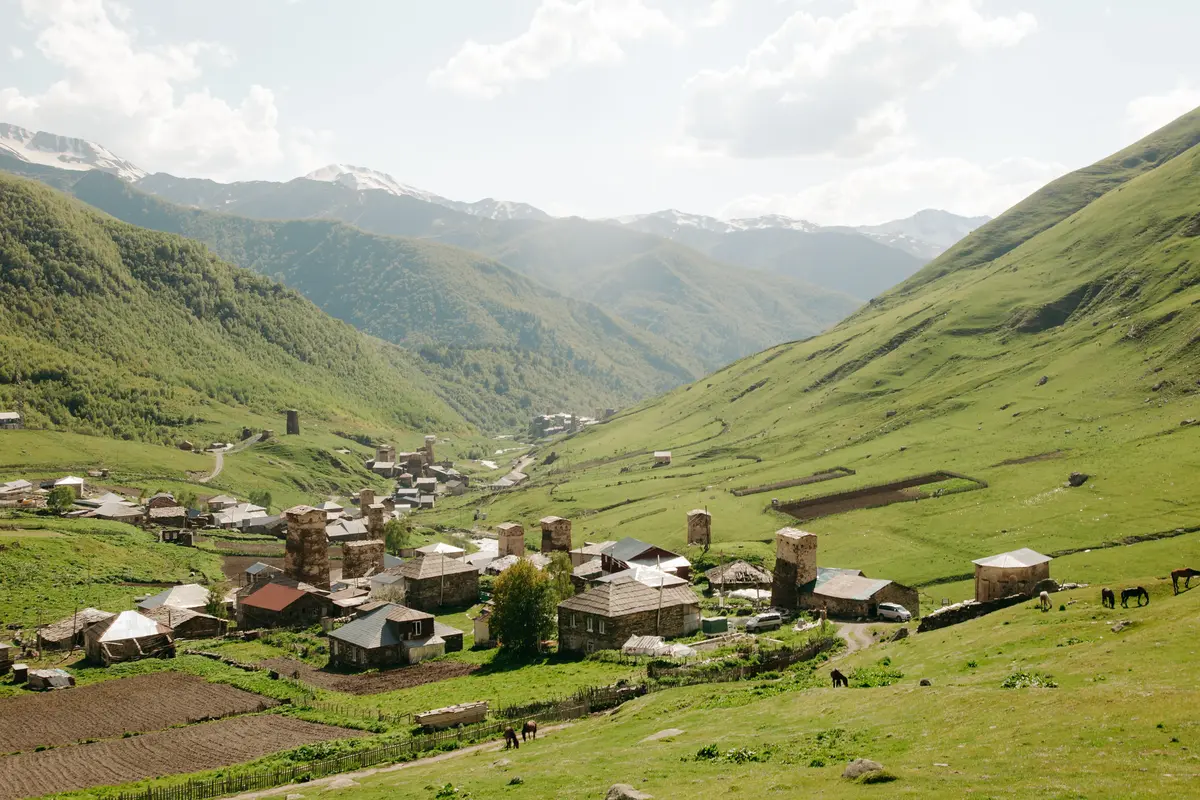
Two weeks is close to the perfect amount of time for a first trip to Georgia, the country in the Caucasus, not the state with peaches and Atlanta traffic. Fourteen days is enough to cover the classic loop: Tbilisi, the Kakheti wine region, Kazbegi by way of the Georgian Military Highway, the cave city of Uplistsikhe and the churches of Mtskheta, Kutaisi and the canyons of Imereti, and finally Svaneti, where stone watchtowers stand under 16,000-foot peaks. Then back to Tbilisi.
Three things every American should know before booking. US citizens can enter visa-free and stay up to one year, no application, no fee. Travel insurance is now legally required to enter Georgia, with a minimum of 30,000 GEL (roughly $11,000) in medical and accident coverage for the full length of your stay. And there are no nonstop flights from the United States, so plan on one connection through Istanbul, Doha, Dubai, or a European hub and 14 to 20 hours of total travel time.
This guide covers the route day by day, with named places to stay, real prices in dollars, honest drive times, and the mountain logistics most itineraries skip.
Is 2 Weeks Enough for Georgia?
Yes. Two weeks lets you pair the capital with wine country, two very different mountain regions, and the country’s headline historic sites without spending every other day in transit. Georgia is small on paper, about the size of West Virginia, but the roads are slow, and that is the trap most first-timers fall into.
Here is the honest math. Tbilisi to Mestia, the gateway to Svaneti, is roughly 290 miles and takes nine to eleven hours by road. Mestia to Batumi is another seven hours. Adding the Black Sea coast to a 14-day loop that already includes Svaneti means burning three of your fourteen days on highways. It is doable. It is not enjoyable.
So the version below skips Batumi and treats Svaneti as the finale, because the Caucasus is what people come to Georgia for and what they remember afterward. If you want the coast, swap it in for Svaneti rather than stacking both.
Three weeks is genuinely better only if you want to add Tusheti, one of the most remote inhabited regions in Europe, or the cave monastery at Vardzia paired with the spa town of Borjomi. With ten days or fewer, cut Svaneti and build a tighter Tbilisi, Kakheti, and Kazbegi triangle instead.
This itinerary suits first-time visitors, hikers, wine drinkers, and couples or friends traveling in a pair or a small group, where splitting a private driver becomes cheap. Solo travelers do fine here too, and Georgia’s guesthouse culture makes it one of the easier places in the region to meet people.
Before You Go: Entry Rules, Visa, Insurance, and Safety for US Citizens
Georgia is one of the most open countries in the world for American passport holders, but one entry requirement changed recently and it catches people at the boarding gate, not the border.
Do US Citizens Need a Visa for Georgia?
No. US citizens can enter Georgia visa-free and stay for up to 365 days, one of the most generous policies anywhere. There is no application, no fee, and no advance registration. Citizens of more than 90 countries get the same deal.
Bring a passport with at least six months of validity remaining and a couple of blank pages. Border officers occasionally ask for proof of onward travel or an accommodation booking, though in practice this is rare at Tbilisi airport. Verify current rules on the Consular Department of Georgia’s official portal at geoconsul.gov.ge before you fly.
Mandatory Travel Insurance: What Decree No. 602 Requires
This is the single biggest change to Georgian entry rules in years, and most itineraries online have not caught up. Since January 1, every tourist entering Georgia must hold valid health and accident insurance for the full duration of their stay.
The requirements, set out in Government Decree No. 602 and summarized by the US Embassy in Georgia, are specific:
- Minimum coverage of 30,000 GEL, roughly $11,000, per traveler
- Must cover both medical treatment and accident-related expenses inside Georgia
- Must be valid for every day of your trip, arrival and departure days included
- Can be issued by a Georgian or a foreign insurance company
- Must be presented in Georgian or English, printed or on your phone
Exemptions are narrow: Georgian residence permit holders, accredited diplomats and their families, and international transport drivers. Standard American travel medical plans generally satisfy the rule as long as Georgia is listed in the covered territory, the medical limit clears the minimum, and the certificate shows your name, policy number, and coverage dates in English.
Two practical warnings. First, airlines have been checking documents at check-in and at the gate, so a missing policy can stop your trip before it starts. Second, enforcement at land borders has been inconsistent, with reported fines around 300 GEL for arriving without cover. Buy the policy online before you leave home, save the PDF offline, and print one copy. It costs a few dollars a day and removes the only real friction in an otherwise effortless entry process.
If you plan to hike, confirm that your policy covers trekking and mountain rescue. Helicopter evacuation in Svaneti is not cheap, and the basic Decree No. 602 minimum is a legal floor, not adequate protection.
Is Georgia Safe for Tourists?
Georgia sits at Level 1, Exercise Normal Precautions, on the US Department of State’s travel advisory scale, the same tier as Japan, Iceland, and most of Western Europe. Violent crime against visitors is rare, and petty theft is far less common than in major European tourist cities.
Two exceptions matter. The Russian-occupied regions of South Ossetia and Abkhazia carry a Level 4, Do Not Travel, designation. The State Department notes that Russian troops and border guards occupy both regions, that the precise locations of the administrative boundary lines are difficult to identify, and that landmines are a danger to travelers near those boundary lines. Entering from Georgian-controlled territory can result in arrest or a fine, and US officials cannot assist you there. Nothing on this itinerary goes near either line, but if you are freelancing a route toward Tusheti or the Truso Valley, stay on marked roads and follow local guidance.
Second, Tbilisi sees periodic demonstrations, usually along Rustaveli Avenue near the Parliament building and usually in the evening. They are typically peaceful and localized, but avoid the crowds, keep your plans flexible if you have a dinner reservation on Rustaveli, and check local news.
The one genuine everyday risk in Georgia is the road. Aggressive overtaking on two-lane mountain highways causes more trouble for visitors than crime ever will. Wear a seat belt, including in the back of a marshrutka, and do not accept a ride from a driver who has been drinking at a supra.
LGBTQ+, Solo, and Women Travelers
Georgia is socially conservative and deeply Orthodox. While there are legal protections on paper, public attitudes toward LGBTQ+ people can be openly hostile, and past pride events have been met with violence. Same-sex couples generally report a comfortable experience in Tbilisi’s contemporary bar and cafe scene, and a much more guarded one in rural guesthouses and small mountain villages. Discretion is the practical advice most travelers give.
Solo travel, including solo female travel, is widely reported as straightforward. The usual precautions apply, especially around nightlife and unlicensed taxis. Use Bolt rather than flagging a car on the street, sit in the back, and be aware that persistent, well-meant hospitality, including relentless toasting at a supra, is a cultural norm rather than a come-on. Georgian guesthouse hosts are, as a rule, protective of guests traveling alone.
When to Visit Georgia, and How the Season Changes This Itinerary
June through September is the only window in which this full loop works, because the high mountain roads that connect it are closed the rest of the year. If Svaneti and Ushguli are on your list, that is the season, full stop.
| Season | Months | What works | What to expect |
|---|---|---|---|
| Spring | April to May | Tbilisi, Kakheti, Mtskheta, Kutaisi | Green valleys, wildflowers, Ushguli road often still closed |
| Early summer | June | Full loop opens mid-month | Long days, snowmelt on trails, fewer crowds than July |
| Peak summer | July to August | Everything, including high trails | Tbilisi hits the mid-90s F, Svaneti guesthouses sell out |
| Early fall | September to mid-October | Full loop, plus grape harvest | The sweet spot: open passes, cool air, thinner crowds |
| Late fall | Late October to November | Cities, wine country, Kazbegi | Mountain roads closing, unpredictable weather |
| Winter | December to March | Tbilisi, Gudauri skiing, Mestia | Ushguli and Tusheti effectively cut off |
September is the best all-around month. The passes are still open, Tbilisi drops out of the heat, and Rtveli, the grape harvest, turns Kakheti into a two-month party where guesthouses will hand you a bucket and put you to work.
The Mountain Access Windows That Determine Your Route
Two roads dictate what a Georgia itinerary can include, and both are seasonal.
The Zagari Pass, which links Ushguli with Lentekhi and the road toward Kutaisi, typically opens around mid-June and can close by late September or early October, depending on snow. Until it opens, Ushguli is reached only as an out-and-back from Mestia.
The Abano Pass to Tusheti, a notorious unpaved switchback climbing above 9,300 feet, follows a similar window, roughly June to early October. It is a 4×4-only route with no guardrails and no rental car in the country insured to drive it.
Mestia itself is reachable year-round. The road up from Zugdidi is paved and open through winter, though snow and rockfall can close it briefly and weather regularly grounds the small planes. That is why a buffer day matters at the end of any Svaneti trip.
One more seasonal note for hikers: the Mestia to Ushguli trail sees up to about 100 walkers a day in July and August. It is a spectacular route, but it is not a wilderness experience at peak season. September thins it out considerably.
Check current road status with the Roads Department of Georgia rather than relying on fixed opening dates. Snowfall shifts the windows by two or three weeks in either direction from one year to the next.
How to Get to Georgia from the USA
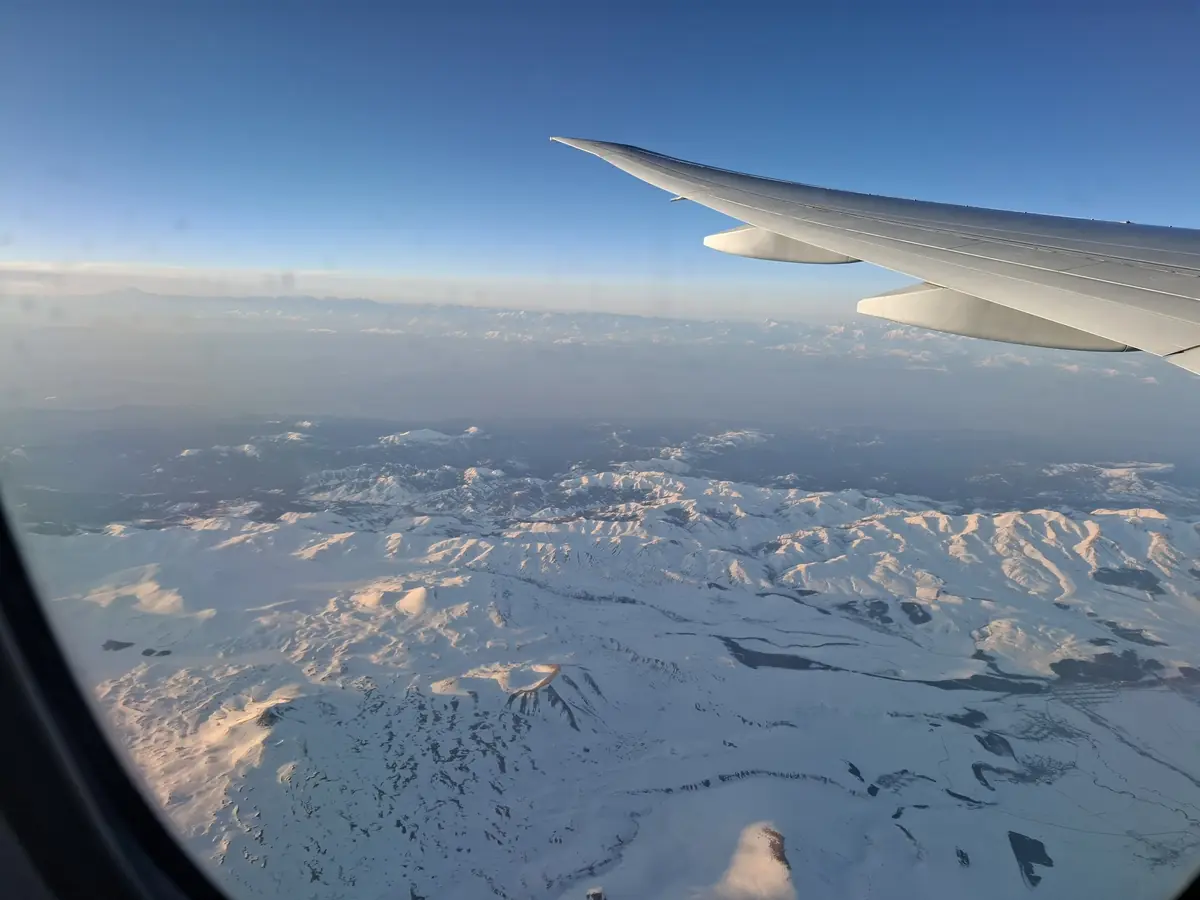
There are no nonstop flights between the United States and Georgia, so every routing involves at least one connection. Budget 14 to 20 hours door to door from the East Coast and 20 to 26 from the West Coast.
Airports, Airlines, and the Best Routings
Tbilisi International (TBS) is the main gateway and the right choice for this itinerary, since the loop starts and ends there. Kutaisi (KUT) is the low-cost hub, served heavily by Wizz Air from European cities, and it can be dramatically cheaper if you are already flying to Europe. Batumi (BUS) is seasonal and mostly relevant if you are prioritizing the coast.
| Routing | Airlines | Typical total time from the East Coast | Notes |
|---|---|---|---|
| Via Istanbul (IST) | Turkish Airlines | 15 to 17 hours | Most frequent connections, often the cheapest full-service option |
| Via Doha (DOH) | Qatar Airways | 18 to 20 hours | Excellent product, longer routing |
| Via Munich or Frankfurt | Lufthansa, United | 15 to 18 hours | Easiest for Star Alliance mile redemptions |
| Via Warsaw (WAW) | LOT | 15 to 17 hours | Frequently the lowest published fare from the East Coast |
| Via Dubai (DXB) | Emirates, flydubai | 19 to 22 hours | Good for West Coast departures |
| Via a European hub to Kutaisi | Wizz Air plus any transatlantic carrier | 18 to 24 hours | Cheapest option, requires a self-transfer and separate tickets |
Round-trip fares from the United States generally land between $700 and $1,500, with the low end appearing in late fall and winter and the high end in July and August. Shoulder season, meaning May and September, is where the price and the weather intersect best.
Now the detail nobody mentions: almost every flight into Tbilisi lands between 3:00 a.m. and 5:00 a.m. This is a legacy of connecting-bank scheduling in Istanbul and the Gulf, and it means your first “day” in Georgia is really a groggy arrival in the dark. Two ways to handle it. Book the first night starting the day before you land, so your room is ready when you arrive. And prearrange the airport transfer, either through your hotel or with a Bolt ride, which runs about $8 to $12 into the city center at that hour.
When to Book and How to Save
Fares to Tbilisi track European patterns: book two to four months out for summer travel, and you can often wait until six weeks out for shoulder season. Mid-week departures are consistently cheaper than weekend ones.
Two money-saving angles worth checking. First, price the trip as two tickets, a cheap transatlantic fare into a European hub plus a separate Wizz Air leg to Kutaisi, and compare it against a single through-ticket to Tbilisi. The savings can exceed $300, though you assume the risk if the first flight is delayed, so leave a long connection and never book a same-day self-transfer.
Second, if you are open on dates, Turkish Airlines runs regular sales on Caucasus routes in the fall. Set a fare alert rather than checking manually.
Getting Around Georgia: The Transport Realities
Georgia has cheap, frequent, and slightly chaotic public transport, plus an unusually good private-driver market that makes hiring a car and driver affordable even for two people. Most travelers end up mixing all of it.
Marshrutkas, the Backbone of Intercity Travel
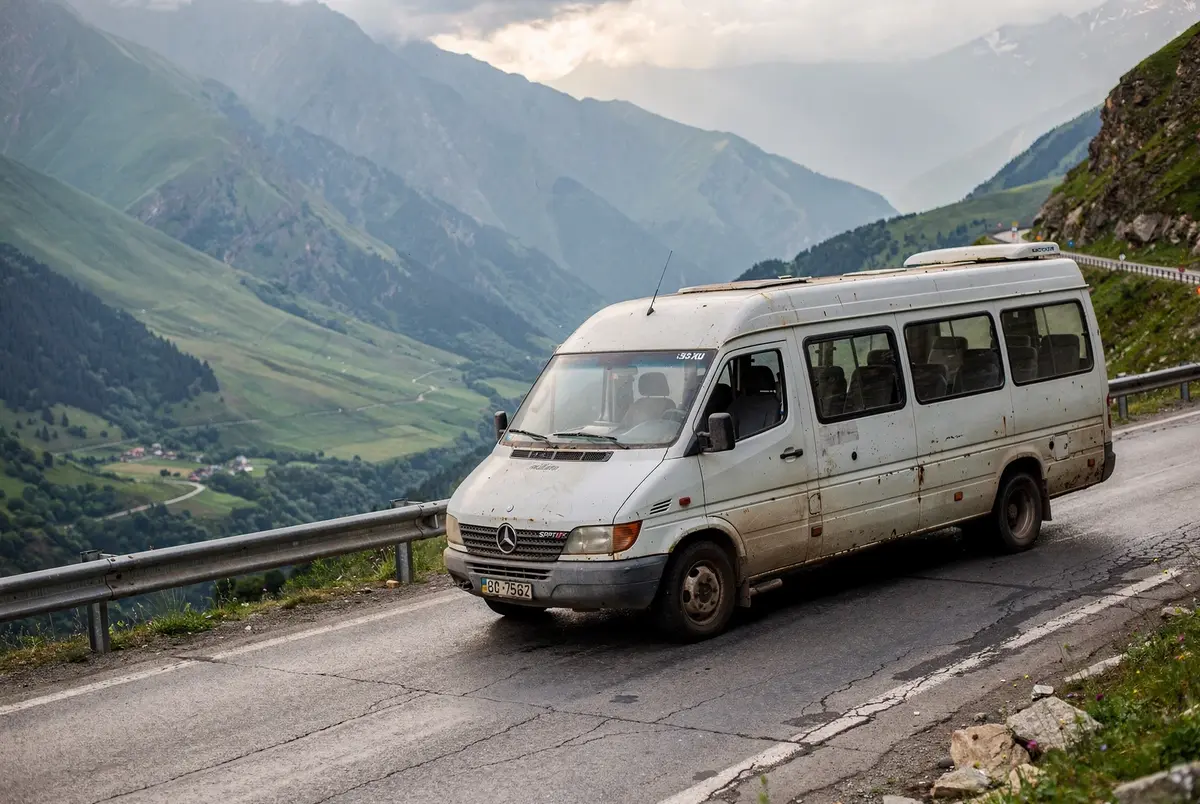
A marshrutka is a shared minibus, usually a well-worn Ford Transit or Mercedes Sprinter, and it is how most of the country moves. They depart from designated stations when full rather than on a schedule, they take cash only, and they are absurdly cheap: Tbilisi to Gori runs about 5 GEL, or under $2, and Tbilisi to Kazbegi about 15 GEL, roughly $5.50.
What to expect in practice. Seats are tight, luggage goes on your lap or in a heap by the door, and the driver’s window is the only climate control. Stops are minimal, so use the bathroom before you board. Departures thin out after mid-afternoon, and the last run to a mountain town can leave as early as 3:00 p.m. Ask your guesthouse to call ahead and confirm the departure time rather than trusting a schedule you found online.
Download the Bolt app before you arrive, and be aware that Uber does not operate in Georgia.
Private Drivers and Day Tours
This is where Georgia genuinely beats its neighbors on value. GoTrip works like a long-distance ride-hailing service with a fixed price agreed upfront: you pick a route, add unlimited stops along the way, and the price does not change if you linger at a monastery for an extra hour. The classic Mtskheta, Gori, and Uplistsikhe day loop from Tbilisi starts around $38 per car, not per person. Split among three or four travelers, it costs less than the marshrutka equivalent and saves half a day.
For mountain routes where rental cars are prohibited, a licensed 4×4 operator is the only sensible option. Friendly.ge runs Kazbegi and Truso Valley expeditions and multi-day trips into the Rainbow Mountains and David Gareja, with prices for the longer excursions starting around $320. Envoy Tours handles regional and cross-border itineraries, including trips that put you at the table in a local home rather than a restaurant, which is a meaningfully better version of the same day.
Book drivers a day or two ahead in July and August. In shoulder season you can usually arrange one the night before through your guesthouse.
Bolt, Trains, and Domestic Flights
Bolt covers Tbilisi, Kutaisi, and Batumi, with typical in-city rides costing $2 to $5. It is the default for anything urban, and it removes the taxi haggling entirely.
Georgian Railway runs a genuinely pleasant double-decker express between Tbilisi and Batumi in about five and a half hours, with first-class seats under $10. It is the one intercity route where the train beats the road. There is also an overnight service toward Zugdidi, the jumping-off point for Svaneti, which some travelers use to avoid losing a daylight day.
The most useful domestic option is Vanilla Sky, which flies 17-seat prop planes from Natakhtari airfield outside Tbilisi to Mestia for around 90 GEL, about $34. The flight takes an hour instead of ten hours by road, and the approach up the valley is spectacular. Two caveats: seats sell out weeks ahead in summer, and flights are canceled routinely for weather. Never book it as your only way out of Svaneti the day before an international flight.
Renting a Car in Georgia: Read This Before You Book
Georgia is one of the cheapest countries in the region to rent an automatic car, and the main highways connecting Tbilisi, Gori, Kutaisi, and the coast are in good shape. For the lowland half of this itinerary, self-driving is a reasonable choice, and it gives you the freedom to stop at roadside honey stands and unmarked wineries that no tour includes.
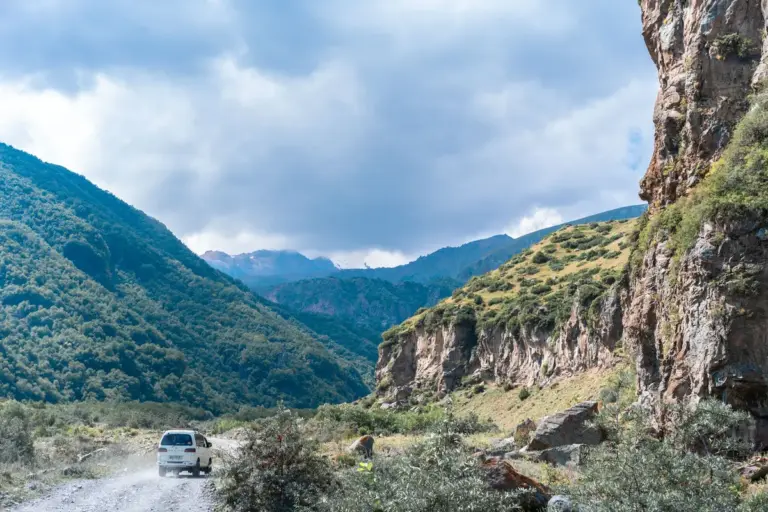
The mountains are a different conversation. Rental agreements in Georgia routinely void insurance coverage on specific prohibited routes, which typically include the Mestia to Ushguli to Lentekhi road, the Abano Pass to Tusheti, the Truso Valley track, the Juta trailhead road, and the route to Shatili. Drive them anyway and any damage is entirely on you. These are also the roads where a rockfall or a river crossing is a normal Tuesday.
Other realities: livestock on the road is a genuine hazard, especially cows lying on warm asphalt after dark, and overtaking behavior on the Georgian Military Highway is aggressive by American standards. Potholes appear without warning on secondary roads. Gas is widely available and cheap.
The pattern that works best for most visitors on a 14-day trip is a hybrid: marshrutkas or a private driver for the long transfers, a driver for anything above 6,000 feet, and Bolt in cities. Rent a car only if you are staying in the lowlands and actively want the wheel.
The 14-Day Georgia Itinerary, Day by Day
This is the classic loop, ordered to minimize backtracking and to put the mountains at the end, when you are acclimated to the roads and the pace. Every stay listed is a real, bookable property, and prices are per night in dollars for a double room unless noted. Treat them as ranges: summer rates in Kazbegi and Svaneti run materially higher than shoulder season.
| Days | Base | Highlights | Getting there |
|---|---|---|---|
| 1 to 3 | Tbilisi | Old Town, sulfur baths, Narikala, Mtskheta | Arrive TBS |
| 4 to 5 | Kakheti | Sighnaghi, Bodbe, qvevri wineries, a supra | 2 hours from Tbilisi |
| 6 to 7 | Kazbegi | Ananuri, Gudauri, Gergeti Trinity, Truso | 3.5 hours via the Military Highway |
| 8 | Gori to Kutaisi | Stalin Museum, Uplistsikhe cave city | 5 hours with stops |
| 9 | Imereti | Prometheus Cave, Martvili Canyon, Gelati | Day trip from Kutaisi |
| 10 to 13 | Svaneti | Mestia, Chaladi Glacier, Koruldi Lakes, Ushguli | 6 to 8 hours or a 1-hour flight |
| 14 | Tbilisi | Return, last meal, departure | 9 to 11 hours or fly |
Days 1 to 3: Tbilisi
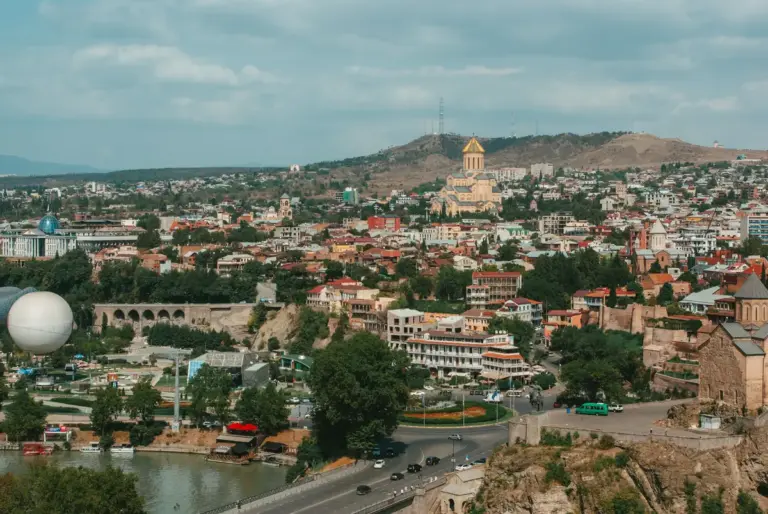
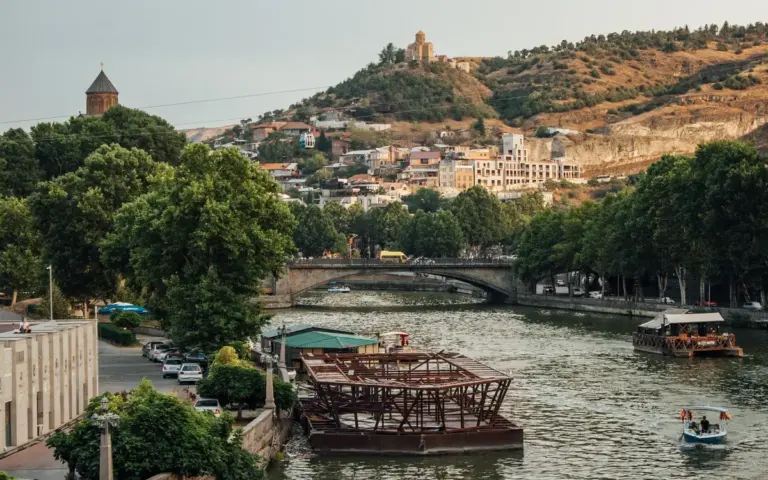
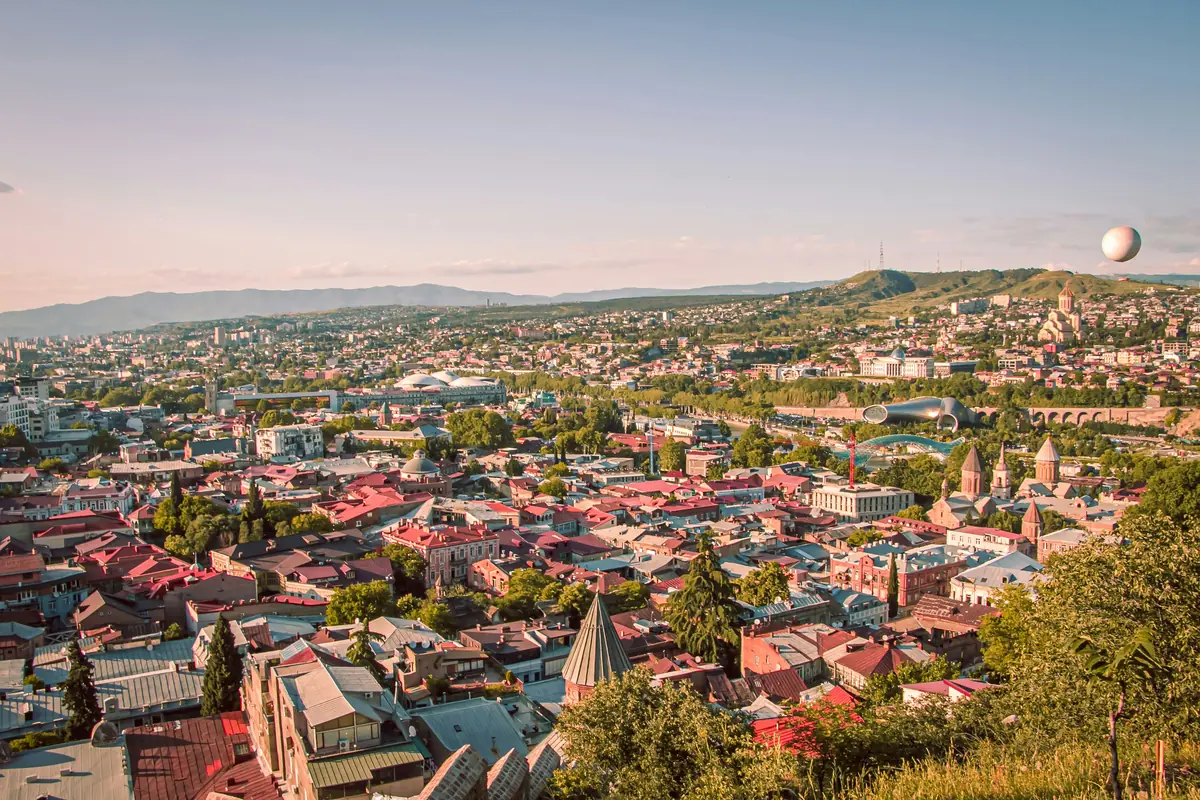
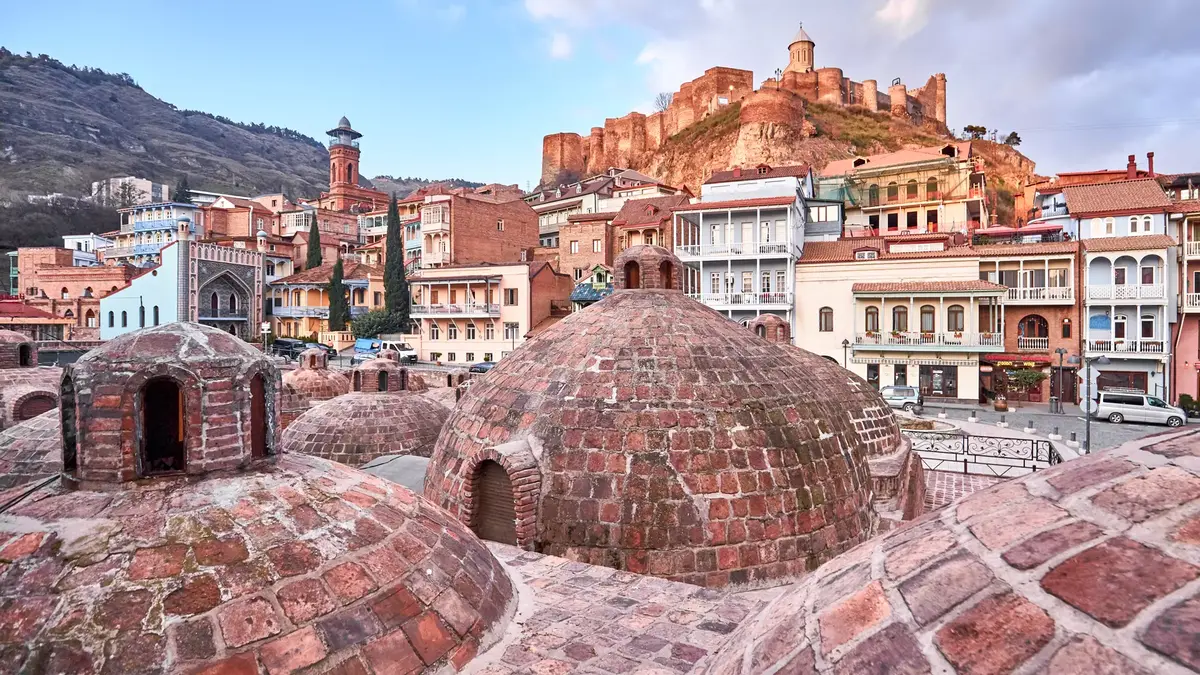
Give the capital three nights. It is the most layered city in the Caucasus, a place where art nouveau balconies sag over Persian-style bathhouses and a Soviet funicular climbs past a medieval fortress.
Day one is a write-off in the best way. You landed at 4:00 a.m., so sleep, then walk. Start in the Old Town at Abanotubani, the sulfur bath district, where domed brick roofs poke out of the ground and the air smells faintly of eggs. A private room at one of the bathhouses runs about $15 to $30 an hour, and adding a kisi scrub is the correct decision after a transatlantic flight. Walk the Legvtakhevi waterfall gorge behind it, then take the cable car from Rike Park up to Narikala Fortress for the view down over the river.
Day two goes to the neighborhoods. Sololaki for crumbling entryways and painted stairwells, Chugureti across the river for the Fabrika complex, and the Dry Bridge Market for Soviet cameras, medals, and enamel pins sold by the people who owned them. Eat at least one meal in a workers’ canteen where a plate of khinkali costs less than a latte at home.
Day three is Mtskheta, the ancient capital, 30 minutes north. Svetitskhoveli Cathedral has been the spiritual center of Georgian Orthodoxy since the 11th century, and Jvari Monastery, on the ridge above the confluence of two rivers, is the single most photographed viewpoint in the country. A Bolt round trip costs about $20; a GoTrip driver combining Mtskheta with a winery costs a little more and is worth it.
Where to stay: Fabrika Hostel and Suites occupies a converted Soviet sewing factory with the best courtyard in the city, dorm beds from about $8 and private rooms around $44 to $86. For something quieter and more refined, Museum Hotel Orbeliani sits in a restored 19th-century building near Freedom Square.
A tip most guides miss: Tbilisi’s restaurant scene is genuinely good and genuinely modern, but the best value is at lunch, when neighborhood spots serve a full meal with wine for under $10.
Days 4 to 5: Kakheti Wine Country
Georgia has been making wine for roughly 8,000 years, and Kakheti is where most of it happens. Two days here is the minimum that lets you drink properly without driving afterward.
Base yourself in Sighnaghi, a walled hilltop town with pastel houses and balconies looking out over the Alazani Valley toward the Greater Caucasus. It is unapologetically pretty and gets called the City of Love, which tells you what it is like on a summer weekend. Walk a section of the 18th-century town wall, visit Bodbe Monastery just outside town where St. Nino is buried, and time your dinner for sunset.
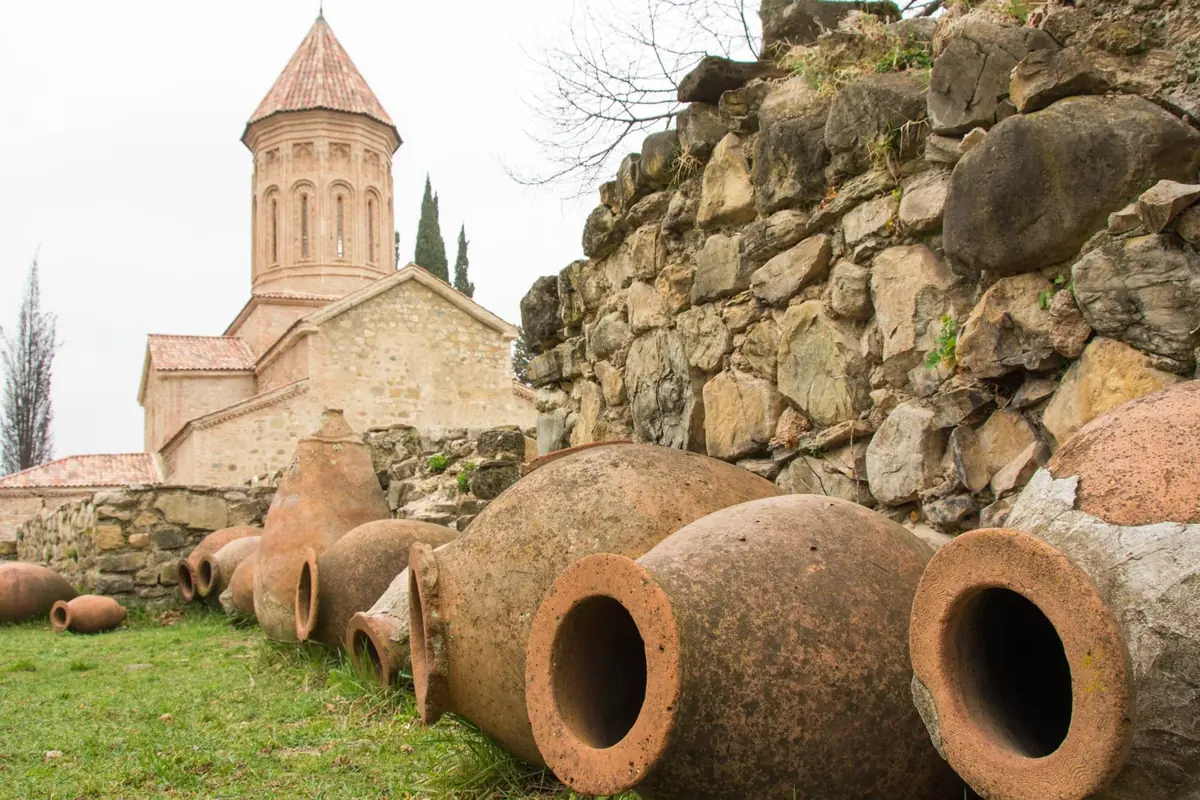
Day five is for wineries. The valley holds hundreds, from garage producers to serious estates, and the distinction that matters is qvevri versus European-style. Qvevri wine is fermented in beeswax-lined clay vessels buried underground, a method inscribed on UNESCO’s list of Intangible Cultural Heritage, and it produces amber whites with tannin and grip that taste like nothing in a California tasting room. Try Rkatsiteli or Mtsvane in that style and Saperavi for reds. Tastings typically cost $8 to $20 per person and usually include bread, cheese, and someone’s grandmother’s pickles.
If you can arrange one supra, the traditional Georgian feast, do it here. A tamada, or toastmaster, runs the table, and nobody drinks until he has spoken. The toasts move in a fixed order, to peace, to parents, to those no longer at the table, and by the fourth one you will understand more about the country than any museum could tell you. Many guesthouses will organize a family supra for around $20 to $30 per person with notice.
Where to stay: Schuchmann Wines Chateau and Spa near Telavi combines a working winery with a proper hotel, roughly $83 to $169 depending on season. On a budget, Zandarashvili Guest House in Sighnaghi is a long-running family-run option with home cooking and valley views.
Days 6 to 7: Kazbegi and the Georgian Military Highway
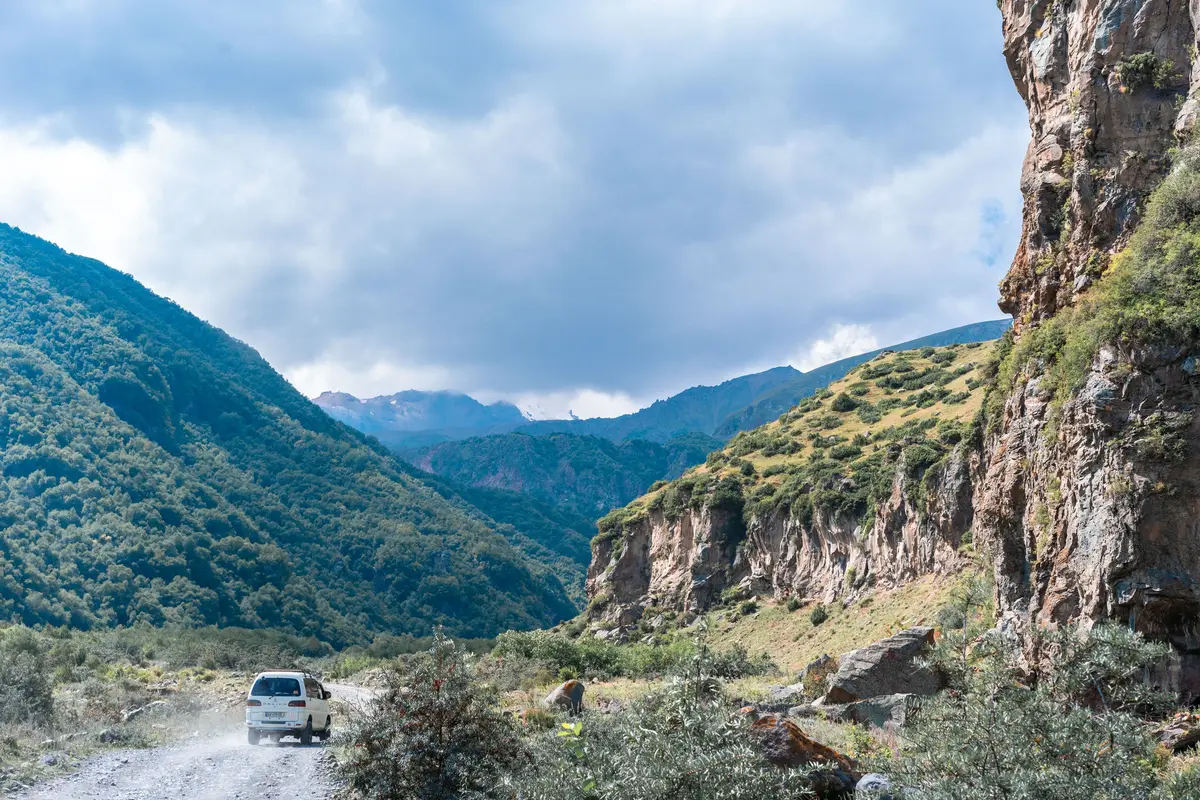
The drive north from Tbilisi to Stepantsminda, still widely called Kazbegi, is the most famous road in the country, and it deserves a full day rather than a transfer.
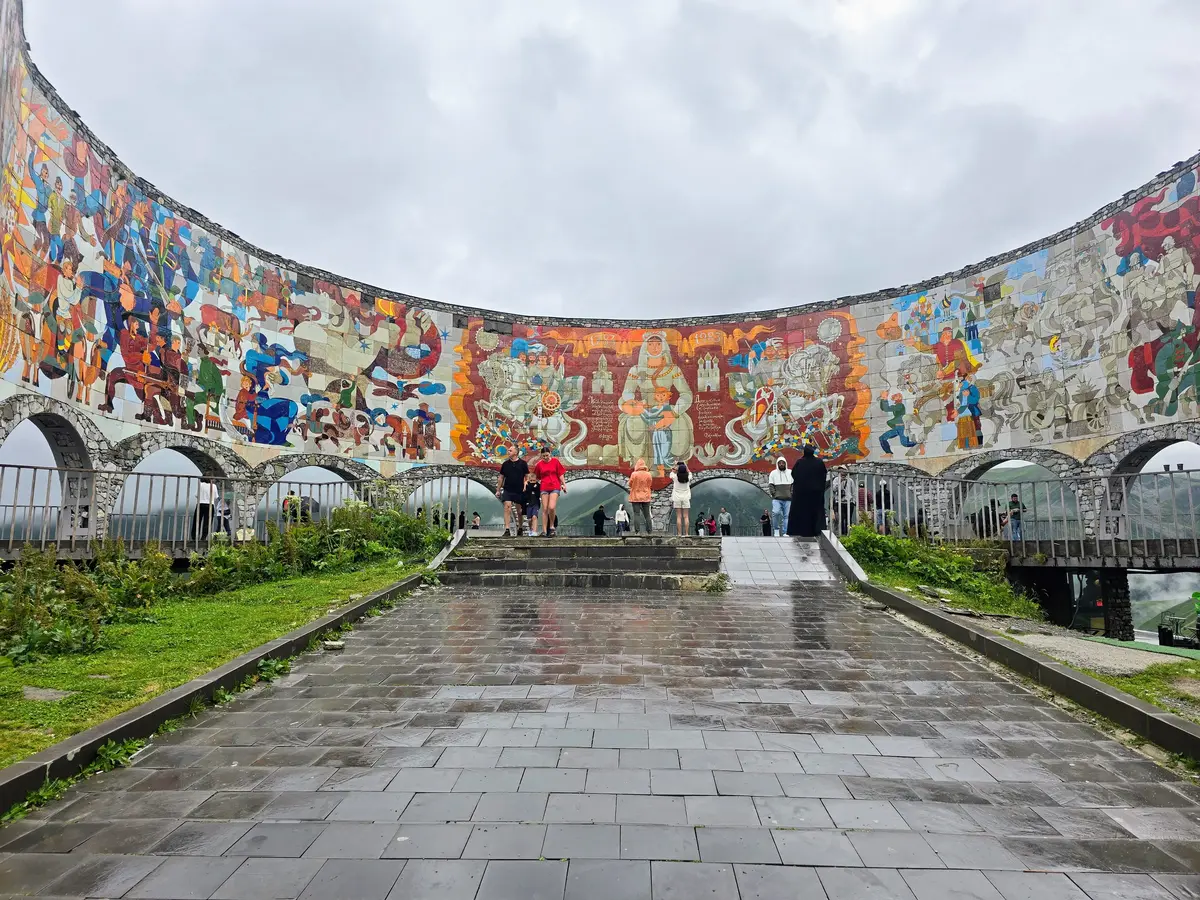
Leaving Tbilisi, the first stop is the Ananuri fortress complex above the turquoise Zhinvali Reservoir, a compact medieval castle with two churches and carved stonework worth 45 minutes. Then the road climbs through Gudauri, Georgia’s main ski resort, to the Russia-Georgia Friendship Monument, a curved Soviet-era mosaic amphitheater cantilevered over the Devil’s Valley. It is kitsch and it is stunning, and it is where paragliders launch in summer.
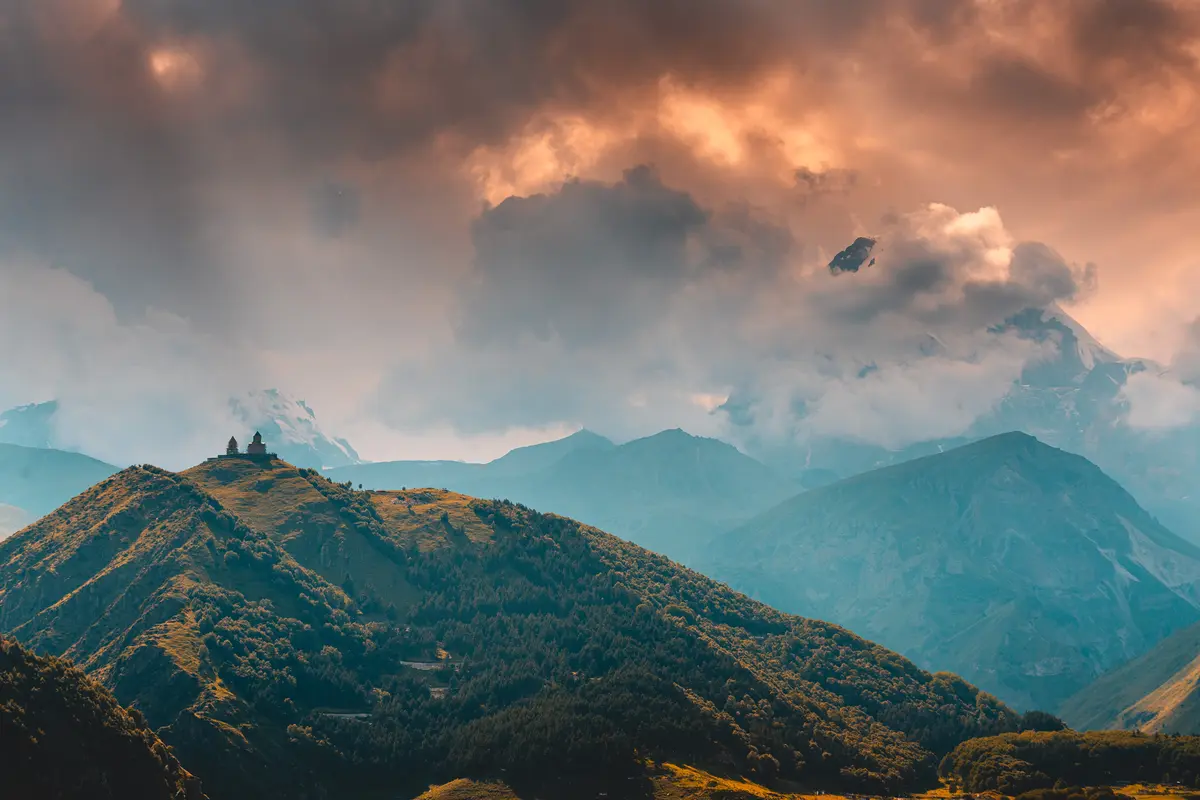
Over the Jvari Pass at 7,815 feet, the landscape flips from green to gray-brown and the mineral springs stain the roadside orange. You arrive in Stepantsminda under Mount Kazbek, a 16,500-foot dormant volcano.
Day seven is the hike everyone comes for. Gergeti Trinity Church sits on a ridge at about 7,120 feet, and the walk up from the village takes 1.5 to 2 hours through a forest and then open meadow, with roughly 1,300 feet of gain. It is not technical, just steady. Start by 8:00 a.m. to get the church without the crowds and the mountain before the clouds build, which they reliably do by late morning. If you would rather not walk, 4x4s run the rough track for about $10 to $15 per person.
With a spare afternoon, the Truso Valley is the better second option: a broad glacial valley with travertine mineral pools, abandoned stone towers, and almost no one. Access is by 4×4 only, and rental cars are not permitted, so book a driver.
Where to stay: Rooms Hotel Kazbegi is the design hotel that put the village on the map, with a wall of glass facing Kazbek, roughly $95 to $191 a night. Guesthouses in the village run $25 to $50 and often include a home-cooked dinner that is better than the hotel’s.
One warning: from late October through April, the Military Highway demands a confident, experienced winter driver, and it closes outright during heavy snow or avalanche risk.
Day 8: Gori, Uplistsikhe, and the Transfer to Kutaisi
Today is a travel day with two excellent stops built in, which is exactly why hiring a driver for this leg pays off.
Gori is Stalin’s birthplace, and the Stalin Museum is one of the strangest institutions in the region: a grand hall built in the 1950s that presents his life largely on his own terms, with a small later addition acknowledging the repressions. The one-room wooden house where he was born stands preserved under a Greek temple canopy in the forecourt, and his personal railcar is parked alongside. Entry is about $6. Go with your eyes open; it is a lesson in how history gets curated.
Twenty minutes east, Uplistsikhe is the real highlight. This is a cave city carved directly into a sandstone ridge above the Mtkvari River, inhabited from roughly the first millennium BC and once home to thousands of people. You walk through a pharmacy, a wine cellar, a theater, and a pagan temple hall, all cut from living rock, with a 10th-century Christian basilica planted on top. Wear shoes with grip; the polished stone is slick.
Continue west to Kutaisi, about two hours further. Georgia’s second city is scruffier and less curated than Tbilisi, with a covered market worth an hour and a good, cheap dinner scene along the river.
Where to stay: Kutaisi’s guesthouse market is strong and inexpensive. Nana’s Home and Green Rooms are both well-run options in the $25 to $45 range, and both will arrange a driver for the next day.
Day 9: Imereti’s Caves, Canyons, and Monasteries
One efficient day covers everything Kutaisi is a base for. Hire a driver for around $60 to $80 for the full loop; the sites are spread out and the marshrutka connections eat hours.
Prometheus Cave is the headline: about a mile of illuminated walkway through chambers of stalactites and underground rivers, with an optional boat ride out at the end. It is cool inside year-round, so bring a layer. Book the standard walking tour rather than the extended version unless you are a caving enthusiast.
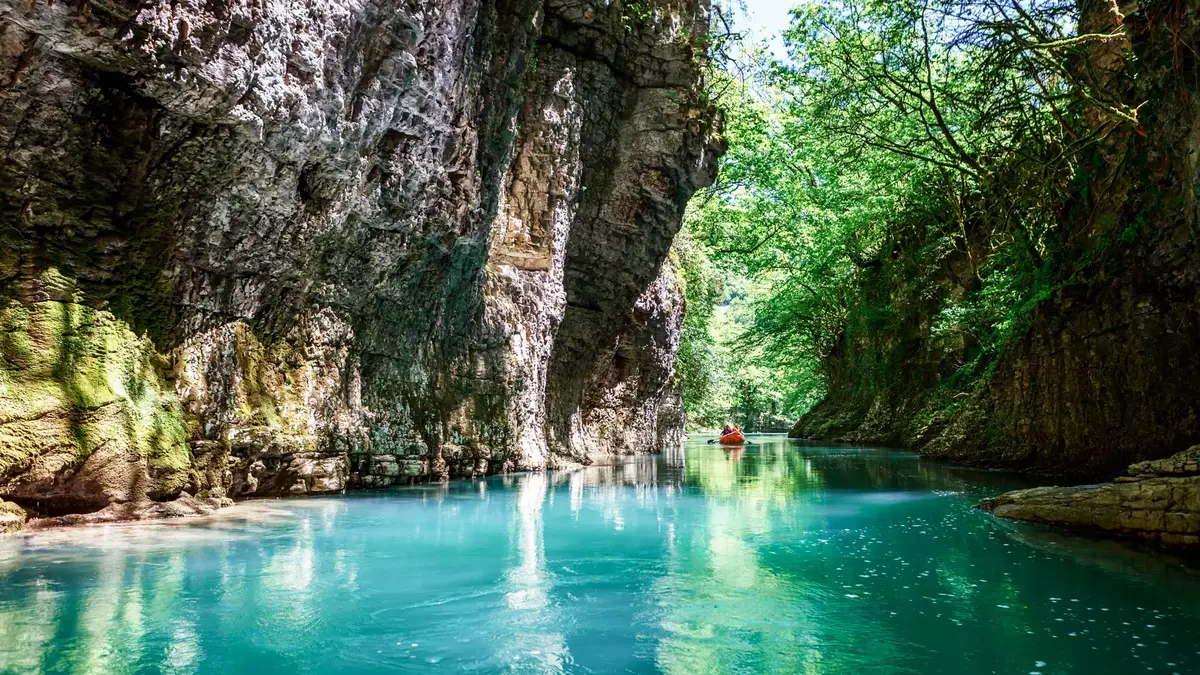
Martvili Canyon is the other must, a narrow limestone gorge where you take a short inflatable boat ride between mossy walls under waterfalls. It is touristy and it is also genuinely beautiful. Go early; the boat line gets long by noon. Okatse Canyon, with its cantilevered walkway suspended over the gorge, makes a good substitute if Martvili is packed.
Finish at Gelati Monastery, a UNESCO World Heritage site founded in 1106 by King David the Builder and once home to an academy that made it the intellectual center of the medieval Georgian kingdom. The mosaics and frescoes inside the main church are extraordinary, and the setting above the valley is quiet in a way the canyons are not.
If there is daylight left, Imereti’s wine scene is a low-key alternative to Kakheti, built on the Tsolikouri grape and much less visited.
Days 10 to 13: Svaneti, Mestia, and Ushguli
Svaneti is the payoff. This is a high, isolated region of stone defensive towers, glaciers, and villages that stayed effectively independent for centuries because nobody could reach them. Four days is right: two for the journey and Mestia, two for Ushguli and a hike.
Getting there is the decision. There are three options. The Vanilla Sky flight from Natakhtari to Mestia takes about an hour and costs roughly $34, but it books out and cancels for weather. The marshrutka route runs via Zugdidi and takes nine to eleven hours total from Tbilisi, which is brutal but cheap at around $20. A private transfer costs roughly $200 per car and takes seven to eight hours with stops, which is the best option for a group of three or four. Coming from Kutaisi, as this itinerary does, the drive is shorter: about six hours to Mestia.
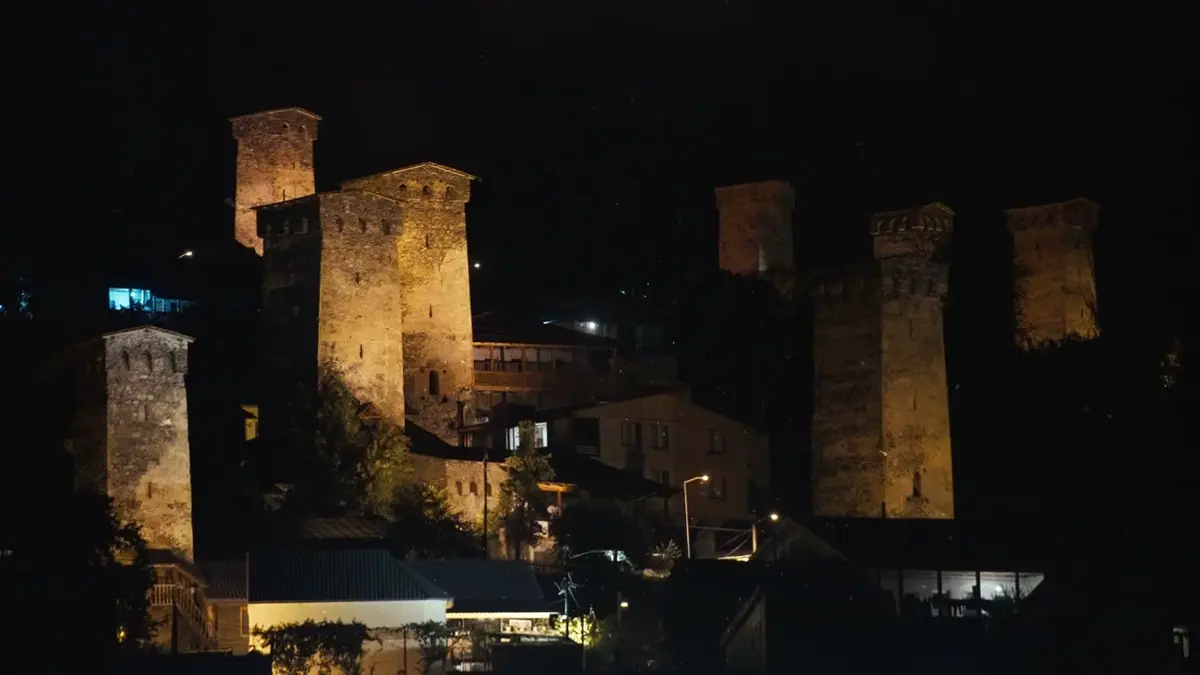
Mestia itself has grown from a village into a small mountain town with a ski lift, an ATM, and decent coffee, while keeping dozens of medieval Svan towers standing between the houses. The Svaneti Museum of History and Ethnography holds illuminated manuscripts and hammered gold icons that belong in a national collection, and it is rarely crowded.
Two half-day walks from town are worth doing. The Chaladi Glacier trail is an easy five miles round trip along a river to the toe of a glacier. The Koruldi Lakes hike is the harder and better one: a steep climb to alpine tarns with a full panorama of Ushba’s twin peaks, about six hours round trip, or a short 4×4 ride to the top if you would rather only walk down.
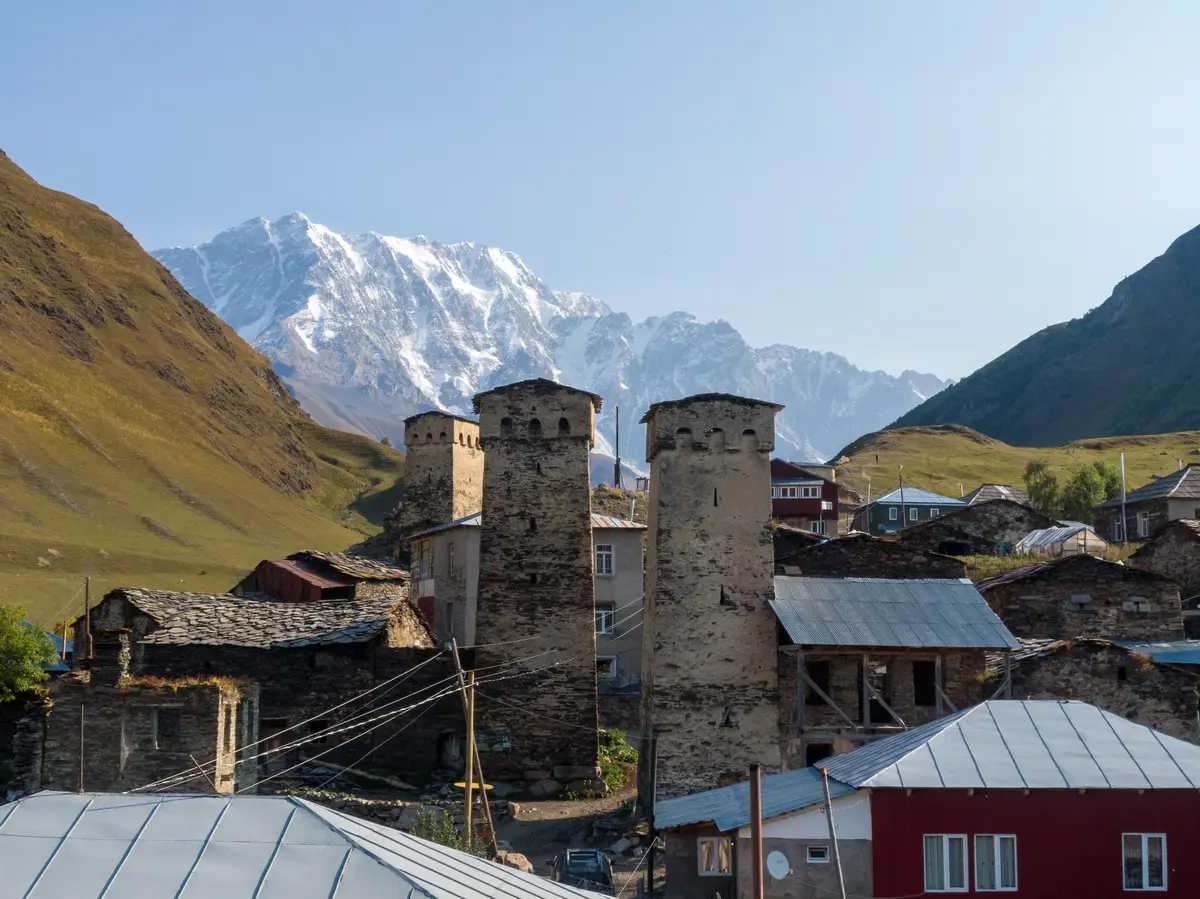
Ushguli is the other half of Svaneti. A cluster of four hamlets at about 6,900 feet, frequently described as one of the highest continuously inhabited settlements in Europe, it sits directly beneath Shkhara, Georgia’s tallest peak at 17,059 feet. The drive from Mestia takes two to three hours each way on a rough road, which is precisely why staying the night is better than day-tripping. Late afternoon, when the tour vans leave and the light goes gold on the towers, is the reason to come.
Where to stay: Travel Inn House in Mestia is a reliable, well-located budget option at roughly $19 to $36. In Ushguli, Panorama Guest House starts around $39 and delivers on its name. Book both well ahead for July and August; Ushguli has a genuinely limited number of beds.
Bring cash. There is no ATM in Ushguli, and card readers in the mountains fail more often than they work.
Day 14: Return to Tbilisi
The trip back is long: nine to eleven hours by road from Mestia to Tbilisi, or an hour by air if the Vanilla Sky flight operates. If your international flight leaves in the early hours, as most do, the road trip can technically be done on departure day, but it is a miserable way to end a good trip.
The better plan is to build a buffer. Return to Tbilisi the afternoon before, keep a room near the center, and spend the last evening on a final khinkali dinner and a wine shop run for bottles to take home. Georgian wine travels well, customs allows a reasonable personal quantity, and it costs a fraction of what the same producer charges in the States.
If you flew into Kutaisi, reverse the logic: Mestia to Kutaisi is a shorter drive, roughly six hours, and it makes a cleaner exit.
Route Variations by Traveler Type
The loop above is the default for a reason, but a few swaps make it fit better depending on what you actually want out of the trip.
| Traveler | What to change | What you give up |
|---|---|---|
| First-timer | Follow the route as written | Nothing |
| Wine lover | Add a third night in Kakheti, time it for the harvest | One night in Svaneti |
| Hiker | Replace the Ushguli day trip with the four-day Mestia to Ushguli trek | Imereti’s caves and canyons |
| Slow traveler | Cut Imereti, add nights in Tbilisi and Mestia | Prometheus Cave and Martvili |
| Family with kids | Swap Svaneti for Batumi and the coast | The high mountains |
| Beach and city | Batumi instead of Svaneti, train from Tbilisi | Alpine scenery entirely |
A few notes on those swaps. Wine lovers should target late September and October for Rtveli, the harvest, when family wineries put visitors to work stomping grapes and the supra season peaks. Hikers should build the trek into the middle of the trip rather than the end, so a weather delay does not threaten the flight home. Families do well in Batumi, where the Black Sea boardwalk, botanical garden, and dancing fountains are easier wins with kids than a two-hour drive on gravel to a stone tower.
Budget travelers can run this entire itinerary on marshrutkas and guesthouses. Mid-range travelers should hire drivers for the three long transfer days and take public transport otherwise. Luxury travelers should book a car and driver for the full two weeks, which costs roughly $80 to $120 per day including the driver’s expenses, and stay at wine estates and design hotels in the four places that have them: Tbilisi, Telavi, Kazbegi, and Mestia.
Hiking in Georgia: Treks and Day Hikes
Georgia is one of the best and least expensive trekking destinations in Europe, and it has a specific advantage: on most classic routes you sleep in family guesthouses rather than carrying a tent. You walk with a daypack, eat someone’s home cooking, and pay $25 to $40 for bed and two meals.
The Mestia to Ushguli Trek
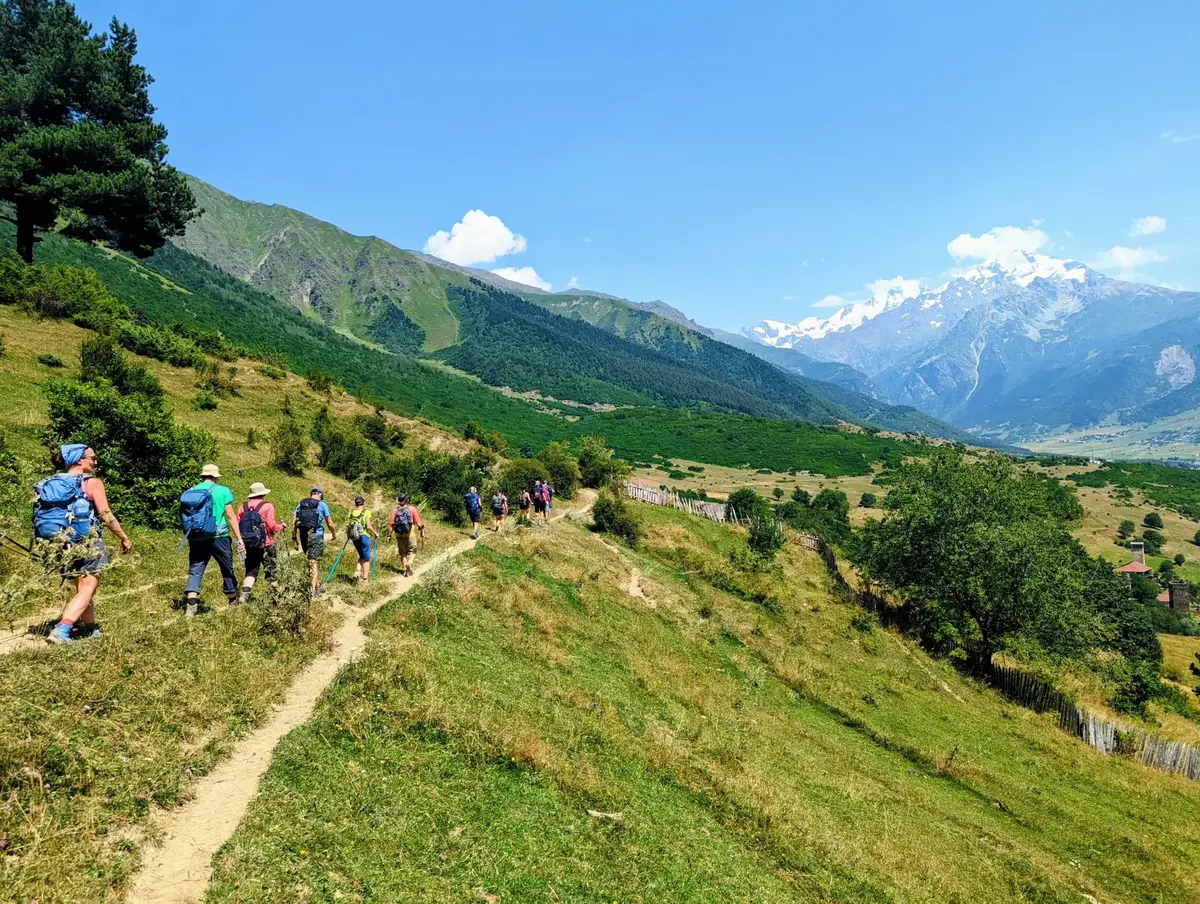
This is the signature multi-day route in the country, and for good reason. It covers about 36 miles with roughly 10,000 feet of cumulative climbing over four days and three nights, staying in the villages of Zhabeshi, Adishi, and Iprari or Kala along the way. The grade is moderate; the challenge is distance and altitude, not technical terrain.
The season runs roughly June through early October. The one obstacle everybody talks about is the river crossing after Adishi, where a glacial stream has to be forded. Cross it early in the morning before snowmelt raises the water, or pay a local horseman a few dollars to carry you and your pack across, which is the normal solution and supports the village economy.
You do not need a guide to follow the route, which is waymarked and well trafficked in summer. You do need offline maps, a warm layer, and a plan for weather, since fog on the passes is common and visibility drops fast. Guesthouses along the way, including options like Guest House Betqil, can usually be booked a day ahead in shoulder season, but reserve in advance for July and August.
If four days is too long, walk the first day to Zhabeshi and take transport back, or hike the final stretch into Ushguli from the Iprari side.
Day Hikes: Juta, Chaukhi, Truso, Gergeti, and Black Rock Lake
Kazbegi is the best day-hiking base in the country, and four routes stand out.
Gergeti Trinity is the easy classic: 1.5 to 2 hours up, 1,300 feet of gain, unbeatable payoff. Do it on your first morning.
Juta to the Chaukhi Pass is the serious one. The village of Juta sits at about 7,400 feet, and the trail climbs toward the Chaukhi massif, a wall of granite spires that looks transplanted from the Dolomites. A day hike to the lakes below the pass takes five to seven hours round trip; crossing all the way over to Roshka is a long, committing day best split with an overnight. Rental cars are not permitted on the road to Juta, so arrange a 4×4 from Stepantsminda.
The Truso Valley is a flat, wide, easy walk past mineral springs and abandoned towers, ideal for a recovery day. Access is again 4×4 only, and it runs close to the South Ossetia administrative boundary line, so stay with a local driver or guide and do not improvise.
Black Rock Lake, near Mestia, is Svaneti’s best full-day hike, a long climb to a dark alpine lake with the Caucasus wall reflected in it. Budget seven to eight hours and start early.
Permits, Guides, Safety, and Coverage
You do not need permits for the standard trails on this list. Georgia’s protected areas are accessible and unbureaucratic compared with alpine Europe.
What you do need is a realistic view of mountain rescue. There is no free national rescue service that will pull you off a ridge for nothing, and helicopter evacuation from Svaneti or Kazbegi runs into thousands of dollars. This is the practical reason to buy insurance that explicitly covers trekking at altitude, rather than the minimum policy that satisfies the entry requirement.
Cell coverage is patchy in the high valleys. Magti has by far the best mountain network, reaching most inhabited areas, so buy that SIM if you plan to hike. Download offline maps before you leave town, tell your guesthouse your route and expected return, and carry a headlamp even on a day hike, because afternoon storms turn a five-hour walk into an eight-hour one with surprising regularity.
Food and Wine: What to Eat and How to Order It
Georgian food is the reason a lot of people come back, and it is the least Westernized major cuisine in the region. Meals are shared, plates arrive when they are ready rather than in courses, and the default portion assumes company.
Qvevri Wine, the Supra, and the Tamada
Wine here is not an industry, it is a household activity. Families across Kakheti and Imereti still ferment their own in qvevri, egg-shaped clay vessels lined with beeswax and buried to the neck in earth, a technique recognized by UNESCO as Intangible Cultural Heritage. Skin-contact whites made this way come out amber, tannic, and savory, closer in structure to a light red than to anything labeled white in an American store.
The grapes to learn are Saperavi, a dark-fleshed red that makes serious, age-worthy wine, and Rkatsiteli and Mtsvane for whites and ambers. A bottle of good producer wine costs $6 to $15 in a shop and $12 to $25 in a restaurant.
The supra is the feast that surrounds it. A tamada, the toastmaster, controls the table: you drink only after a toast, you drain the glass, and the toasts follow a sequence that starts with peace and moves through parents, children, guests, and the departed. Turning your glass upside down or drinking between toasts reads as rude. The correct response when you have had enough is to take a small sip rather than a full glass, which everyone understands. Say gaumarjos, meaning victory, when you raise it.
Khachapuri, Khinkali, and the Rules Nobody Tells You
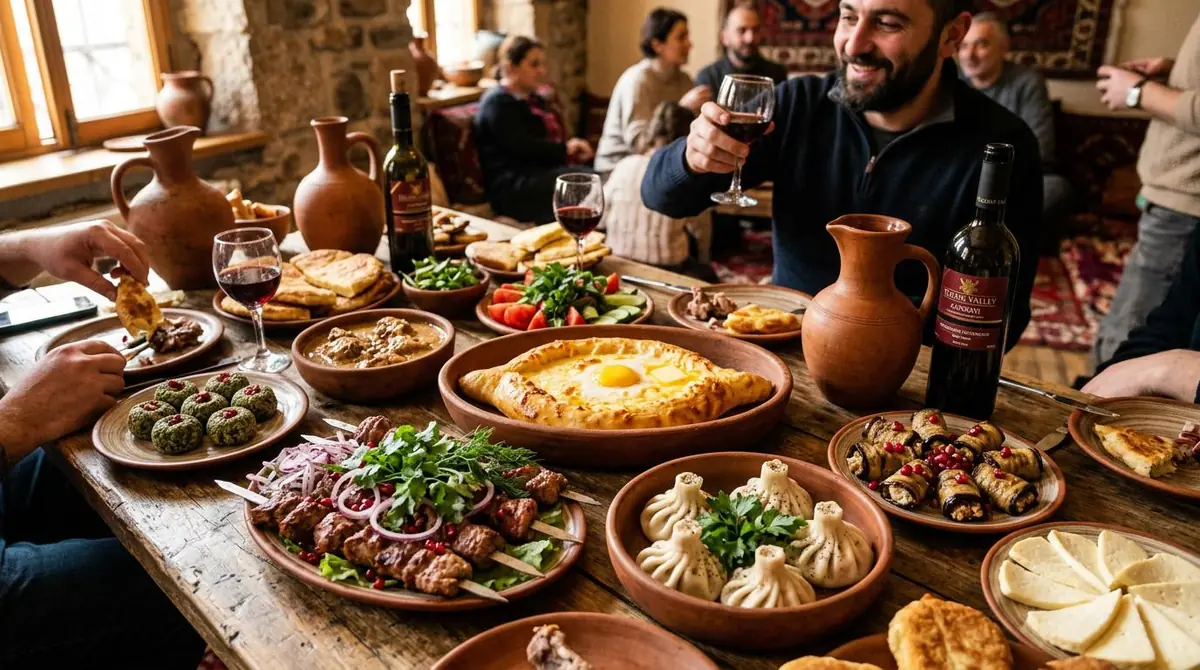
Khachapuri is cheese bread, and the version matters. Imeruli is a flat, round loaf with cheese sealed inside, the everyday standard. Megruli adds a second layer of cheese baked on top. Adjaruli is the famous one: an open boat of dough filled with molten cheese, a raw egg yolk, and a slab of butter, which you stir together with the torn-off ends of the crust and eat with your hands. One Adjaruli is a meal for two.
Khinkali are soup dumplings, and there is etiquette. Hold the twisted knot at the top, bite a small hole in the side, sip the broth before it escapes, then eat the body. Do not eat the knot, and never touch them with a knife and fork, which locals will notice immediately. Restaurants usually have a five-piece minimum. Leave the knots on your plate to keep score; the count is part of the fun.
In Svaneti, look for two mountain specialties: kubdari, a bread stuffed with spiced chunks of meat rather than ground, and tashmijabi, a fondue-like mash of potato and stretchy cheese that exists to fuel people who walk up hills.
Other essentials: badrijani nigvzit, fried eggplant rolled around walnut paste; pkhali, vegetable and walnut pâtés; mtsvadi, skewered pork grilled over grapevine cuttings; and churchkhela, the candle-shaped strings of walnuts dipped in grape must that hang in every market.
Vegetarian, Vegan, and Gluten-Free Travelers
Georgia is unexpectedly excellent for vegetarians and vegans, largely because Orthodox fasting periods created an entire tradition of meat-free and dairy-free cooking. Lobio, a slow-cooked bean stew served in a clay pot with cornbread, is vegan as standard. So are most pkhali, ajapsandali, a rich eggplant and pepper stew, badrijani when made without dairy, and mushroom khinkali, which are widely available. Ask for the fasting menu, samarkhvo, and you will get a whole page.
Gluten-free is harder. Bread and dough are structural to the cuisine, and cross-contamination in a small kitchen is likely. That said, mtsvadi, grilled vegetables, lobio, pkhali, and salads cover a lot of ground, and mchadi, the cornbread, is naturally wheat-free.
Costs and Budgeting for Georgia in Dollars
Georgia is one of the best-value destinations in Europe or Asia, but it is not as cheap as it was five years ago. Accommodation has risen fastest, with reports of roughly a 10 percent year-over-year jump heading into the summer season.
Daily Budget Tiers
| Tier | Per person, per day | What that buys |
|---|---|---|
| Budget | $30 to $45 | Hostel dorms and guesthouses, marshrutkas, canteen meals, self-guided hikes |
| Mid-range | $75 to $140 | Private guesthouse or 3-star rooms, occasional private driver, restaurant dinners, tastings |
| Comfort and up | $150 and up | Design hotels and wine estates, a car with driver, guided treks, tasting menus |
For a two-week trip excluding international airfare, that translates to roughly $450 to $650 for a careful budget traveler, $1,100 to $2,000 for a mid-range one, and $2,300 and up for the comfortable version. Traveling as a pair cuts the per-person cost meaningfully, since rooms and drivers are priced per unit, not per head.
What Things Actually Cost
| Item | Typical price |
|---|---|
| Khinkali, each (five-piece minimum) | $0.45 to $0.95 |
| Khachapuri | $2 to $5 |
| Lunch at a local spot | $5 to $10 |
| Dinner for two with a bottle of wine | $25 to $40 |
| Bottle of decent local wine, shop | $6 to $15 |
| Marshrutka, intercity | $2 to $10 |
| Bolt ride within Tbilisi | $2 to $5 |
| Private driver, full day | $60 to $80 |
| Group day tour with guide | $25 to $60 per person |
| Winery tasting | $8 to $20 per person |
| Sulfur bath, private room per hour | $15 to $30 |
| Guesthouse bed with dinner and breakfast, mountains | $25 to $40 |
Museum and site entries are almost all under $8. The Vanilla Sky flight to Mestia at about $34 is the single best transport value in the country.
Cash, Cards, and Tipping
The currency is the Georgian lari, GEL, and the rate hovers near 2.6 lari to the dollar. Recheck it before you travel, since it moves.
Cards work in cities, at hotels, and at most restaurants in Tbilisi, Kutaisi, and Batumi. They do not reliably work in mountain guesthouses, at trailheads, in marshrutkas, or in markets. Carry at least a few hundred lari in cash before heading to Svaneti or Kazbegi, and remember there is no ATM in Ushguli or in Tusheti.
Always pay in lari. If a card terminal offers to charge you in dollars, decline; that is dynamic currency conversion and the rate is bad. ATMs from major banks like TBC and Bank of Georgia are everywhere in cities and generally have reasonable fees.
Tipping is not obligatory and was not traditional, but it has become normal in tourist-facing businesses. Ten percent is generous in a restaurant. Check the bill first, though: many Tbilisi restaurants add a 10 to 15 percent service charge automatically, in which case no further tip is expected. Round up for Bolt drivers, and tip a private driver or guide $10 to $20 for a good full day.

Practical Logistics: SIM Cards, Plugs, Language, and Etiquette
SIM Cards and Staying Connected
Buy a local SIM at the airport or any provider shop; you will need your passport to register it. Magti has the strongest mountain coverage, reaching close to all populated areas, and it is the right choice for anyone going to Svaneti, Kazbegi, or Tusheti. Silknet performs well in cities and along main highways. Cellfie is the cheapest and the weakest outside Tbilisi.
A tourist SIM with a generous data allowance costs about 10 to 30 GEL, or $4 to $12, for the length of a typical trip, which is cheap enough that it beats an international roaming plan outright.
An eSIM is convenient if you want connectivity the moment you land, but be aware that most global eSIM providers ride on a secondary network in Georgia, which means noticeably worse coverage in exactly the mountain valleys where you want it. A reasonable approach is an eSIM for the first day and a Magti SIM for the rest.
Currency, Power, Water, and Altitude
Plugs are Type C and Type F, the standard two-round-pin European style, at 220 volts and 50 Hz. American electronics with dual-voltage chargers, which is most of them, need only a plug adapter, not a converter. Check the label on anything with a heating element.
Tap water is safe to drink in Tbilisi and in most of the country, and mountain spring water is famously good. Bottled water is cheap if you would rather not risk an adjustment period.
Altitude is mild by Rocky Mountain standards. Ushguli sits at about 6,900 feet and the Jvari Pass at 7,815, high enough to feel a little short of breath on a climb but well below the range where altitude sickness is a real concern for most people. Trekking passes reach around 9,200 feet, so pace the first day.
Language and the Georgian Alphabet
Georgian is not related to Russian, Turkish, or anything else you have encountered, and it uses its own alphabet, a looping, rounded script that is one of only a handful of writing systems in active use worldwide. It is not Cyrillic, and locals will gently correct you if you say so.
English is widely spoken by younger people in Tbilisi, Kutaisi, and Batumi and in the tourism industry generally. Older Georgians often speak Russian, though using it carries political weight and is not always welcome. A few words of Georgian go a very long way:
- Gamarjoba, hello
- Madloba, thank you
- Ki and ara, yes and no
- Gaumarjos, cheers
- Ra ghirs, how much
- Nakhvamdis, goodbye
Road signs on major routes are in Georgian and Latin script, so navigation is manageable.
Church Dress Codes, Photography, and Etiquette
Georgian Orthodox churches are working places of worship, not monuments, and the dress code is enforced. Women should cover their heads and shoulders and wear a skirt below the knee; wrap skirts and scarves are usually available in a basket at the entrance. Men should not wear shorts or hats inside. Photography is often prohibited inside churches; look for a sign or ask.
A few other norms worth knowing. Do not photograph military installations, border posts, or police checkpoints. Be thoughtful when discussing Abkhazia, South Ossetia, or Russia; a large share of Georgians have direct personal experience of displacement from the conflicts, and it is not casual conversation. Accept hospitality graciously, since refusing food or a toast outright can read as an insult, and expect that a stranger who asks where you are from may end up inviting you to lunch.
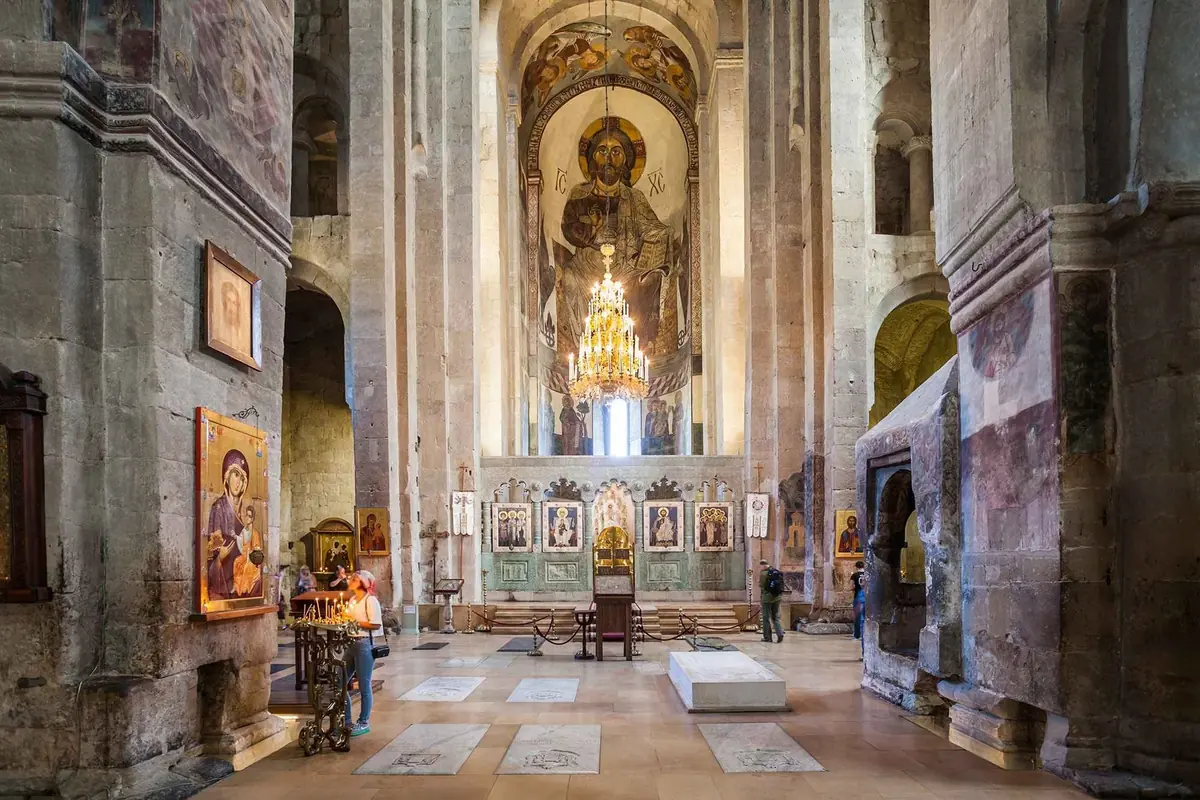
Common Mistakes on a Two-Week Georgia Trip
Cramming in Batumi. Adding the Black Sea to a loop that already includes Svaneti costs you three days of driving for one day of beach. Pick one.
Underestimating drive times. Georgian distances lie. Two hundred miles of mountain highway is a full day, not a morning, and marshrutka schedules assume nothing goes wrong. Add 30 percent to every estimate and build one flexible day into the plan.
Driving a rental car on prohibited mountain roads. The Abano Pass, the Ushguli road, and the Juta and Truso tracks void most rental insurance. Hire a 4×4 with a driver who does the route weekly.
Booking Svaneti accommodation late. Mestia and especially Ushguli have limited beds and sell out in July and August. Reserve those nights first and build the rest of the trip around them.
Treating the Vanilla Sky flight as guaranteed. The plane is small, the weather is mountain weather, and cancellations are routine. Never make it the last leg before an international departure without a full buffer day.
Paying in dollars or accepting card conversion. Always choose lari at the terminal.
Skipping the insurance step. It is now a legal entry requirement, airlines check it at the gate, and adequate coverage costs less than one restaurant dinner per day of travel.
Trying to keep up at a supra. The tamada will out-drink you, and the toasts keep coming. Sip, eat, pace yourself, and drink water between rounds.
Assuming everything closes for the mountains in shoulder season. Kazbegi, Tbilisi, and Kakheti are excellent in May and October, when prices drop and crowds thin. Only Svaneti’s high routes are truly seasonal.
Can You Add Armenia or Azerbaijan in Two Weeks?
Short answer: you can add Armenia, but it will cost you Svaneti. Neither add-on fits comfortably in fourteen days if you want to see Georgia properly.
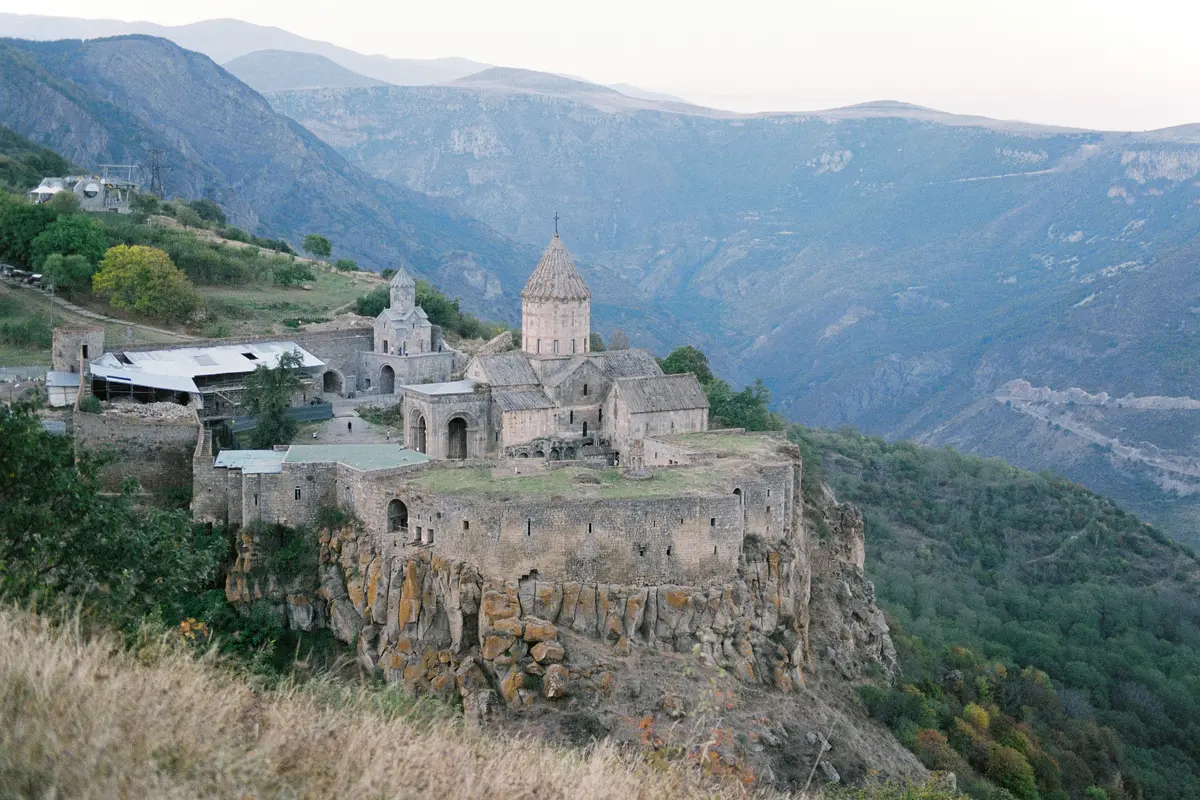
Armenia is the easier of the two. Yerevan is reachable from Tbilisi by overnight train, roughly ten hours, or by marshrutka in about six, and US citizens do not need a visa in advance. A three-night detour gets you Yerevan, the monasteries at Geghard and Khor Virap, and a view of Mount Ararat. Do it by cutting Svaneti and the Imereti day entirely, so the shape becomes Tbilisi, Kakheti, Kazbegi, Yerevan, Tbilisi.
Azerbaijan is harder. US citizens need an e-visa arranged in advance, the land border adds bureaucracy, and Baku is far enough east that a meaningful visit needs four days minimum. The overnight train from Tbilisi to Baku runs, but the return eats another night.
The honest recommendation is to save both for a three-week Caucasus trip, where Georgia gets twelve days and each neighbor gets four or five. Two weeks is exactly enough for one country here, and Georgia has the most varied terrain of the three.
How This Guide Was Put Together
Route logistics, drive times, and transport options in this itinerary reflect current conditions on the ground rather than schedules copied from older guides, and the accommodation prices listed are drawn from current bookable rates for the named properties, quoted in dollars at prevailing exchange rates.
Entry requirements, safety guidance, and the mandatory insurance rule are sourced to primary official material: the Consular Department of the Ministry of Foreign Affairs of Georgia for visa policy, Government Decree No. 602 and the US Embassy in Georgia for the insurance requirement, and the US Department of State travel advisory for safety classifications. Mountain road opening windows follow the Roads Department of Georgia rather than fixed calendar dates, because snowfall shifts them by weeks from one year to the next.
Prices, road openings, and entry rules in Georgia change faster than most destinations. Verify accommodation rates at the time of booking, confirm your insurance policy meets the 30,000 GEL minimum before you fly, and check pass status before committing to any route through Ushguli or Tusheti.