Georgia country travel requirements are some of the friendliest anywhere: US, UK, Canada, Australia, and EU citizens need only a valid passport to enter, and can stay up to a year. But a new insurance law and strict occupied-territory rules ended the old “just show up” simplicity. Here’s what actually gets you across the border.
Do You Need a Visa for Georgia? The Quick Answer
No. Citizens of the US, UK, Canada, Australia, and every EU and Schengen country need no visa for Georgia and can enter on a valid passport alone, staying up to 365 days per entry. Since January 1, 2026, all visitors must also carry health-and-accident travel insurance. Only a minority of nationalities need an e-Visa.
That 365-day window is one of the most generous in the world, and it covers tourism, business, remote work for a foreign employer, and study — no separate permit needed for any of them. Georgia’s list of visa-free countries runs to over 90, though the exact count shifts as rules change. Before you fly, confirm your nationality’s status on the Ministry of Foreign Affairs consular portal, geoconsul.gov.ge, which is the authoritative source.
The one thing that trips people up: visa-free and insurance-free are not the same. Being waved through without a visa does not exempt you from the insurance requirement below.

Georgia Visa Rules by Nationality
Which rule applies to you depends on your passport. There are four tiers — full visa-free for a year, visa-free for 90 days on the strength of another country’s visa, an e-Visa, or an embassy visa — and most Western travelers land in the first.
| Traveler group | Visa needed? | Max stay | Enter on ID card? | Notes |
|---|---|---|---|---|
| US, Canada, UK (plus overseas territories), Australia | No | Up to 365 days per entry | No | Passport only; insurance still required |
| All EU and Schengen states | No | Up to 365 days per entry | Yes | National ID card accepted at the border |
| Japan, South Korea, Israel, Gulf states, Turkey, Armenia, Azerbaijan, Ukraine | No | Up to 365 days per entry | Turkey, Armenia, Ukraine: ID card OK | Ukraine’s allowance was cut from three years to one |
| Holders of a valid EU / US / UK / Canada / Japan / GCC visa or residence permit (nationality not on the list) | No | 90 days within any 180 days | No | Must carry the qualifying visa or permit |
| Roughly 50-plus other nationalities (for example India, China) | e-Visa | 30 days within a 120-day window | No | Apply at evisa.gov.ge only |
| Everyone else | Embassy visa | Varies | No | Apply through a Georgian embassy |
Two recent changes are worth knowing. Ukrainian citizens’ visa-free stay dropped from three years to one. And 17 nationalities who rely on a Gulf Cooperation Council (GCC) visa or residence permit to qualify now need one that is multiple-entry and valid for at least a year, so an expiring single-entry GCC visa no longer opens the door.
The 90-day third-country rule is the quiet workaround few guides explain clearly. If your passport isn’t on the visa-free list but you hold a valid US, UK, EU, Canadian, Japanese, or GCC visa or residence permit, you can still enter visa-free for 90 days in any 180-day period. Carry the qualifying document, not just a screenshot of it.
Who Needs a Georgia e-Visa (and What It Costs)
If your nationality needs an e-Visa, the process is short and cheap — as long as you use the real portal.
- Where to apply: the official government site evisa.gov.ge, and nowhere else
- Government fee: $20 USD plus a 2% service fee
- Processing time: at least five business days, so don’t leave it to the last minute
- Tourist e-Visa validity: a 30-day stay within a 120-day window (confirm the current terms on the portal before you apply)
- Identity check: a DuVerify step now applies, with an additional fee reported at $15
Pro Tip: Search results are full of look-alike “Georgia e-Visa” sites that pad the government fee with their own markup. The only address that issues a real e-Visa is evisa.gov.ge. If a site charges far more than $20 plus 2%, close the tab.
What Documents Do You Need to Enter Georgia?
Bring a passport valid for your whole stay, proof of health-and-accident insurance (mandatory since January 1, 2026), and ideally proof of onward travel, accommodation, and enough funds. Border officers can ask for any of these and may deny entry at their discretion — even to visa-free travelers who tick every box.
It helps to separate what the law strictly requires from what an officer may simply ask to see.
Legally required:
- A valid passport. Georgia sets no fixed statutory minimum validity, but airlines and officers often apply the common six-month rule, and travel.state.gov advises a passport valid for your intended stay plus one blank page for the entry stamp.
- Proof of compliant travel insurance (see the next section).
Discretionary — officers may request, and occasionally do:
- Proof of onward or return travel. Not a documented legal requirement for visa-free visitors, but frequently asked for.
- Proof of accommodation for your first nights.
- Proof of sufficient funds. Guides commonly cite an unofficial benchmark of roughly $50 to $100 a day; treat that as a rule of thumb, not a published figure.
The practical takeaway: have digital and printed copies of your insurance, a return or onward ticket, and your first hotel booking within reach at passport control. You may show none of them. You may show all of them.
Is Travel Insurance Now Required for Georgia?
Yes. Since January 1, 2026, under Georgia’s Law on Tourism (Government Regulation No. 602), every tourist must hold valid health-and-accident insurance covering the full stay, with minimum coverage of 30,000 GEL (about $11,000). It applies to all nationalities, including visa-free travelers, and both border officers and airlines check it.
This is the single newest rule and the one most existing guides still gloss over. Here’s what a compliant policy has to do:
- Coverage minimum: no less than 30,000 GEL (about $11,000), per the U.S. Embassy in Tbilisi notice
- What it must cover: both medical and accident risk, for the entire stay including your arrival and departure dates
- Language: issued in Georgian or English
- Format: digital or printed — carry it where you can reach it
- Insurer: a Georgian or a foreign provider both qualify
A few travelers are exempt: accredited diplomats and their families, people covered by treaty, and air-transit passengers who never clear passport control. Residence-permit holders and citizens fall outside the “tourist” definition, so the rule targets ordinary visitors.
One discrepancy to flag honestly: Ireland’s foreign-office advisory lists 33,000 GEL, while the Georgian regulation and the U.S. Embassy notice both state 30,000 GEL. Treat 30,000 GEL as authoritative and check geoconsul.gov.ge if you want the current figure in writing.
Enforcement has real teeth at both ends of the trip. Reporting from Georgian insurance sources notes that airlines are checking insurance documents at check-in and again at the gate before boarding, so an uninsured passenger can be stopped before ever reaching Georgia. On the ground, a reported non-compliance fine of 300 GEL (about $110) applies, rising to 900 GEL (about $330) if it goes unpaid within 30 days. Note that the U.S. Embassy notice states the requirement but names no fine amount, so treat the penalty figure as reported rather than official.
Pro Tip: Buy the policy before you fly and keep a printed copy. Because airlines check at the gate, a plan you meant to buy on arrival can cost you the flight, and border-desk coverage isn’t guaranteed at every crossing.
How Long Can You Stay, and How the 365-Day Clock Works
Georgia’s year works differently from Europe’s, and the difference is easy to get wrong. The Schengen zone counts 90 days within any rolling 180-day window. Georgia counts per entry: your clock starts the day you arrive, runs for up to 365 consecutive days, and the moment you leave and re-enter, a fresh 365 days begins.
That per-entry reset is why long-stayers do a “border run” — a quick hop into Armenia or Turkey and straight back — to restart the year. Beyond the entry rules, a few thresholds matter if you plan to linger:
- Remote work for a foreign employer is allowed during the visa-free stay. Local employment needs a work permit, a system Georgia has been introducing, so verify its current status if you plan to work for a Georgian company.
- Tax residency can trigger at 183 days in a 12-month period. Cross that line and Georgia may treat you as a tax resident.
- Long-stayers who want to stop resetting the clock should arrange a residence permit through the Public Service Hall before the year runs out.
What Happens If You Overstay
Georgia sharply raised its overstay penalties. Effective October 1, 2025, an amendment to the Code of Administrative Offences added steeper fines and, for the first time, re-entry bans. The old figures — you’ll still see 180 or 360 GEL cited across the web — are obsolete. Don’t rely on them.
Reported tiers now run roughly like this:
- Shorter overstays: around 1,000 GEL (about $365), with a re-entry ban of up to one year
- Six to twelve months over: around 2,000 GEL (about $730), with a ban of up to two years
- More than a year over: around 3,000 GEL (about $1,100), with a ban of up to three years
Sources disagree on where the first tier ends — some describe it as an overstay of up to three months, others as up to six — so confirm the exact boundaries against the Code of Administrative Offences before you cut a departure close. The U.S. State Department confirms the principle plainly: overstay the permitted period and you will be fined. Treat the specific tier amounts as reported figures from relocation and law-firm sources, not as a published tariff.

Customs, Currency, and What You Can Bring In
Most travelers walk the green channel and never open a bag. The rules still matter, because the fines land at the red-and-green split, not on the plane.
Currency:
- Declare cash or monetary instruments over 30,000 GEL, or the foreign equivalent (about $11,100), on both entry and exit. The Revenue Service and travel.state.gov both set the threshold here.
Duty-free per traveler aged 18 and over:
- Tobacco: 200 cigarettes, or 50 cigars, or 50 cigarillos, or 250g of loose tobacco — or a proportional mix up to 250g
- Alcohol: commonly cited as 4 liters of wine plus 16 liters of beer, plus either 1 liter over 22% ABV or 2 liters up to 22%
- Other goods: personal items up to 3,000 GEL (about $1,100) and 30kg (66 lbs) by air
Two rules catch travelers off guard. Georgia’s anti-drug laws are strict, and some codeine-based or over-the-counter medicines that are routine elsewhere are illegal here. Firearms are banned outright, with a narrow exception for hunting weapons carried under a Georgian hunting license, and genuine cultural artifacts need an export permit to leave.
Pro Tip: If you carry prescription medication, bring it in its original packaging with a copy of the prescription, and declare it. A common painkiller from home can be treated as a controlled substance at the border.
Entering Georgia Overland From Turkey, Armenia, and Azerbaijan
Georgia’s visa-free rules apply identically at a land border and at the airport — the same passport, the same 365-day clock. What changes is which gates are actually open, and a couple of them aren’t.
| Crossing | Neighbor | Status | Notes |
|---|---|---|---|
| Sarpi | Turkey | Open, 24 hours | Busiest crossing; Black Sea coast near Batumi; walkable on foot |
| Vale, Kartsakhi | Turkey | Open | Quieter inland routes |
| Sadakhlo / Bagratashen | Armenia | Open | Main Tbilisi-Yerevan road; roughly 1.5 hours from Tbilisi |
| Ninotsminda / Bavra | Armenia | Open | Southern route through the Javakheti highlands |
| Red Bridge, Lagodekhi | Azerbaijan | Closed to entry | Azerbaijan’s land borders have stayed shut to tourists; verify before relying on them |
| Verkhny Lars (Kazbegi) | Russia | Open, legal | The only legal Russia crossing; long queues, winter closures, not advised for tourists |

Sarpi is the workhorse — right on the coast, open around the clock, and one of the few crossings you can cross on foot, which makes it a natural border-run point. Sadakhlo is the one to know if you’re combining Georgia and Armenia, since it sits on the main road to Yerevan.
If you hold an e-Visa rather than visa-free status, you’re restricted to approved entry points, which include Tbilisi (TBS), Kutaisi (KUT), and Batumi (BUS) airports plus designated land posts. Check that your intended crossing is on the approved list before you route yourself to it.
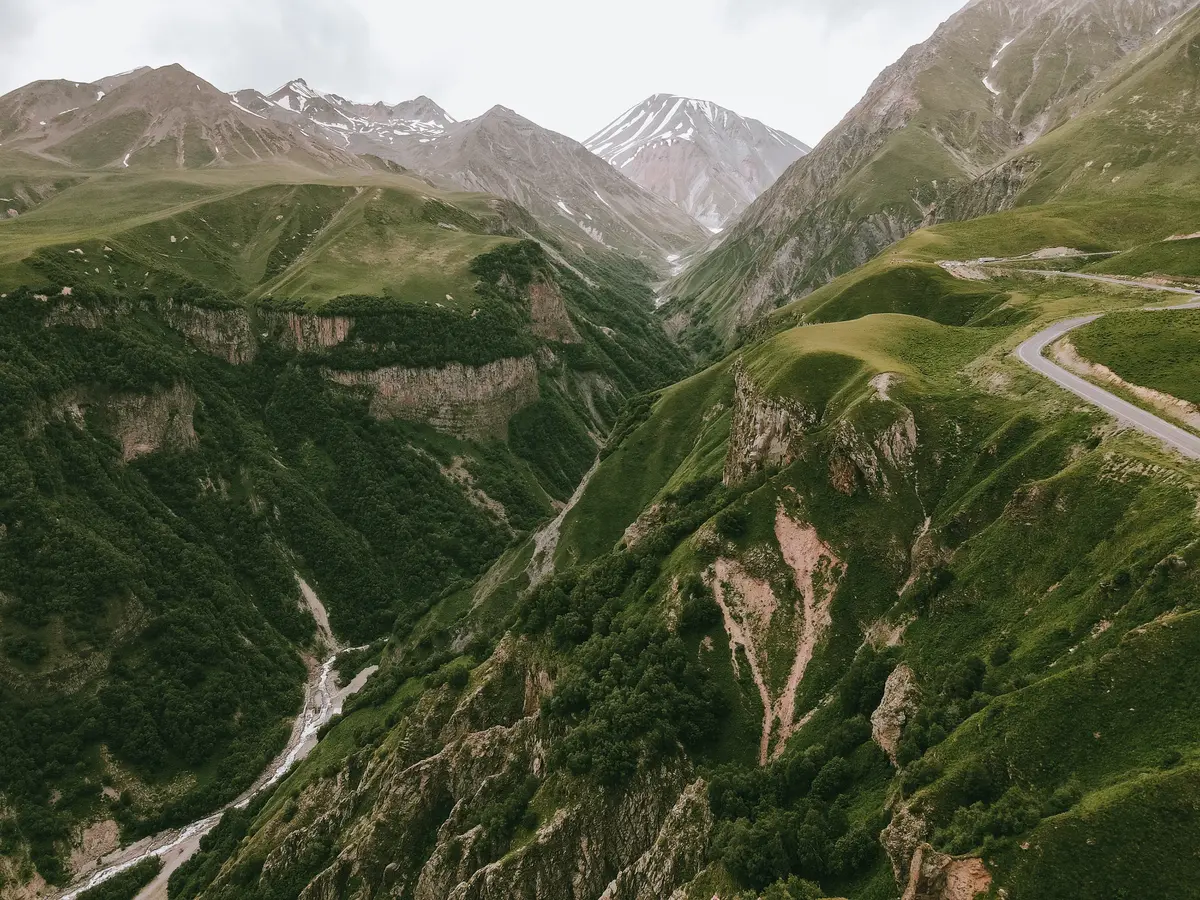
The Russia crossing deserves a flag of its own. Verkhny Lars, reached through the Dariali Gorge above Kazbegi, is the only legal land border with Russia, and it’s known for long waits and seasonal snow closures. It is not a route most tourists should plan around.
Abkhazia, South Ossetia, and the Rules That Can Get You Banned
Entering the Russian-occupied regions of Abkhazia or South Ossetia from the Russian side — rather than from Georgian-controlled territory — is illegal under Georgian law. It can bring heavy fines or a prison term of up to about four years. Passport stamps issued by these regions’ authorities can be read as illegal entry and get you refused.
This is the highest-stakes rule in the whole guide, and it’s badly under-warned. Plenty of articles label Abkhazia and South Ossetia as “unsafe” and stop there. The bigger issue is legal: under the Law of Georgia on Occupied Territories, Abkhazia may only be approached through Zugdidi Municipality and South Ossetia only through Gori Municipality — that is, from the Georgian-controlled side. Any other route is punishable, with UK and Irish advisories citing a prison term of up to four years.
- Georgia does not recognize passports or entry stamps issued by the Abkhazian or South Ossetian authorities.
- Both regions carry a U.S. State Department Level 4 “Do Not Travel” rating, the highest there is.
- Risks include landmines and kidnapping, and U.S. consular staff cannot provide help inside either region.
- Do not attempt to enter Georgia by land from Russia except at Verkhny Lars.
The safest read: keep well clear of both regions unless you are approaching from Georgian-controlled territory with full knowledge of the law, and never let a Russian-side entry stamp end up in your passport.
Is Georgia Safe, and Could You Be Denied Entry?
Georgia is broadly safe for visitors — the U.S. State Department rates the country overall at Level 1, “Exercise Normal Precautions,” with the Level 4 carve-outs for the occupied regions covered above. Violent crime against travelers is uncommon. The everyday risks are more mundane: assertive driving and road safety, and frequent demonstrations in central Tbilisi that can close streets on short notice.
There’s a caveat most guides skip. Border officers can refuse entry at their discretion regardless of nationality, and there are documented cases of foreign journalists and activists being turned away, reported by press-freedom groups including CPJ and RSF, amid tightened migration enforcement. For the overwhelming majority of tourists this never comes up, but it’s why the discretionary documents in the checklist section are worth having ready. Travelers should also be aware that a Georgian “family values” law restricts LGBTQ+ speech and public events, which may affect some visitors’ plans.

Health, Vaccines, and Medicines
No vaccinations are required to enter Georgia for stays of 365 days or less, according to travel.state.gov. The CDC still recommends being up to date on routine vaccines, and notes Hepatitis A and rabies for some travelers. Georgia was certified malaria-free by the World Health Organization on January 23, 2025, so that’s one less thing to plan around, and there are no COVID entry requirements. The strict prescription-medicine rules from the customs section apply here too: carry documentation for anything you can’t do without.
Dual Nationals, Kids, and Other Special Cases
A handful of travelers face rules that don’t fit the standard visa-free picture.
- Dual US-Georgian nationals must enter and exit on a Georgian passport, per Georgian law. Dual-national males aged 18 to 27 may face military conscription, which is worth checking before a trip.
- Other dual nationals should enter and exit on the same nationality’s passport to avoid mismatched stamps.
- Children generally follow their parents’ visa status. A notarized consent letter is advisable when a child travels with one parent or a non-parent guardian, and children aged 14 and over need their own passport.
- Foreign documents intended for official use in Georgia — for residency, or registering a birth — need an apostille from the issuing country.
Before You Land — Your Georgia Entry Checklist
TL;DR: For most US, UK, EU, Canadian, and Australian travelers, three things get you into Georgia — a passport valid for your whole stay, a compliant health-and-accident insurance policy (minimum 30,000 GEL, about $11,000), and proof of onward travel, funds, and a place to stay. Skip the occupied territories, mind the 365-day per-entry clock, and confirm your nationality’s rule on geoconsul.gov.ge.
Run through this before you fly:
- Passport valid for your intended stay, with a blank page for the stamp
- Health-and-accident insurance meeting the 30,000 GEL minimum, printed and on your phone
- Onward or return ticket within reach at passport control
- First accommodation booking and a rough sense of your daily budget
- e-Visa printed if your nationality needs one (from evisa.gov.ge only)
- No plans that route you into Abkhazia or South Ossetia from the Russian side
- A departure date that respects the 365-day clock, given the steeper overstay fines
Get those in order and Georgia’s entry requirements are genuinely among the easiest you’ll meet. Which part of the trip are you sorting out first — the insurance policy, an overland crossing, or a long stay that outlasts the visa-free year? Tell me in the comments and I’ll point you to the right official source.