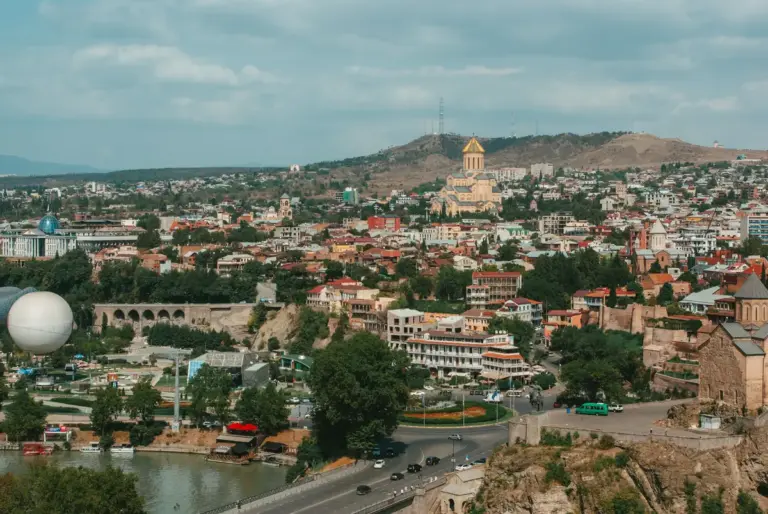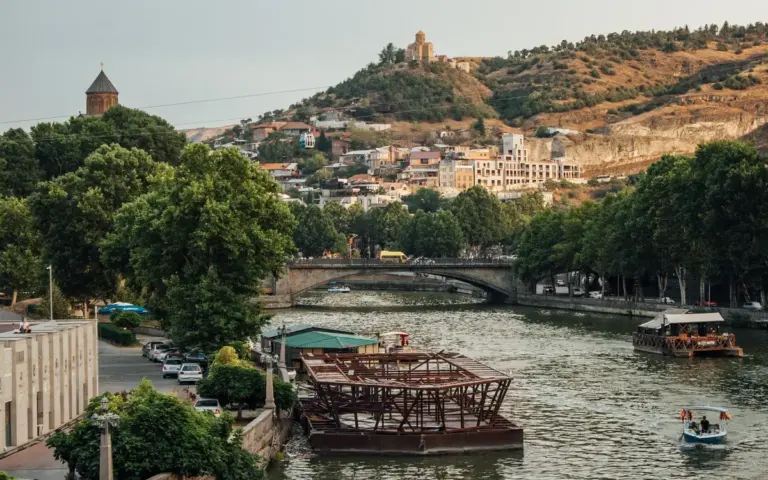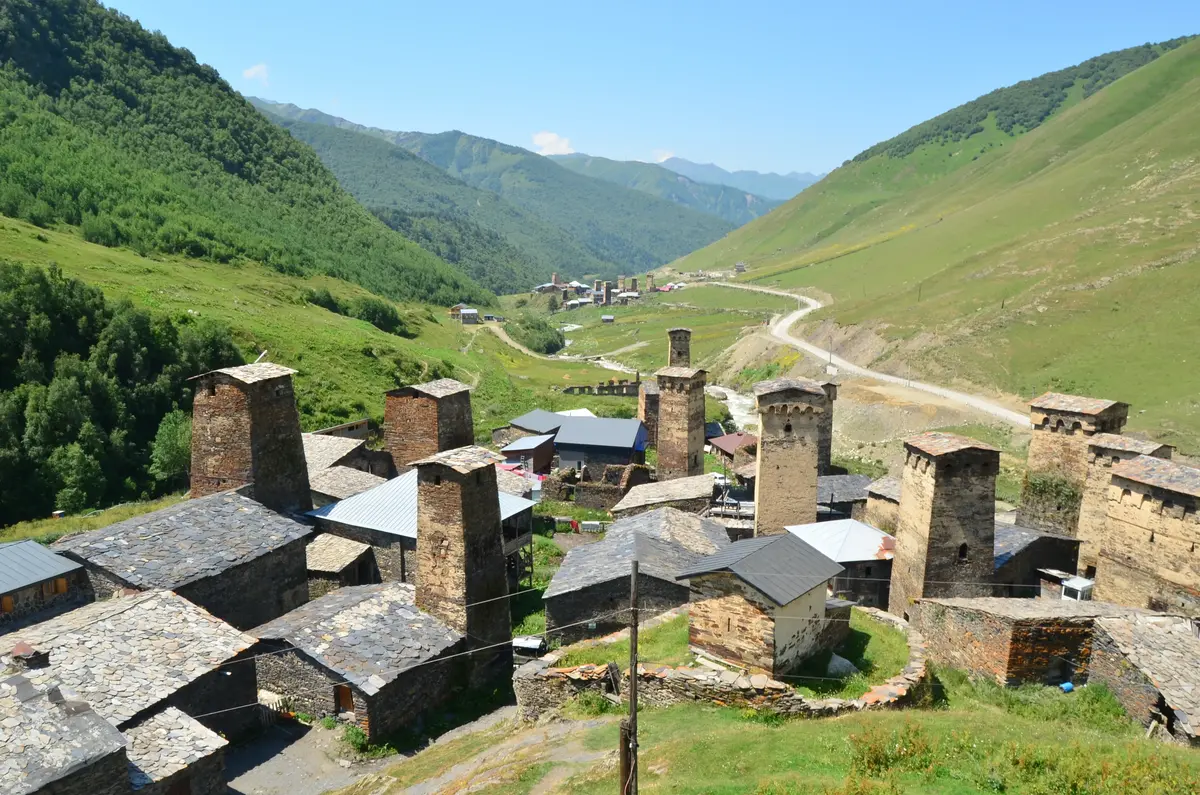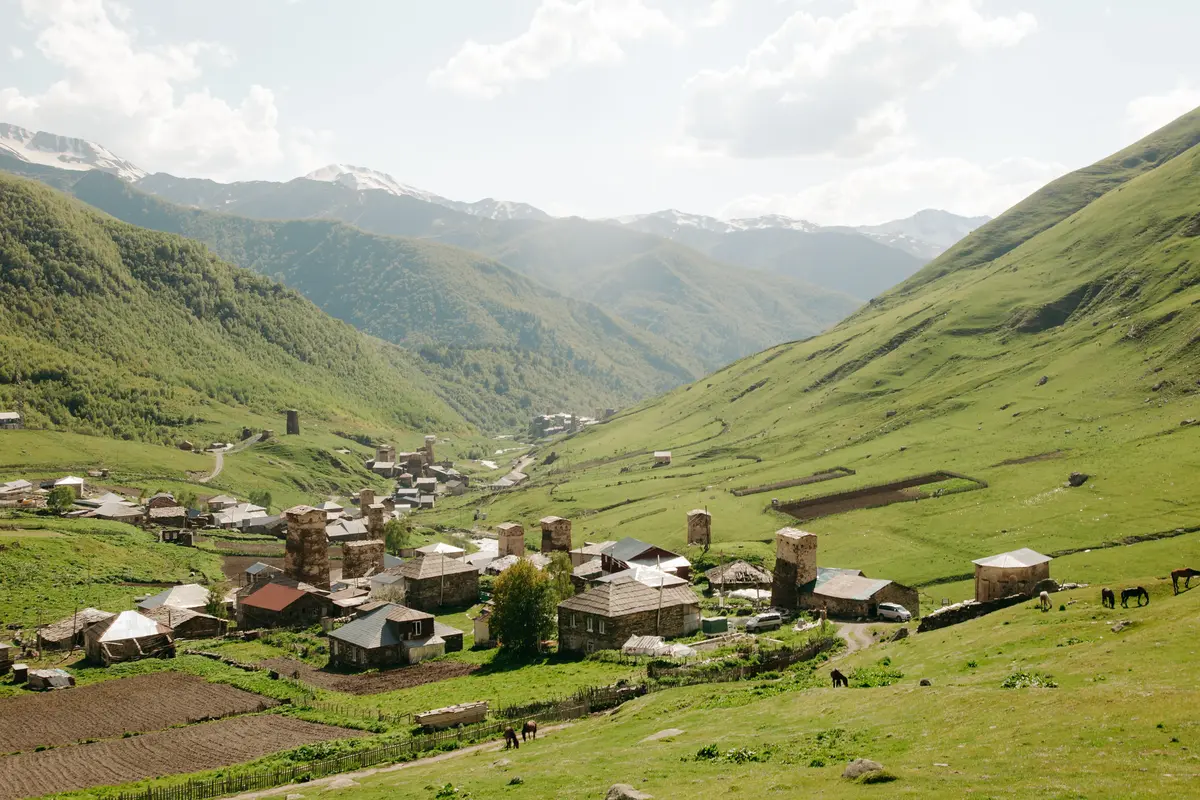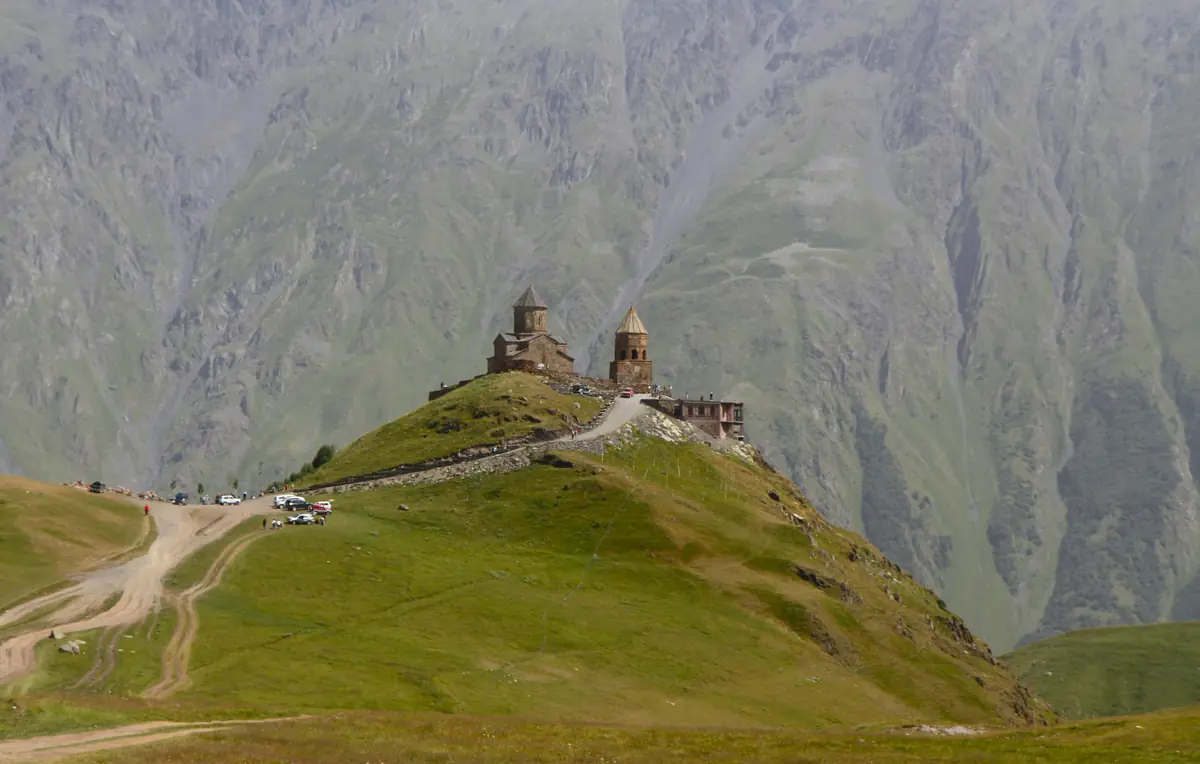
Ask ten atlases whether Georgia is in Europe or Asia and you’ll get at least three answers. The country sits in the Caucasus, wedged between the Black and Caspian seas, on the exact line mapmakers have argued over for centuries. Here’s the honest breakdown — geography, culture, EU status, and what it means if you’re flying there.
Which Continent Is Georgia On?
Georgia is a transcontinental country at the crossroads of Eastern Europe and Western Asia, and it is generally regarded as part of Europe. By the most common physical boundary — the Greater Caucasus watershed — most of the country technically falls in Asia, but politically and culturally it is European.
The uncomfortable truth is that there is no single correct answer. The continent you assign to Georgia depends entirely on which boundary convention you trust, and geographers have never agreed on one. The country even markets itself, in its own National Atlas, as “the balcony of Europe.”
Here’s how the three lenses shake out:
| Lens | Where It Puts Georgia | Why |
|---|---|---|
| Geographic (physical) | Mostly Asia, partly Europe | Most land sits south of the Greater Caucasus watershed, the line many maps use; a few remote northern districts sit north of it |
| Cultural | Europe | Orthodox Christianity since the 4th century, a European self-identity going back generations, membership in UEFA and Eurovision |
| Political | Europe | Council of Europe member, EU candidate, a constitution that mandates Euro-Atlantic integration |
If I had to answer in one line at a dinner party, I’d say Europe, and I’d be ready to defend it. Geography gives you a technicality; everything else about the place points west.
Where Does the Europe-Asia Border Actually Fall in Georgia?
There is no official Europe-Asia border, only competing conventions. Three lines matter for Georgia: the Greater Caucasus watershed (puts most of Georgia in Asia), the Kuma-Manych Depression (puts all of it in Asia), and the Aras River and Turkish border (puts all of it in Europe). Cartographers disagree by design.
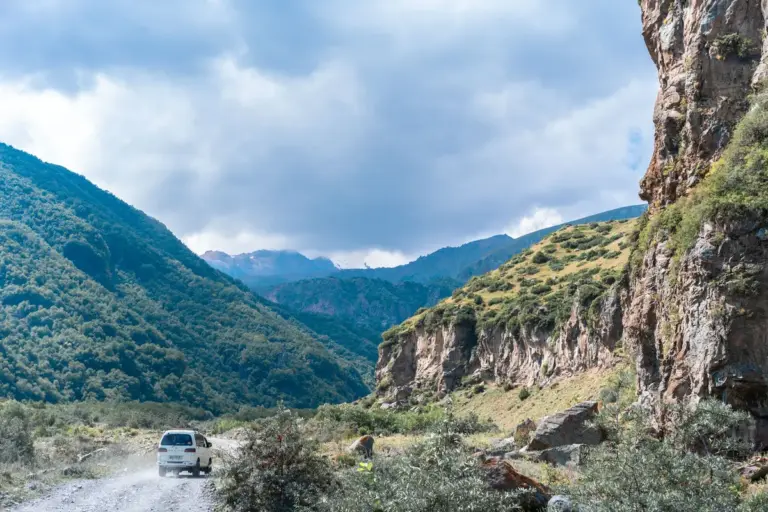
Georgia is also one of the most mountainous countries on Earth, which is why the argument even exists. Its mean elevation is about 4,700 feet (1,432 m), it has three peaks above 16,400 feet (5,000 m), and the two deepest caves ever explored — Veryovkina and Krubera — both plunge more than 7,200 feet (2,200 m) underground in the country’s western mountains. When your terrain is that dramatic, a watershed makes a tempting continental divide.
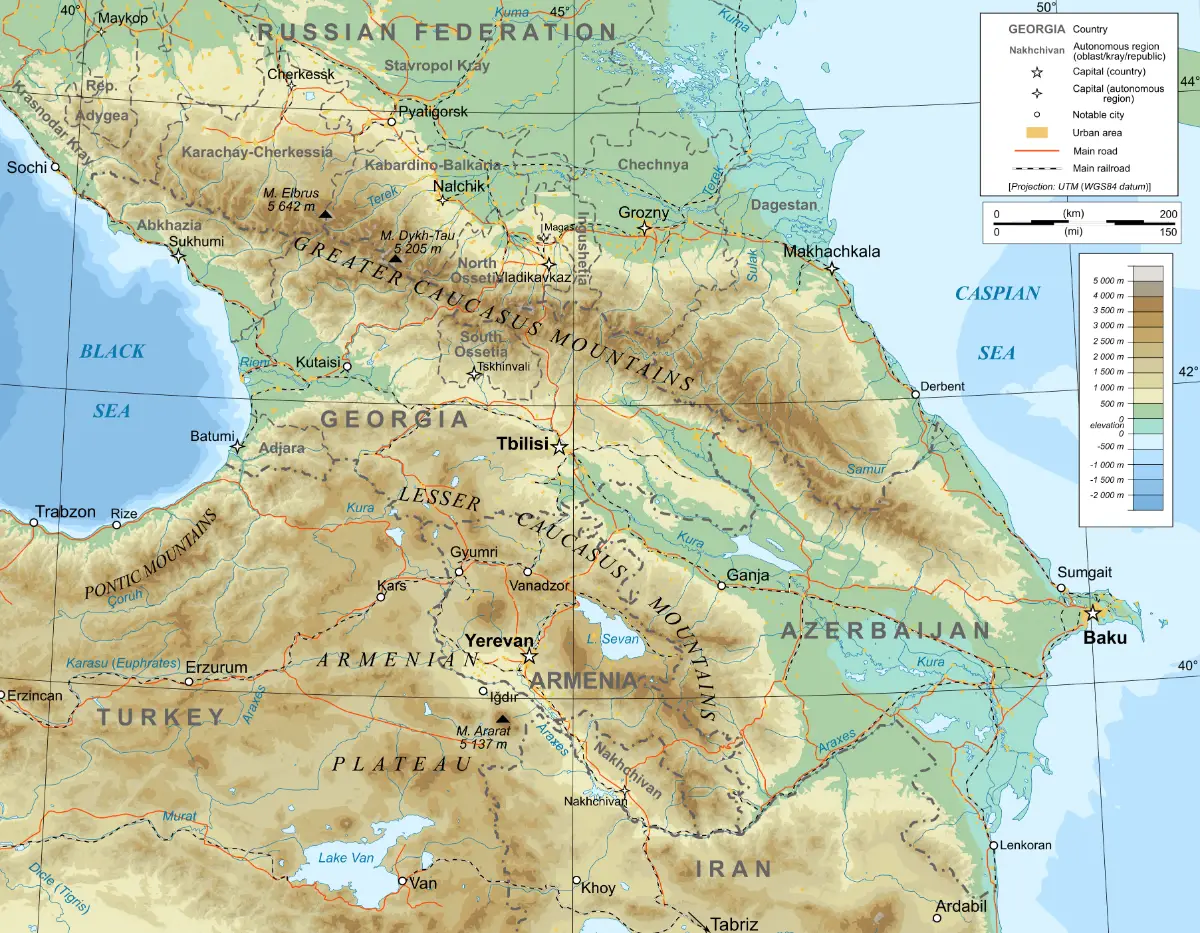
The Watershed Line — Most of Georgia Lands in Asia
The most widely used convention, followed by the National Geographic Society and the CIA World Factbook, runs the border along the crest of the Greater Caucasus. Under this reading, the bulk of Georgia sits south of the divide, in Asia.
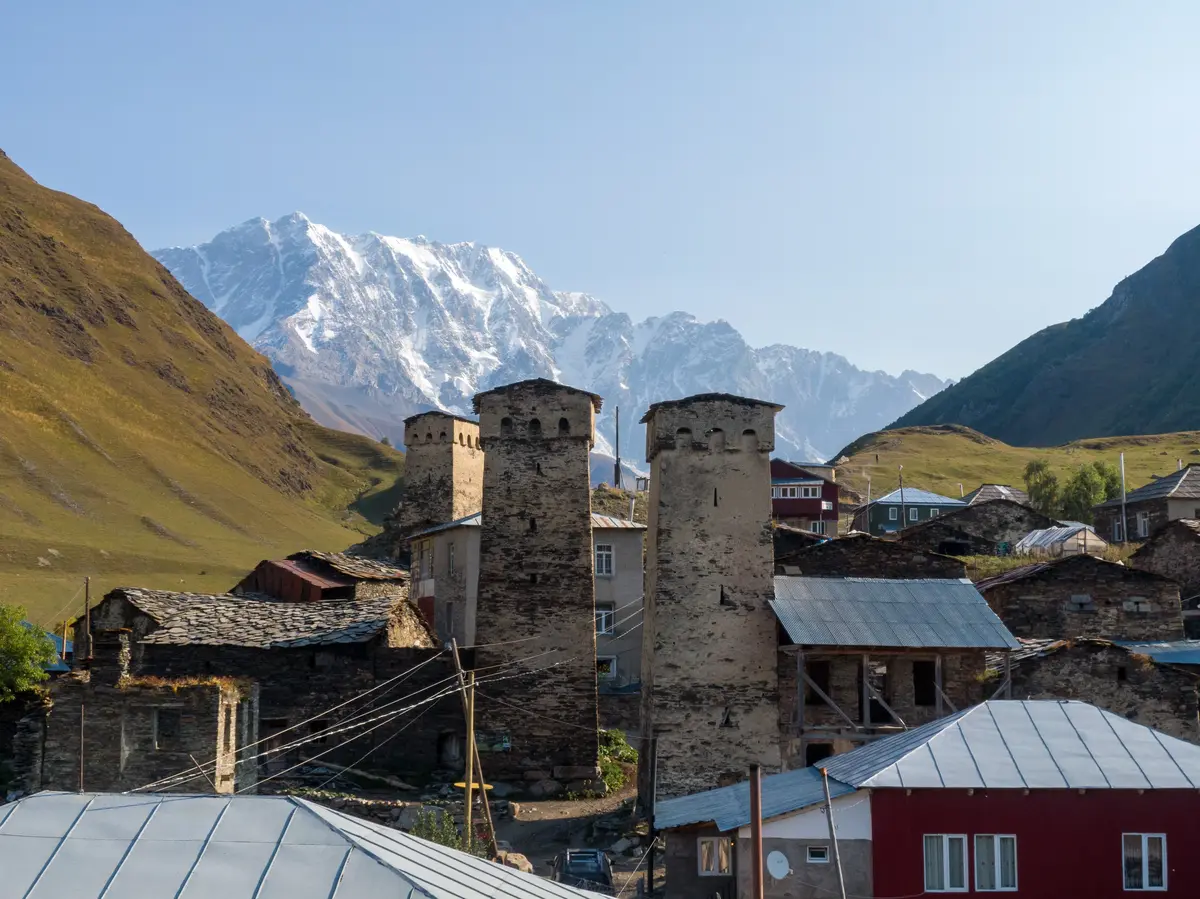
The catch: a few remote, sparsely populated northern districts sit north of the crest, which puts them “officially” in Europe. These are the high valleys of Kazbegi, Khevsureti, and Tusheti — places most travelers never reach, where the country’s small European sliver technically lives.
The Kuma-Manych Line — All of Georgia in Asia
An older definition, traced to the 18th-century geographer Philip Johan von Strahlenberg, draws the boundary far to the north along the Kuma-Manych Depression. That line hands the entire Caucasus, and therefore all of Georgia, to Asia.
This is the reading behind older reference pages that flatly state Georgia is “technically in Asia.” It’s defensible, it’s just not the version most modern maps or Georgians themselves use.
The Aras River Line — All of Georgia in Europe
A third convention runs the border south of the Caucasus, along the Aras River and Turkey’s frontier. Under this line, all of Georgia — plus Armenia and Azerbaijan — lands squarely in Europe. Ancient Greek geographers like Anaximander and Herodotus went even further south in spirit, using the Phasis (today’s Rioni) River as their divide.
The geographer Martin Lewis has argued that “Asia” is such a broad catch-all here that it borders on meaningless, and that the Caucasus is best treated as its own region rather than shoehorned onto either continent. It’s a fair point. The honest position is that Georgia sits on a seam, not inside a box.
Why Georgia Is Considered European
Georgia counts as European mainly for cultural and political reasons rather than strict geography. It adopted Christianity as a state religion in the 4th century, uses its own ancient alphabet, competes in UEFA and Eurovision, sits in the Council of Europe, and holds EU candidate status. Its constitution commits the country to European integration.
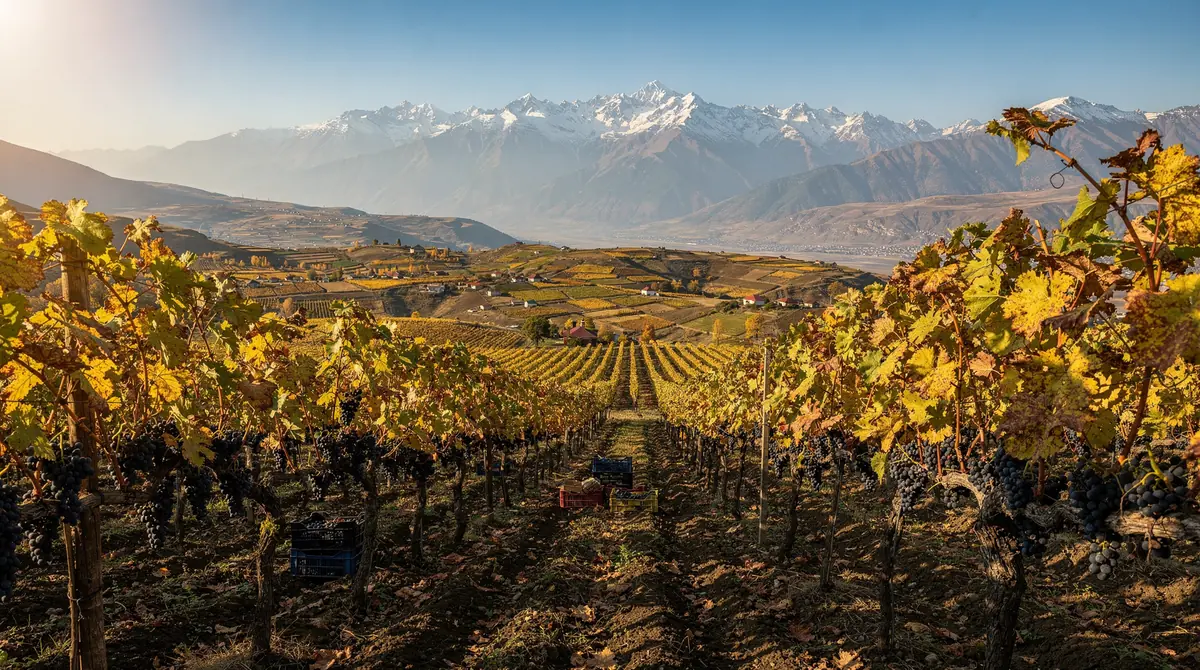
The cultural case is old and deep. Georgia became one of the world’s first Christian nations when it adopted the faith around 337, and the Georgian Orthodox Church has anchored national identity ever since. The language belongs to the Kartvelian family — unrelated to Indo-European, Turkic, or Semitic tongues — and is written in a 33-letter script called Mkhedruli, one of three Georgian alphabets recognized by UNESCO. Then there’s wine: Georgians have been fermenting grapes in buried clay qvevri for roughly 8,000 years, the oldest continuous winemaking tradition known, with more than 525 native grape varieties still in use.
The political case is more recent but just as clear:
- Council of Europe: member since 1999
- UEFA: member since 1992, with the men’s national team debuting at the European Championship
- Eurovision: competing since 2007
- European Union: an official candidate since late 2023
The late Georgian prime minister Zurab Zhvania summed up the national mood with one sentence: “I am Georgian, and therefore I am European.” Public opinion still backs it — roughly three-quarters of Georgians say they’d vote to join the EU.
Is Georgia in the European Union?
No. Georgia is an official EU candidate, not a member. It applied for membership and was granted candidate status, but the accession process has stalled amid disputes over democratic backsliding, and the European Commission has described Georgia as a candidate “in name only.” Georgians themselves overwhelmingly support joining.
The numbers on public opinion are striking. In one major regional survey, about 74% of Georgians said they would vote for EU membership and only 5% against, with roughly 80% expecting more advantages than disadvantages. A separate poll put “fully or somewhat” support near 89%, an all-time high. Georgia’s constitution actually obliges the government to pursue EU and Euro-Atlantic integration.
The gap between that public appetite and official progress is the real story. The European Council concluded that the government’s actions had de facto halted accession, and the process has since been suspended from the Georgian side. So the candidacy exists on paper while the momentum has drained out of it.
Pro Tip: This is the single fastest-moving fact in this article. EU candidacy status can shift with one election or one Council decision, so verify the current state before you cite it. One thing that hasn’t changed: Georgian citizens have held visa-free short-stay access to the Schengen area, an EU-adjacent perk that predates the current freeze.
Is the Country of Georgia the Same as the US State?
No. The country of Georgia — Sakartvelo in its own language — is an independent nation in the Caucasus with its capital at Tbilisi, its own alphabet, and roughly 3.7 million people. The US state of Georgia, capital Atlanta, is home to about 10.5 million. They share an English name by coincidence: the state was named for King George II of Great Britain.
The contrast is easy to hold in your head:
- Country of Georgia: Sakartvelo; capital Tbilisi; about 3.7 million people; in the Caucasus; Georgian language and Mkhedruli alphabet; 8,000-year wine culture
- US state of Georgia: capital Atlanta; about 10.5 million people; in the southeastern United States; named after King George II
Google surfaces this confusion for a reason — plenty of searches for “Georgia” can’t tell the peach state from the wine country. If you’re reading a page about the Caucasus and it starts talking about Atlanta, you’ve landed on the wrong one.
What US Travelers Should Know Before Visiting Georgia
If the continent debate got you curious enough to go, the logistics are refreshingly friendly for Americans. Here’s the practical layer the encyclopedia pages leave out.
Do You Need a Visa?
US citizens don’t need a visa for Georgia, and the visa-free allowance is one of the most generous anywhere: you can enter, stay, and even live or work for up to 365 days without paperwork. There’s a newer wrinkle on insurance worth checking before you fly.
- Visa: none required for US citizens
- Length of stay: up to 365 days visa-free
- Passport validity: at least 3 months, with 6 recommended
- Insurance: Georgia requires tourists to hold health and accident insurance with coverage of at least 30,000 GEL (about $11,000). Border enforcement has been uneven, but carry proof to be safe.
How to Get There From the US
There are no nonstop flights from the United States, so every trip routes through a hub. The most popular connection is Istanbul on Turkish Airlines, which has the shortest final hop and the most frequency. Other solid options are Doha (Qatar Airways), Warsaw (LOT), and the European hubs of Frankfurt, Munich, and Vienna.
- Common connecting hubs: Istanbul, Doha, Warsaw, Frankfurt, Munich, Vienna
- Total travel time from New York: roughly 15 to 21 hours, depending on the layover
- Round-trip fare from NYC: typically about $700 to $960, dipping toward $300 to $530 in the off-season and climbing past $1,200 in summer
- Final leg examples: Doha to Tbilisi about 1,194 miles and 3h20; Istanbul to Tbilisi about 2h20 to 2h30
Pro Tip: Book through Istanbul if you can. It’s the shortest hop into Tbilisi, and the flight frequency means a missed connection isn’t a lost day.
Money, Time Zone, and What Things Cost
Georgia runs on the lari (GEL), worth about $0.38, so a dollar buys roughly 2.6 lari. ATMs are everywhere in the cities and cards work in most restaurants and hotels, but carry cash once you head into the mountains. The clock sits at UTC+4 year-round with no daylight saving, which puts Tbilisi about 8 to 9 hours ahead of US Eastern time.
The food is where the budget breathes easy:
- Khinkali (soup dumplings): about 1 to 2.5 GEL each, or $0.40 to $1
- Khachapuri (cheese bread): about 5 to 15 GEL, or $2 to $5
- Casual sit-down meal: about 25 to 45 GEL per person, or $9 to $17
- Bottle of local wine from a shop: about 10 to 25 GEL, or $4 to $10
- Bolt rideshare across Tbilisi: about 4 to 10 GEL, or $1.50 to $4
- Marshrutka (shared minibus) from Tbilisi to Kazbegi: about 15 GEL, or $6

When to Go, and Is It Safe?
The sweet spots are May to June and September to October, when the weather is mild, the crowds thin out, and autumn brings the Rtveli wine harvest. July and August turn hot in the lowlands but open up the Black Sea beaches around Batumi and the high trekking in Svaneti and Kazbegi. Winter is ski season in Gudauri and Bakuriani.
On safety, the US State Department rates Georgia Level 1 — “Exercise Normal Precautions,” its calmest tier. Two big exceptions apply. The Russian-occupied regions of Abkhazia and South Ossetia carry a Level 4 “Do Not Travel” warning for crime, unrest, and landmines, and the Pankisi Gorge warrants extra caution. Central Tbilisi also sees frequent demonstrations, so check the news before you build a day around the main squares.

Quick Answers to Common Georgia Questions
What Continent Is Georgia In?
Georgia is transcontinental — it sits where Eastern Europe meets Western Asia. Most physical maps place the bulk of it in Asia by way of the Caucasus watershed, but it is generally counted as a European country.
Is Georgia Part of Europe or Russia?
Georgia is an independent country, not part of Russia. It shares a northern border with Russia, and two Georgian regions (Abkhazia and South Ossetia) are Russian-occupied, but the nation governs itself from Tbilisi and orients firmly toward Europe.
Is Georgia a Transcontinental Country?
Yes, by the most common convention. The Greater Caucasus watershed crosses its far north, so a handful of remote districts sit in Europe while most of the country sits in Asia — the textbook definition of transcontinental.
Is Georgia in the EU?
No. Georgia is an EU candidate, not a member, and the accession process has stalled. Georgian citizens have enjoyed visa-free short stays in the Schengen area, but full membership is not on the near horizon.
Do US Citizens Need a Visa to Visit Georgia?
No. Americans can enter visa-free and stay up to 365 days. Bring a passport with several months of validity left and proof of travel health insurance, which border officers may ask to see.
What to Tell People Who Ask
TL;DR: Georgia is a transcontinental country generally counted as European. By strict geography, most of it sits in Asia, south of the Caucasus watershed, while a few remote northern valleys fall in Europe. By culture, politics, and self-identity, it is European through and through. For US travelers, it’s visa-free for a full year and reachable through Istanbul or Doha.
So, is Georgia in Europe or Asia? The most defensible short answer is Europe, with an asterisk that the geography is genuinely split. Anyone who tells you it’s simple is picking one convention and hiding the other two. What isn’t complicated is the trip itself: a year of visa-free access, $2 cheese bread, and one of the oldest wine cultures on the planet.
If you’re mapping a Caucasus route, are you routing through Istanbul or Doha — and is Georgia the whole trip or a stop on the way to Armenia? Tell me below.